Remember those late nights hunched over textbooks, crafting physics problems that would challenge your students without crushing their spirits? Well, those marathon question-writing sessions might just become a thing of the past. Welcome to the age of AI-generated physics exams – where artificial intelligence meets Newton’s laws, and creating assessments becomes as smooth as a frictionless surface.
If you’ve ever wondered whether robots could help you write better physics questions than you can at 2 AM fueled by nothing but caffeine and determination, you’re about to find out. Spoiler alert: they’re pretty darn good at it.
Table of contents
- What Makes AI Physics Exam Creation So Revolutionary?
- Step-by-Step Guide for AI-Powered Physics Exam Creation
- Best Practices for AI-Generated Physics Excellence
What Makes AI Physics Exam Creation So Revolutionary?
Think of AI physics practice questions as your personal teaching assistant who never sleeps, never runs out of creative juice, and somehow remembers every physics concept from thermodynamics to quantum mechanics. But unlike that overeager student teacher who enthusiastically volunteers for everything, AI actually delivers.
The magic happens through sophisticated algorithms that understand not just the mechanics of physics problems, but the pedagogical art of crafting questions that actually teach. It’s like having Einstein and your favorite physics professor collaborate on your next exam – except they work at the speed of light (literally speaking, of course).
The Science Behind the Magic
Here’s where things get deliciously nerdy. Artificial intelligence in physics education leverages natural language processing and machine learning to understand the intricate relationships between physics concepts. These systems don’t just randomly generate numbers and plug them into formulas – they craft scenarios that mirror real-world applications.
Picture this: instead of another boring “A ball is thrown at 30 degrees” problem, AI might generate a question about calculating the trajectory of a basketball shot during the final seconds of a championship game. Same physics, way more engagement.
Create Your Next Quiz/Exam Using AI in OnlineExamMaker
Step-by-Step Guide for AI-Powered Physics Exam Creation
Ready to dive into the world of AI-powered exam preparation? Let’s walk through the process of creating your first AI-generated physics exam using OnlineExamMaker – think of it as your GPS for navigating the exam creation highway.
Step 1: Set Up Your Digital Workspace

First things first – fire up your browser and head to OnlineExamMaker. Creating an account is simpler than calculating velocity in uniform motion (and takes about as long as a photon traveling one meter in a vacuum).
Once you’re in, you’ll see the “Create Exam” button practically winking at you. Click it, and you’re officially in the driver’s seat of your AI examination vehicle.
Step 2: Define Your Physics Universe
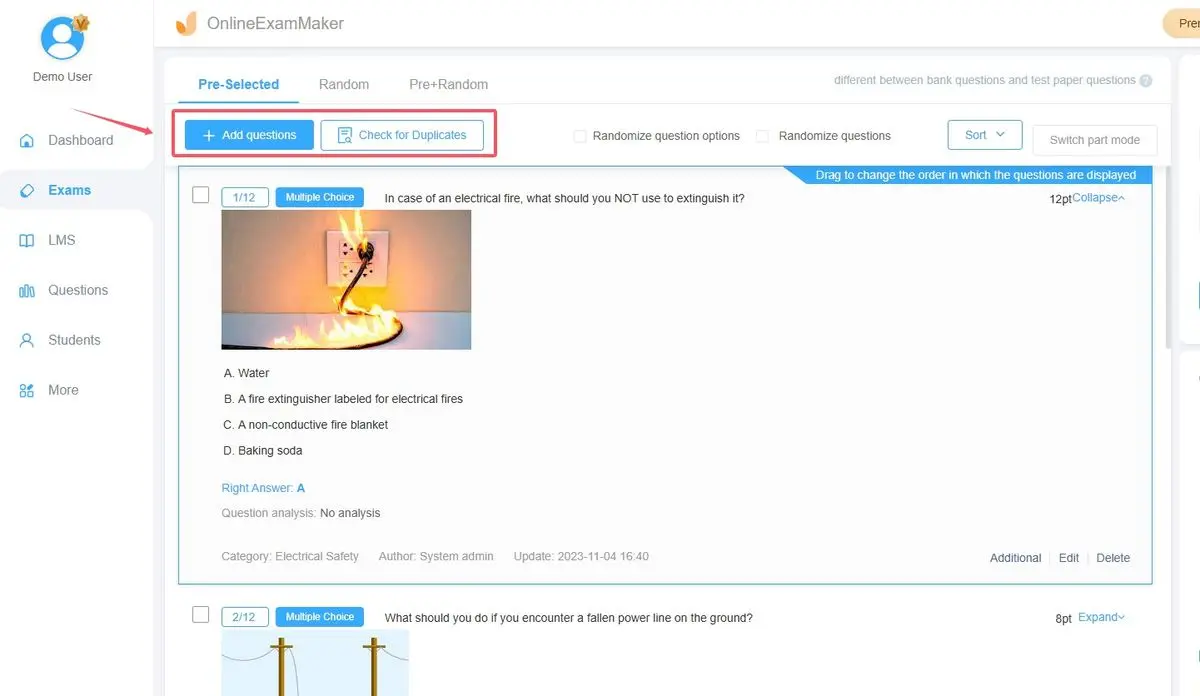
Here’s where the rubber meets the road – or where the coefficient of friction meets the inclined plane, if you prefer. You’ll need to specify:
- Subject area: Physics (obviously, but the system needs to know)
- Difficulty level: From “my grandmother could solve this” to “Stephen Hawking would be impressed”
- Topic coverage: Mechanics, thermodynamics, electromagnetism – pick your poison
- Question types: Multiple choice, numerical problems, conceptual explanations
Think of this as programming your AI sous chef with the recipe for academic success.
Step 3: Unleash the AI Question Generator
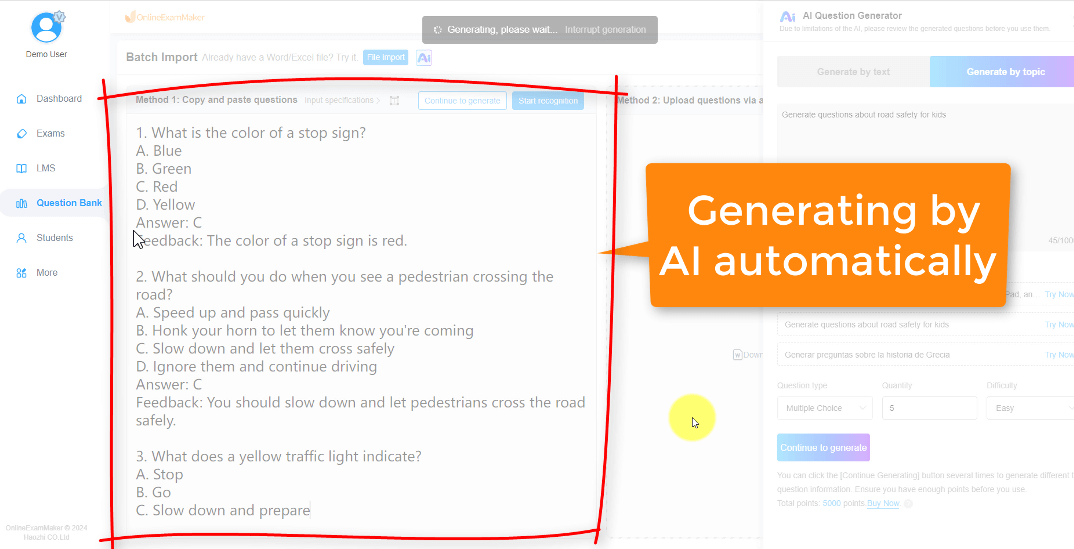
This is where the magic happens. With automated physics problem generation, you simply input your parameters, hit the “Generate Questions” button, and watch as the AI works faster than electrons flowing through a superconductor.
The system will present you with a buffet of physics problems, each one crafted to test specific concepts and skills. It’s like having a crystal ball that shows you exactly what questions your students need to master the material.
Step 4: Quality Control (Because Even AI Needs a Second Opinion)
Here’s a pro tip that separates the physics teaching rookies from the veterans: always review your AI-generated questions. While these systems are impressively smart, they occasionally need a human touch to ensure scientific accuracy and pedagogical soundness.
Look for:
- Realistic scenarios and values
- Clear, unambiguous wording
- Appropriate difficulty progression
- Balanced coverage of concepts
Step 5: Customize and Personalize
This is where you add your personal teaching flair. Maybe you want to include a question about the physics of your school’s notorious broken elevator, or perhaps you’d like to reference a recent space mission. Custom physics test creation with AI allows you to blend algorithmic efficiency with human creativity.
Step 6: Set Up Intelligent Grading
One of the most beautiful aspects of using AI to grade physics exams is the consistency and speed. No more weekends buried under stacks of papers, trying to decipher handwriting that looks like seismic activity readings.
The AI grading system can handle everything from multiple-choice questions to complex numerical problems, providing instant feedback that’s more reliable than your morning coffee routine.
Best Practices for AI-Generated Physics Excellence
Creating effective AI-driven physics mock exams is part science, part art, and part educated intuition. Here’s how to maximize your AI partnership:
The Goldilocks Principle of Question Variety
You want your exam to be like a well-balanced meal – not too heavy on conceptual questions, not too light on numerical problems, but just right. Aim for a mix that includes:
- 30% conceptual understanding questions
- 40% numerical problem-solving
- 20% application-based scenarios
- 10% synthesis and analysis challenges
This distribution ensures you’re testing not just calculation skills, but genuine physics comprehension.
The Human-AI Collaboration Sweet Spot
Think of AI as your incredibly knowledgeable teaching partner, not your replacement. The best results come from combining AI efficiency with human insight. Let the AI handle the heavy lifting of question generation, while you focus on ensuring the questions align with your specific learning objectives.
Progressive Difficulty: The Physics Learning Curve
Your exam should tell a story – starting with confidence-building basics and gradually escalating to more challenging applications. It’s like a good physics experiment: controlled variables leading to meaningful conclusions.
The Future is Now: Benefits of AI in Physics Learning
The benefits of AI in physics learning extend far beyond just exam creation. We’re talking about a fundamental shift in how physics education adapts to individual student needs.
Personalized physics study using AI means each student gets exactly the practice they need. Struggling with rotational motion? The AI serves up targeted questions. Acing electromagnetic induction? Time to move on to more advanced applications.
It’s like having a tutor who remembers every mistake, celebrates every breakthrough, and never gets tired of explaining why F=ma for the hundredth time.
Real-Time Analytics and Insights
Modern AI systems provide analytics that would make a data scientist weep tears of joy. You’ll see exactly which concepts your class is mastering and which ones need more attention. It’s like having X-ray vision for learning gaps.
Troubleshooting Common AI Question Creation Challenges for Physics Assessments
Even in our AI-powered utopia, challenges exist. Here’s how to handle the most common speed bumps:
Challenge 1: Questions that are technically correct but pedagogically awkward
Solution: Always review generated questions through the lens of student experience, not just scientific accuracy.
Challenge 2: Repetitive problem structures
Solution: Use the customization features to inject variety and specify different scenario types.
Challenge 3: Difficulty calibration issues
Solution: Start with smaller question sets and adjust parameters based on student performance data.
