Open-book exams sound like an invitation to copy. Yet when the questions are built well, notes and search engines stop being a shortcut. Students still have to think, and that is the point. This guide shows teachers, trainers, and HR managers how to write open book exam questions that prevent cheating, and how to add AI proctoring when you need extra assurance.
- Why Open Book Exams Need a Different Question Design?
- Higher-Order Question Types That Resist Copying
- Anti-Collusion Strategies
- Extra Safeguards for Open Book Exams
- OnlineExamMaker AI Exam Proctoring Software
- How to Create an AI Proctored Open Book Exam
- FAQs
Why Open Book Exams Need a Different Question Design?
A closed-book test rewards memory. An open-book test cannot, because any fact can be looked up in seconds. If you simply reuse old questions such as “Define term Y,” you hand students the answer key.
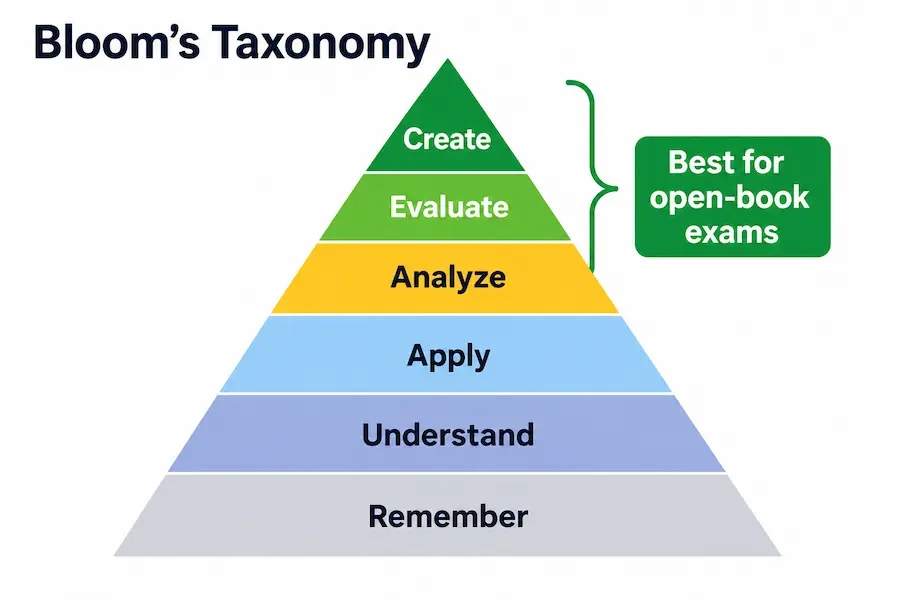
The fix is to move up the thinking ladder. Questions should ask students to apply, analyze, and judge. Indiana University’s teaching center recommends exactly this shift toward higher-order thinking, using Bloom’s Taxonomy as the guide. The University of Waterloo also advises using mainly application and critique questions in unproctored open-book exams.
One honest caveat: no question design removes every risk. Students can still collaborate or consult an expert, so combine good questions with the safeguards below.
Higher-Order Question Types That Resist Copying
Aim for the upper levels of Bloom’s Taxonomy. Three question families work well:
- Analyze: “Compare two theories using evidence from your notes.”
- Evaluate: “Critique this policy’s effectiveness in the situation described.”
- Create: “Design a solution that integrates concepts A and B.”
Scenario-based prompts are especially strong. Give a short case study with data, then ask students to interpret it or predict what happens next. Sources such as the Faculty Focus list of cheating-reduction strategies and Indiana University’s open-book guidance support this approach.
Weak vs. Strong Questions: Quick Examples
| Weak (easy to look up) | Strong (needs understanding) | Level |
|---|---|---|
| Define “conflict of interest.” | Read the case below. Identify the conflict of interest and recommend how the manager should respond. | Evaluate |
| List the steps of the audit process. | This audit missed two steps. Explain which errors are most likely and why. | Analyze |
| What is formative assessment? | Design a short formative check for a safety training session and justify your choices. | Create |
Anti-Collusion Strategies
Good questions stop copying from sources. These tactics stop copying from classmates:
- Randomize. Shuffle question order, or give each student a unique version. The University of Waterloo notes that shuffling forces students to spend time hunting for questions, which is a useful friction.
- Build on your own course. Extend a class discussion or a local example. Outsiders and impersonators will struggle to answer.
- Set a tight but fair time limit. Multi-step tasks that need sequential reasoning leave little room for outside help.
Extra Safeguards for Open Book Exams
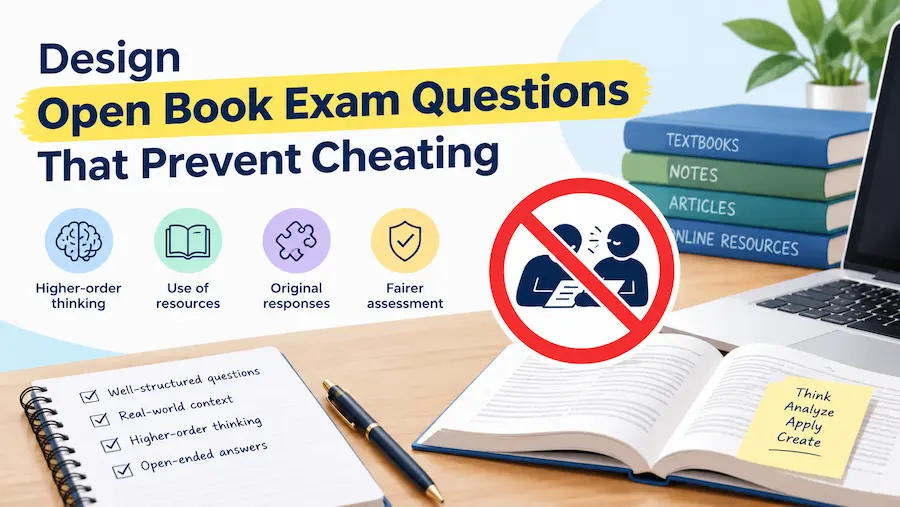
- Require justification. Add “Explain why, with examples” to answers. Reasoning is hard to borrow.
- Use visuals. Charts and graphs for interpretation are harder to search.
- Ask “what-if” questions. Hypotheticals test judgment, not recall.
- Disable backtracking. Platforms such as Moodle can lock earlier answers, which forces on-the-spot decisions.
- State the rules clearly. Tell students which resources are allowed and whether collaboration is permitted. An honor pledge at the start can also help.
OnlineExamMaker AI Exam Proctoring Software
Smart question design handles most of the problem. For high-stakes tests, certifications, or remote employee assessments, you may want to see who is actually taking the exam. That is where OnlineExamMaker, an online quiz and assessment platform, fits in.
Here are the features most relevant to open-book exams:
| Feature | How it helps |
|---|---|
| AI Question Generator | Drafts scenario and application questions from a topic, so you can build varied versions faster. |
| AI Webcam Proctoring | Monitors test-takers through the webcam during the exam to flag suspicious behavior. |
| Automatic Grading | Scores responses automatically, which saves hours after a large exam. |
Webcam monitoring does not replace thoughtful questions. Think of it as a second layer: questions make cheating pointless, and proctoring makes impersonation and obvious misconduct harder.
How to Create an AI Proctored Open Book Exam
Menu names may differ slightly as the platform updates, but the workflow is straightforward.
- Sign up and log in to OnlineExamMaker.
- Build your question bank. Add your own scenario-based questions, or use the AI Question Generator to draft ideas that you then edit.
- Create the exam. Select questions, then set a time limit and enable question randomization.
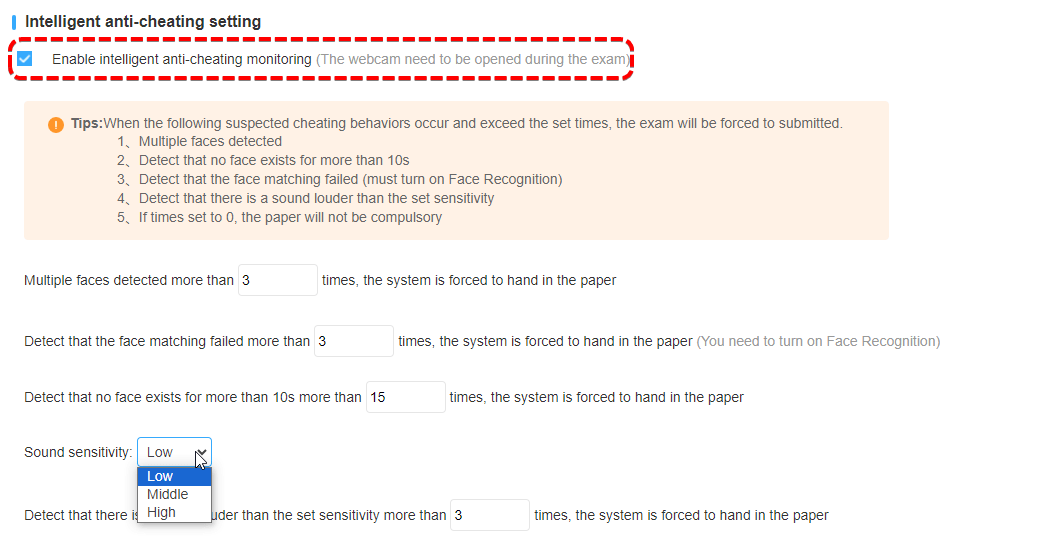
- Turn on AI webcam proctoring in the exam’s anti-cheating settings.
- Write clear instructions. State which resources are allowed.
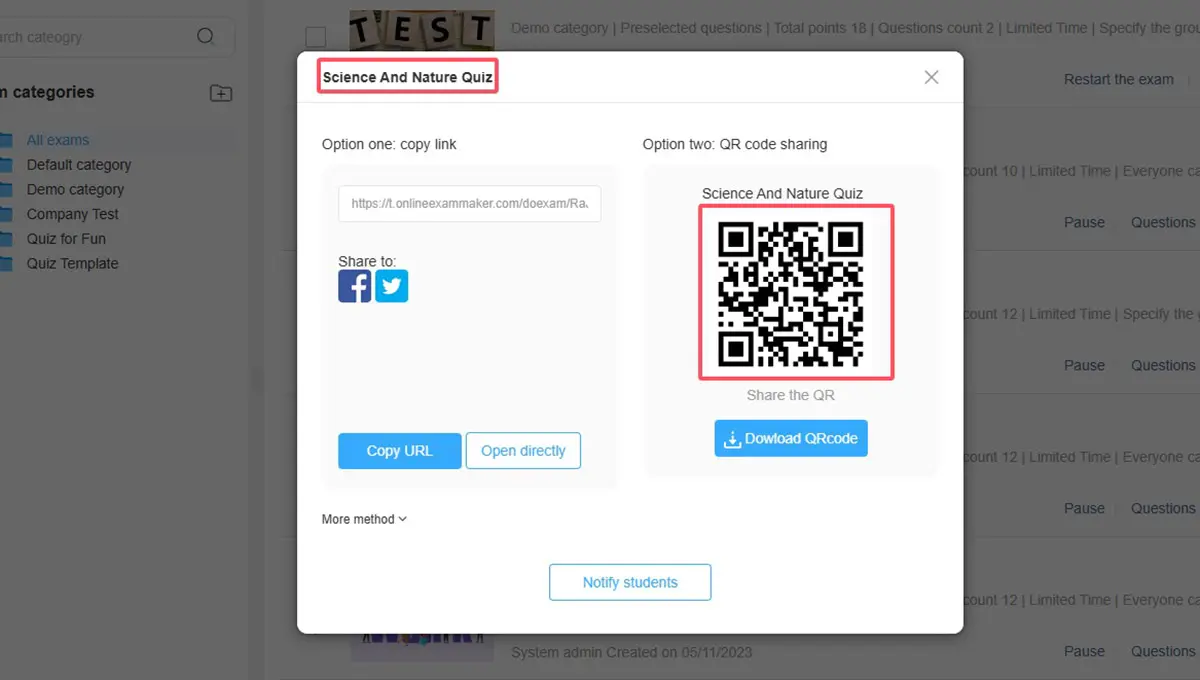
- Publish and share the exam link or invite code with participants.
- Review results. Let automatic grading score objective items, then check flagged sessions and grade open responses.
For trainers and HR teams, this setup works well for compliance training and onboarding tests, where employees may use reference materials but you still want proof the right person did the thinking.
FAQs
Can students still cheat on an open-book exam?
Yes, through collaboration or outside help. Higher-order questions, randomization, time limits, and proctoring reduce the risk but cannot remove it entirely.
Should every open-book exam be proctored?
Not necessarily. Low-stakes quizzes often rely on question design alone. Use proctoring for high-stakes assessments and certifications.
How long should an open-book exam be?
Long enough for careful thinking, short enough to limit outside help. Faculty at Indiana University report that instructors often underestimate the time online exams take, so pilot your exam first.
