Here’s a confession: I once watched a student take an online exam while simultaneously Googling every single question. By question three, they had a spreadsheet open, a Discord chat running, and probably their grandmother on speed dial. The worst part? The exam was so predictable that this absurd setup actually worked.
If you’ve ever designed an online assessment, you know the sinking feeling. You craft what seems like a perfectly reasonable test, only to discover later that half the class found the exact answers on Quizlet, or worse, they simply shared screenshots in a group chat faster than you can say “academic integrity.”
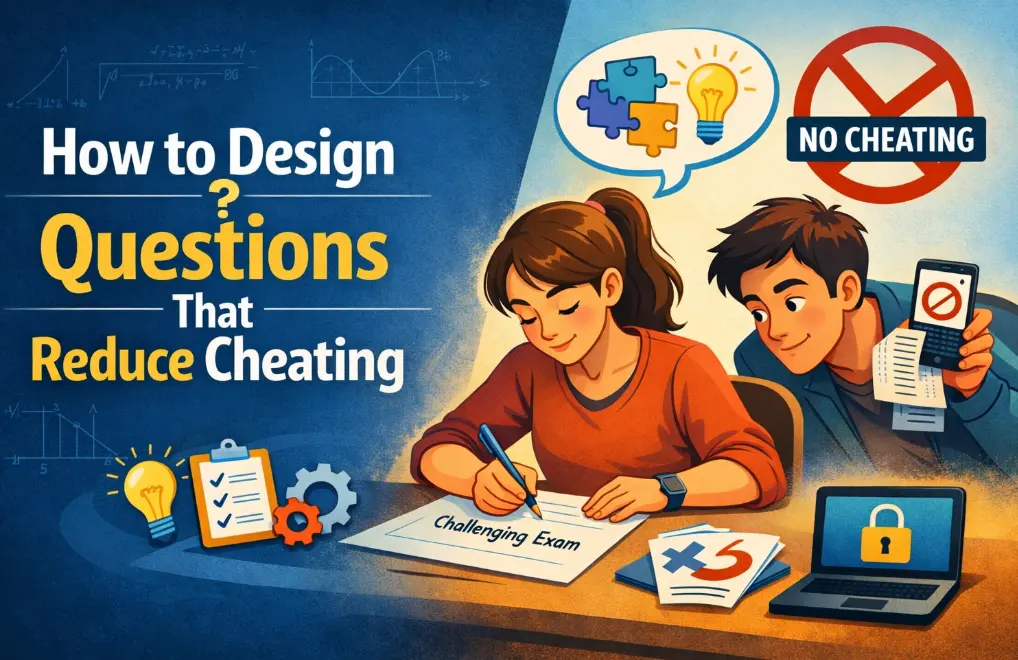
But here’s the thing: the battle against online cheating isn’t won with surveillance cameras and browser lockdowns alone. The real defense? Questions so clever that cheating becomes harder than just learning the material.
- Why Traditional Questions Fail Online?
- Strategy 1: Embrace Higher-Order Thinking
- Strategy 2: Make It Personal and Authentic
- Strategy 3: Eliminate Copy-Paste Opportunities
- Strategy 4: Master Question Banks and Randomization
- Strategy 5: Design for Speed and Individual Work
- How OnlineExamMaker Simplifies Anti-Cheating Design?
- Putting It All Together
Why Traditional Questions Fail Online
Remember when exams happened in quiet rooms with invigilators pacing the aisles? Those days are gone, and frankly, good riddance to the back pain from uncomfortable chairs. But online testing introduced a new reality: students take exams in environments you can’t control, with the entire internet three clicks away.
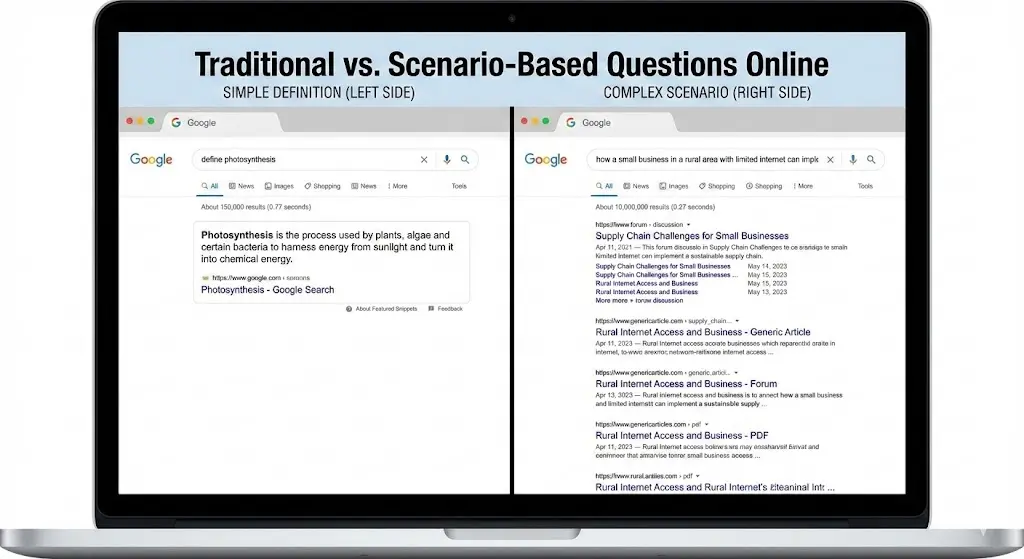
Traditional questions like “Define photosynthesis” or “What year did the Treaty of Versailles end?” have always been easy to memorize. Online, they’re even easier to search. Type the question into Google, and boom—Wikipedia, study guides, and YouTube explainers appear instantly.
The solution isn’t turning every exam into Fort Knox. It’s designing questions that can’t be answered by a quick search or a copied paragraph.
Strategy 1: Embrace Higher-Order Thinking
If you’ve heard of Bloom’s Taxonomy, you know it categorizes thinking skills from simple recall to complex evaluation. Most cheating-prone questions sit at the bottom: remembering and understanding. To outsmart cheaters, climb higher.
What Higher-Order Questions Look Like
Instead of asking students to define something, ask them to analyze, evaluate, or create:
- Bad question: “What is supply and demand?”
- Better question: “A local coffee shop raises prices by 15% but sees a 5% increase in customers. Analyze what this tells us about demand elasticity for their product and suggest two reasons this might occur.”
See the difference? The second question requires students to apply concepts to a specific situation. They can’t just copy the textbook definition because there is no textbook answer to this exact scenario.
Powerful Question Starters
These prompts naturally push students toward original thinking:
- “Evaluate whether…”
- “Compare the effectiveness of X and Y when…”
- “Justify your choice of…”
- “What would happen if… and why?”
- “Design a solution for…”
When students must defend their reasoning, they can’t rely on memorization or quick searches. They actually have to think. Novel concept, right?
Strategy 2: Make It Personal and Authentic
Here’s a secret: the best anti-cheating measure is making the question about something only that specific student has experienced or created.
Use Realistic Scenarios
Generic questions invite generic (read: Google-able) answers. Specific, realistic scenarios force students to apply knowledge:
- Generic: “Describe the stages of project management.”
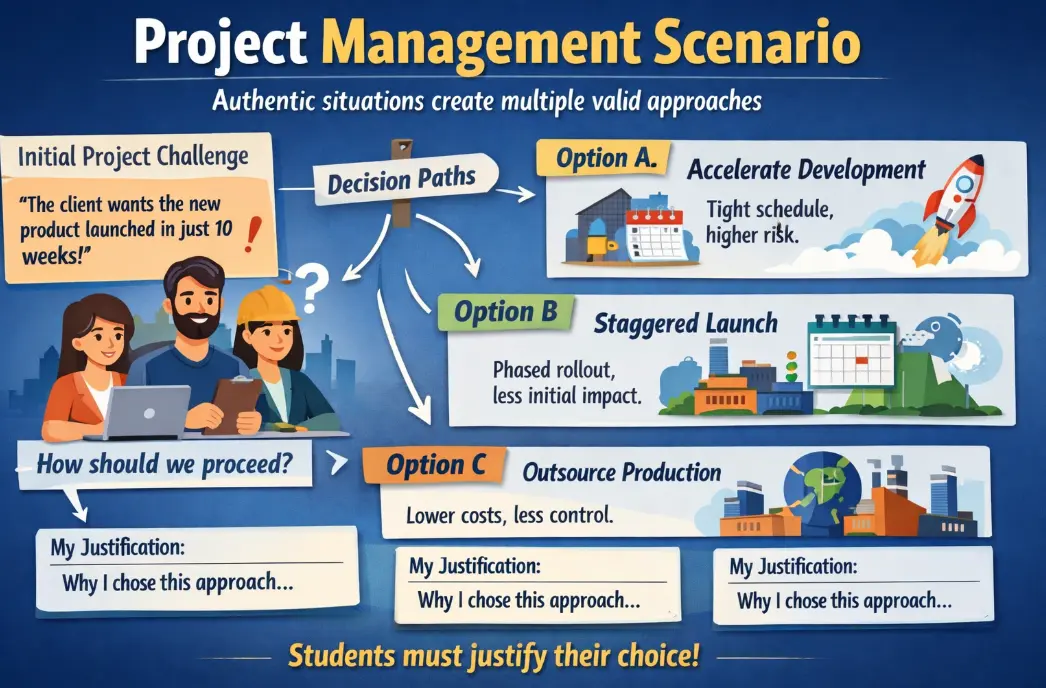
- Specific: “You’re managing the launch of a new employee wellness program with a $50,000 budget and a three-month timeline. Two weeks in, your key vendor drops out. Walk through your next steps using project management principles.”
The second question uses real-world constraints. There’s no single “right” answer hiding on page two of Google results.
Require Personal Reflection
Questions that ask students to connect course material to their own experience are inherently cheat-proof:
- “Reflect on a time when you witnessed a leadership failure. Using three concepts from this course, analyze what went wrong.”
- “In your current or most recent workplace, identify one process that could benefit from lean principles. Propose specific improvements.”
Unless students have telepathically connected classmates willing to share their life stories in real-time, these questions can’t be shared or copied.
Build on Previous Work
Reference assignments students completed earlier in the course. If they wrote a business plan in Week 3, ask them to evaluate it using new frameworks from Week 8. This approach creates continuity that’s impossible to fake.
Strategy 3: Eliminate Copy-Paste Opportunities
Let’s talk about the elephant in the virtual room: students copy-pasting entire paragraphs from websites, barely changing a word.
Set Strategic Word Limits
Here’s the counterintuitive trick: shorter answers are often harder to cheat on. When you ask for a 50-word response, students must synthesize information. They can’t paste a 300-word Wikipedia paragraph and hope you won’t notice.
- “In exactly 75 words, explain how confirmation bias affected the case study outcome.”
- “Provide three bullet points (max 20 words each) outlining your recommended approach.”
Tight word limits force precision. Students must understand the material well enough to be selective.
Add the “Part B” Technique
This is brilliant in its simplicity. After asking a question, add:
- “Part B: Justify why you chose this approach over the alternatives.”
- “Part B: What would you do differently if the budget were cut in half?”
- “Part B: Rank these three solutions and explain your reasoning.”
Even if a student copies the Part A answer from somewhere, Part B requires original thinking that connects to Part A. It’s like a built-in plagiarism trap.
Strategy 4: Master Question Banks and Randomization
Imagine if every student saw a completely different exam, but all versions were equally difficult and covered the same learning objectives. This isn’t fantasy—it’s smart question banking.
Build Robust Question Pools
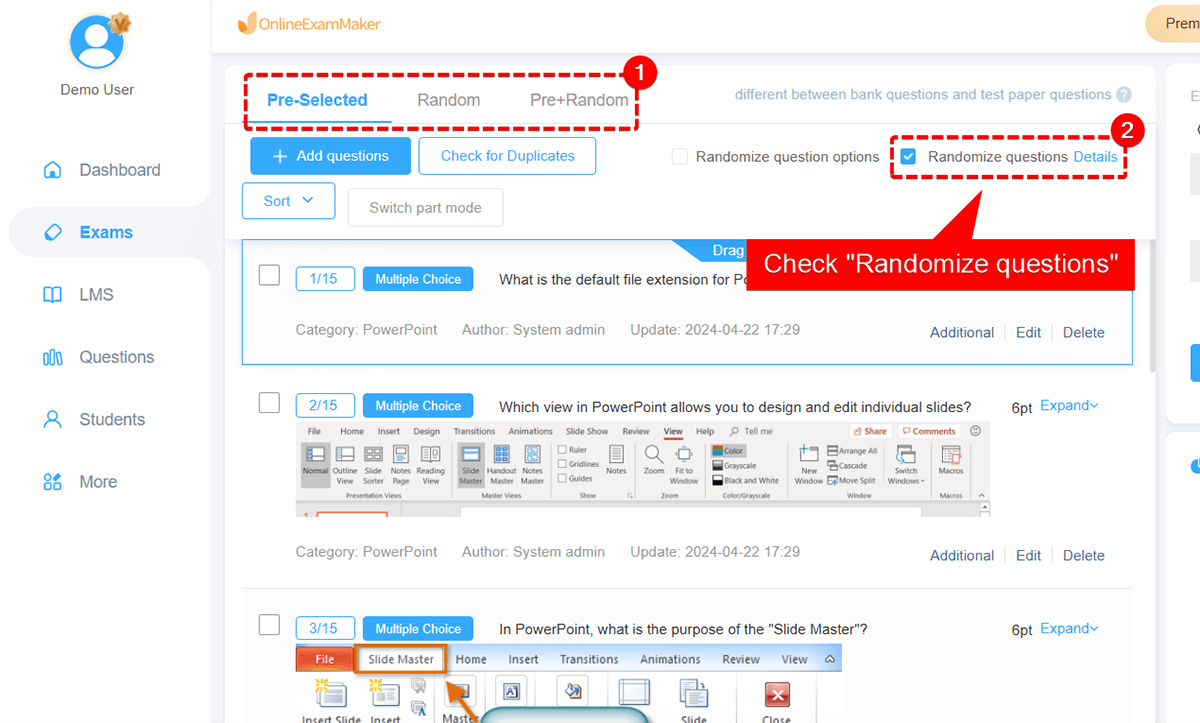
Instead of creating one 20-question exam, you can use OnlineExamMaker Question Bank to create a bank of 60 questions covering the same content at the same difficulty level. The system randomly selects 20 for each student.
| Without Question Banks | With Question Banks |
|---|---|
| All students see identical questions | Each student sees a unique subset |
| Easy to share screenshots | Screenshots only help with a fraction of questions |
| Answers easily circulated | Too many variations to memorize |
| Group chats are effective | Collaboration becomes impractical |
Randomize Everything
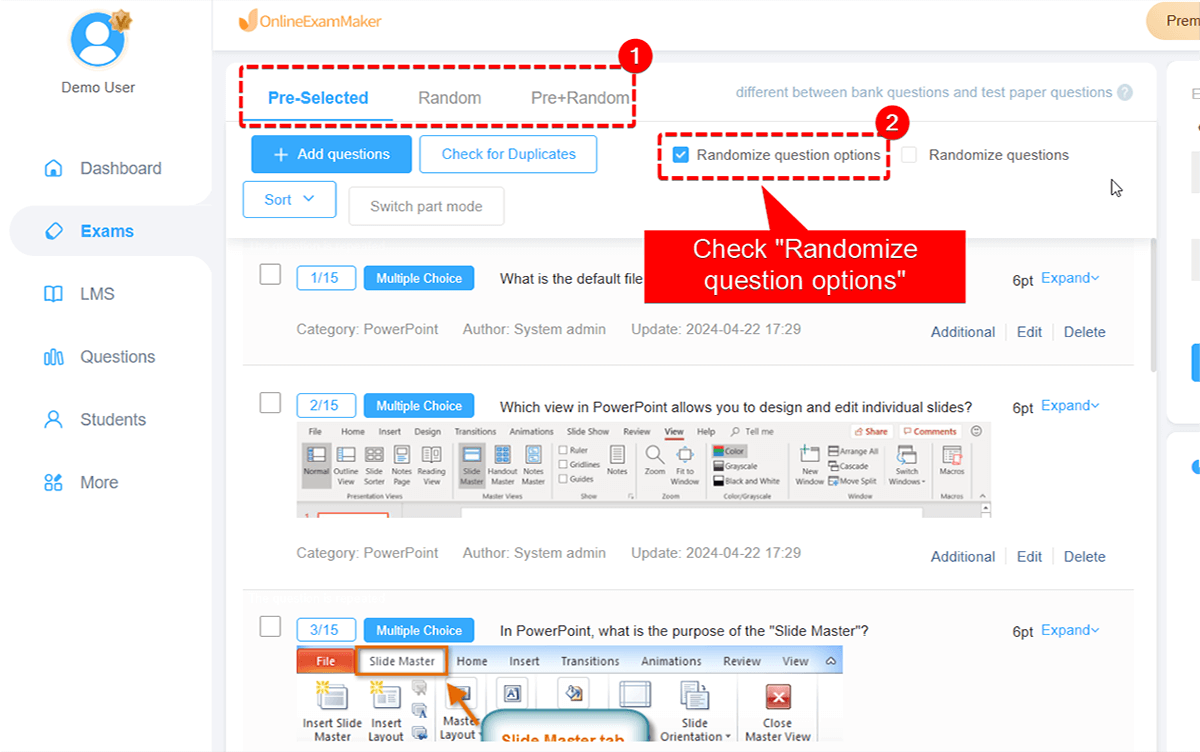
Don’t stop at question selection. Randomize:
- Question order: Student A gets questions 5, 12, 3, while Student B sees 8, 1, 19
- Answer options: For multiple choice, shuffle the A-B-C-D order
- Numerical values: For calculation problems, use variable parameters so each student solves a different version
When Student A asks Student B for “the answer to question 3,” it’s meaningless because their question 3s are different.
Use Formula-Based Questions
For quantitative subjects, create questions with randomized numbers but consistent formulas:
- Student A: “Calculate ROI for an investment of $15,000 returning $19,500”
- Student B: “Calculate ROI for an investment of $22,000 returning $27,940”
Both test the same skill, but sharing answers is useless.
Strategy 5: Design for Speed and Individual Work
Here’s an uncomfortable truth: given unlimited time, determined students can cheat on almost anything. The solution? Make exams fast-paced enough that cheating takes more effort than just knowing the answers.
Calculate Realistic Timing
For closed-book online exams, time pressure is your friend. If students barely have enough time to read, think, and respond, they don’t have time to search, coordinate, or compare notes.
- Rule of thumb: Allow 1-1.5 minutes per multiple choice question, 3-5 minutes per short answer
- Test the timing yourself, then multiply by 1.5 to account for student variability
- Make it brisk but not cruel—students should feel they need to focus, not panic
Avoid Recycling Old Questions
That brilliant question from 2019? It’s probably on Chegg or Course Hero by now. Students have discovered that past exam questions are gold mines.
Instead:
- Refresh scenarios with new data or contexts each semester
- Keep the same learning objectives and difficulty, but change the surface details
- If you must reuse questions, save them for low-stakes quizzes, not major exams
How OnlineExamMaker Simplifies Anti-Cheating Design
Now, I’ll level with you: implementing all these strategies manually sounds exhausting. Creating multiple question versions, randomizing everything, timing exams precisely, preventing copy-paste—who has time for that on top of actually teaching?
This is where smart exam software like OnlineExamMaker becomes your secret weapon.
Create Your Next Quiz/Exam Using AI in OnlineExamMaker
What Makes OnlineExamMaker Different
OnlineExamMaker is exam creation software designed specifically for educators who want to reduce cheating without drowning in administrative work. Here’s what makes it practical:
Key Anti-Cheating Features:
- Built-in question randomization from pools
- Automatic answer shuffling for multiple choice
- Timed sections with countdown alerts
- Browser lockdown options
- AI-powered proctoring and monitoring
Using OnlineExamMaker to Build Anti-Cheating Exams
Let’s walk through the practical steps:
Step 1: Build Your Question Bank
Use the AI Question Generator to create multiple versions of questions testing the same concept. Upload your course materials, and the AI suggests variations automatically. Instead of writing 60 questions manually, you write 20 and let the AI generate equivalent alternatives.
Step 2: Enable Smart Randomization
In the exam settings, activate question pool randomization. Specify how many questions from each pool appear per student. OnlineExamMaker handles the rest—every student gets a unique but equivalent exam.
Step 3: Configure Anti-Cheating Settings
Turn on features like:
- One-question-at-a-time display (prevents students from screenshotting the entire exam)
- Disable copy-paste functionality
- Randomize answer order automatically
- Set strict time limits per question or section
Step 4: Add AI Proctoring
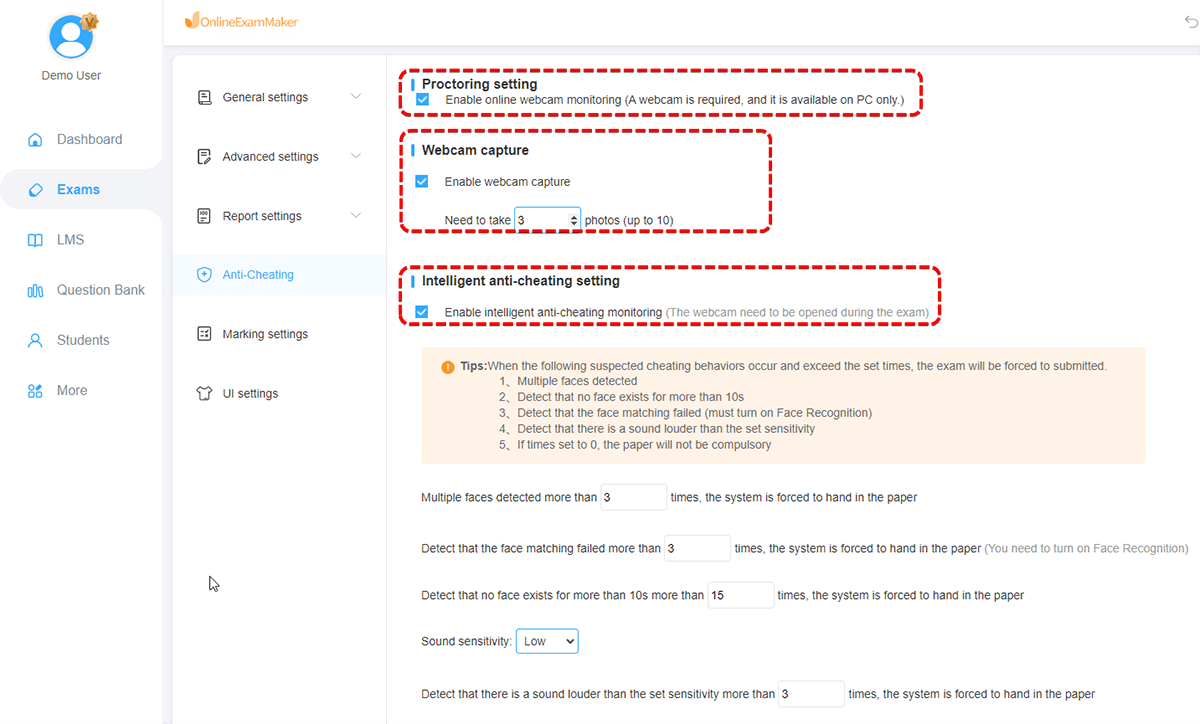
The AI Webcam Proctoring feature monitors student behavior during the exam. It flags suspicious activities like looking off-screen frequently, multiple people in frame, or unusual tab switching. You’re not watching 30 students simultaneously—the AI does it and alerts you to review specific moments.
Step 5: Leverage Automatic Grading
After the exam, Automatic Grading handles objective questions instantly. For short answers, the AI can flag responses that appear similar across students (potential collaboration) or contain text matching online sources. You review flagged items instead of reading every response word-for-word.
Real-World Impact
A high school science teacher I know implemented OnlineExamMaker’s randomization features last semester. Her previous online exams had a suspicious pattern: students finishing within seconds of each other with nearly identical scores. After switching to randomized question pools, the score distribution normalized, completion times spread out, and—interestingly—average scores stayed the same. Translation: capable students still succeeded, but coordinated cheating became impossible.
Putting It All Together
Creating cheat-resistant online exams isn’t about being suspicious or punitive. It’s about designing assessments that genuinely measure what students know, not how well they can search or collaborate inappropriately.
Your Anti-Cheating Checklist
Before publishing your next online exam, run through this:
- Review your questions: Can they be answered with a quick Google search? If yes, revise them to require analysis or application.
- Add personalization: Include at least 2-3 questions that require students to reference their own work, experience, or specific scenarios.
- Implement randomization: Build question pools with at least 1.5x as many questions as each student will answer.
- Set appropriate timing: Calculate based on question complexity, then test it yourself.
- Use technology wisely: Tools like OnlineExamMaker handle the technical heavy lifting while you focus on question quality.
- Communicate expectations: Tell students in advance that exams use randomization and proctoring, reducing the temptation to cheat.
The Bigger Picture
Here’s what I’ve learned after years of assessment design: students don’t cheat primarily because they’re lazy or dishonest. They cheat when the path to cheating feels easier than the path to learning.
When you design questions that require genuine understanding, when you make exams unique to each student, when you create scenarios that can’t be Googled—you’re not just preventing cheating. You’re building assessments that actually measure learning. And weirdly enough, students often prefer these exams once they realize they’re fairer to those who prepared legitimately.
The student I mentioned at the beginning with the elaborate cheating setup? Last semester, they took an exam with randomized, scenario-based questions. No spreadsheet. No Discord. Just them, their knowledge, and questions that required thinking rather than searching. They passed with a solid B.
Turns out, when you remove the easy path to cheating, students take the path you wanted them on all along: actually learning the material.
Start designing smarter exams today. Your future self—and your honest students—will thank you.
