Remember those late nights hunched over your desk, crafting the perfect chemistry exam questions? The periodic table staring back at you while you wondered if your molecular structure problems were too easy or impossibly hard? Well, those days might be numbered. AI chemistry exam design is revolutionizing how educators create assessments, and honestly, it’s about time.
Why Chemistry Teachers Are Embracing AI (And You Should Too)
Let’s be real for a moment. Chemistry isn’t just about memorizing the atomic weight of carbon or balancing equations. It’s about understanding how our world works at the most fundamental level. But here’s the kicker – traditional exam creation often falls short of capturing this wonder.
AI tools for chemistry education aren’t here to replace your expertise. They’re here to amplify it. Think of artificial intelligence as your brilliant teaching assistant who never sleeps, never gets tired, and has access to virtually unlimited question banks and assessment strategies.
Consider Sarah, a high school chemistry teacher from Portland. She used to spend entire weekends creating exams, often recycling the same question formats year after year. Now? She generates diverse, engaging chemistry assessments in under an hour, leaving more time for what really matters – connecting with her students.
The Chemistry Knowledge That Matters Most
Before diving into AI exam creation, let’s establish what chemistry knowledge is important for students:
- Atomic structure and periodic trends – The foundation of everything chemical
- Chemical bonding and molecular geometry – How atoms dance together
- Stoichiometry and chemical reactions – The mathematical poetry of chemistry
- Thermodynamics and kinetics – Energy and time in chemical processes
- Acid-base chemistry and equilibrium – Balance in chemical systems
- Organic chemistry fundamentals – The chemistry of life
Getting Started with OnlineExamMaker: Your AI-Powered Assessment Partner
Now, let’s roll up our sleeves and create something amazing. OnlineExamMaker’s AI chemistry exam creation transforms the traditionally tedious process into something almost… fun? (Yes, I said fun and exam creation in the same sentence.)
Create Your Next Quiz/Exam Using AI in OnlineExamMaker
Step 1: Setting Up Your Chemistry Exam Foundation
Log into OnlineExamMaker and navigate to the exam creation dashboard. Here’s where the magic begins. Select “Create New Exam” and choose the AI-assisted option. The platform will prompt you to specify your subject – in this case, chemistry – and your target audience level.
Pro tip: Be specific about your student level. “High school general chemistry” will generate different questions than “AP Chemistry” or “College-level organic chemistry.”
Step 2: Defining Your Learning Objectives
This is where your expertise shines. The AI needs to understand what you want to assess. Are you testing conceptual understanding of molecular bonding? Problem-solving skills in stoichiometry? Or perhaps application of thermodynamic principles?
Input your learning objectives clearly. Instead of “test chemical reactions,” try “evaluate student ability to predict products of single and double replacement reactions and balance chemical equations.” The AI responds beautifully to specificity.
Step 3: Leveraging AI for Question Generation
Here’s where AI-powered chemistry test generation truly impresses. The system analyzes your objectives and generates diverse question types:
- Multiple choice questions with scientifically accurate distractors
- Problem-solving scenarios that require multi-step calculations
- Conceptual questions that test deep understanding
- Application problems connecting chemistry to real-world situations
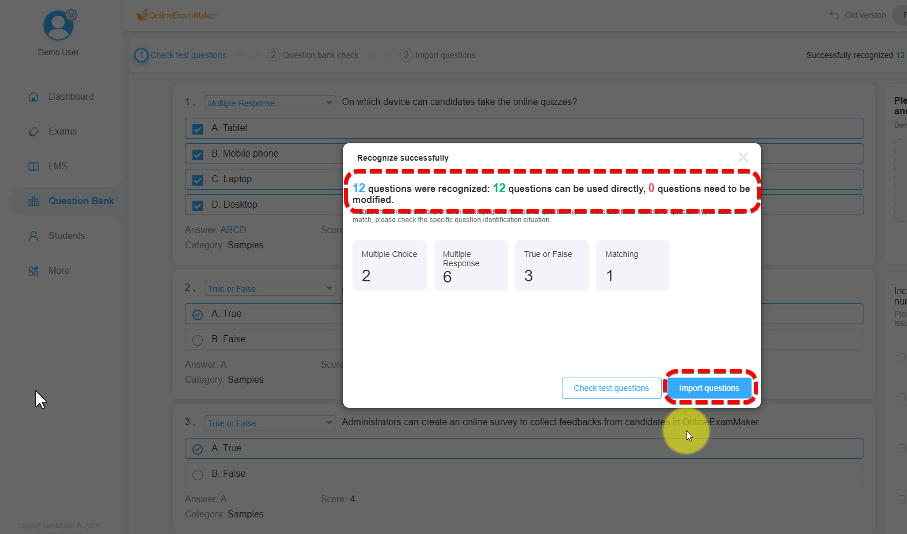
The AI doesn’t just create random questions – it crafts assessments that progressively build in complexity, ensuring you’re truly measuring student understanding.
Step 4: Customizing and Refining Questions
Review each AI-generated question carefully. This isn’t about blind trust – it’s about intelligent collaboration. You might find a stoichiometry problem that’s perfect but needs adjustment for your specific textbook’s notation style. Or perhaps a conceptual question about molecular geometry that could benefit from a diagram.

The beauty of designing chemistry assessments with AI lies in this iterative process. The AI provides the foundation, and you add the personal touch that makes the exam truly yours.
Step 5: Incorporating Multimedia and Interactive Elements
Modern chemistry education isn’t stuck in textbook mode, and your exams shouldn’t be either. OnlineExamMaker’s AI can suggest where to include:
- Molecular structure diagrams for visualization questions
- Graph interpretation problems for kinetics and equilibrium
- Interactive periodic table references for element property questions
- Video clips of chemical reactions for observation-based questions
AI Tutoring Systems: Beyond Just Exam Creation
Here’s something most educators don’t realize – chemistry exam AI tutoring systems can provide incredible insights into student learning patterns. The AI analyzes not just final answers but problem-solving approaches, common misconceptions, and areas where students consistently struggle.
Imagine knowing before you even grade the exams that 80% of your students are confused about electron configuration patterns, or that they’re consistently making the same algebraic error in gas law calculations. This isn’t science fiction – it’s available right now.
Maintaining Academic Integrity in AI-Assisted Assessments
Let’s address the elephant in the room. Ensuring AI-assisted exams maintain fairness and originality requires thoughtful implementation. Here are key strategies:
Randomization is your friend: Generate multiple versions of each exam with varied numerical values and slightly different scenarios. Students can’t share answers when the questions themselves are different.
Focus on application over memorization: AI excels at creating problems that require understanding rather than rote recall. A student can’t simply Google “What is the molecular formula of glucose?” when the question asks them to predict the products of glucose combustion in varying oxygen concentrations.
Time-sensitive assessments: AI can help create exams that are appropriately challenging for the allotted time, reducing the temptation to seek external help.
Wrapping It All Up: Your Next Steps
Creating chemistry exams doesn’t have to be a dreaded weekend activity anymore. Chemistry exam automation through AI tools like OnlineExamMaker transforms assessment creation from a chore into a creative collaboration between human expertise and artificial intelligence.
Remember, the goal isn’t to replace your educational judgment – it’s to enhance it. AI handles the heavy lifting of question generation, formatting, and even preliminary analysis, leaving you free to focus on what you do best: teaching and inspiring the next generation of chemists.
Ready to revolutionize your assessment strategy? Start with one exam, embrace the learning curve, and prepare to wonder how you ever managed without your AI teaching assistant. Your students – and your weekend schedule – will thank you.
The future of chemistry education isn’t just arriving; it’s here, waiting in your digital toolkit. The question isn’t whether you’ll embrace AI-assisted exam creation, but when you’ll take that first, transformative step.
