- What Is AI Skill Assessment Software?
- How We Chose the Best Tools
- 1. OnlineExamMaker
- 2. HireVue
- 3. TestGorilla
- 4. iMocha
- 5. HackerRank
- 6. Harver
- Comparison Table
- How to Choose the Right Platform
- Conclusion
Hiring has never been more competitive — or more chaotic. Recruiters are drowning in resumes, under pressure to fill roles fast, and still expected to find the right person. That’s a lot to ask of a spreadsheet and a gut feeling.
AI skill assessment software changes that equation. Instead of manually reviewing every candidate, you let the platform do the heavy lifting: auto-scoring tests, ranking applicants, flagging standouts, and delivering structured data before the first interview even happens. The result? Faster screening, fairer evaluation, and better hires.
Here are the six best tools worth your attention in 2026.
What Is AI Skill Assessment Software?
At its core, AI skill assessment software helps recruiters evaluate candidates before they enter the interview room. These platforms typically handle:
- Automated candidate screening and scoring — no more reading through the same answers 200 times.
- Skills testing across technical, cognitive, language, and behavioral competencies.
- Interview intelligence and analytics — structured scorecards and benchmarking data.
- ATS and workflow integration so assessments fit naturally into your hiring pipeline.
The shift from manual screening to AI-assisted evaluation isn’t just about speed — it’s about consistency. Every candidate gets the same test, the same scoring rubric, and the same fair shot. That matters more than most hiring teams realize.
How We Chose the Best Tools
Not every “AI-powered” platform is built equal. Here’s what actually guided this list:
- Assessment quality and breadth — does the test library cover real skills, or just surface-level trivia?
- AI scoring and transparency — can you explain why a candidate scored the way they did?
- Bias reduction and structured evaluation — is the platform actively working to level the playing field?
- Ease of use — a tool your team won’t actually use is not a good tool.
- ATS integration and scalability — can it grow with your hiring volume?
- Reporting and benchmarking — does it help you improve over time, not just screen faster today?
1. OnlineExamMaker
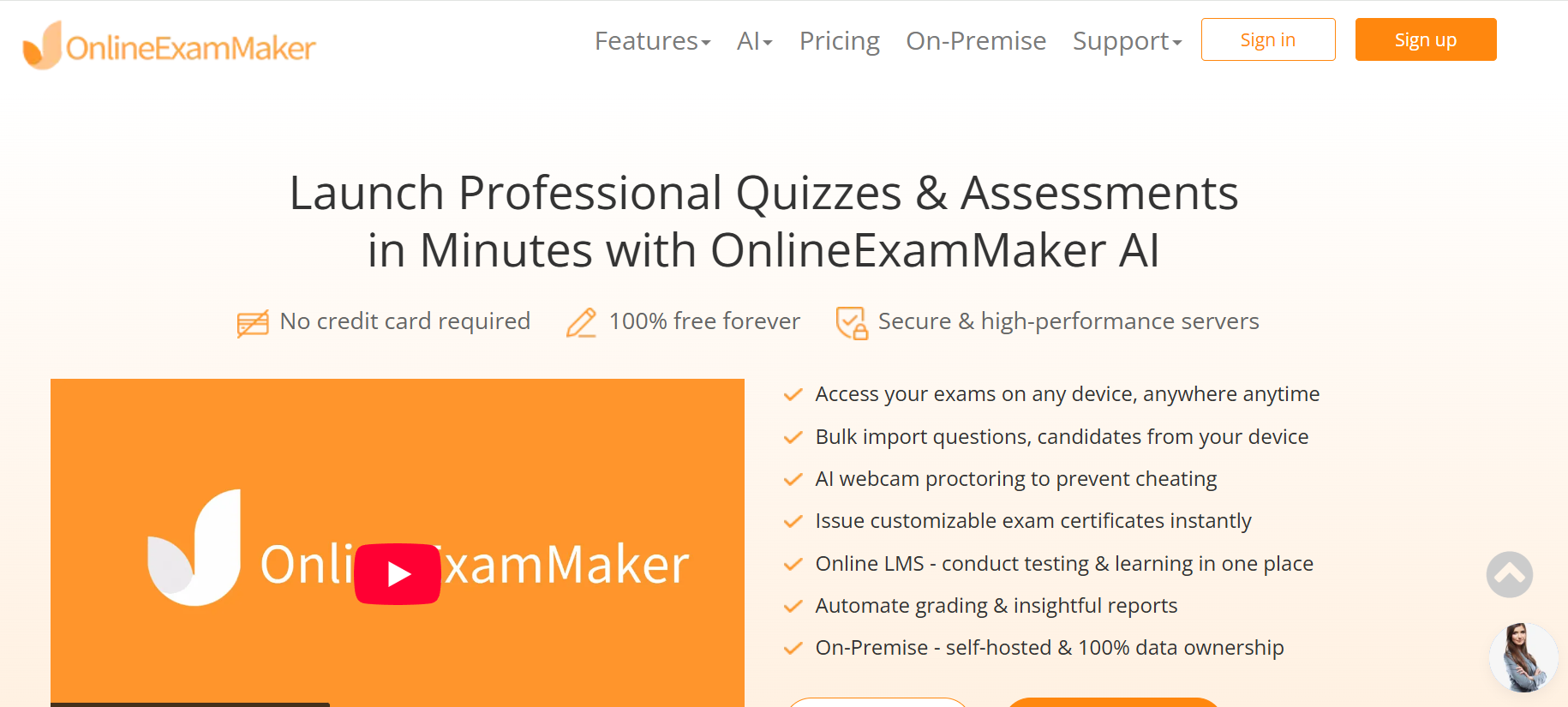
Best for: HR managers, trainers, and educators who need a flexible, all-in-one skill assessment platform with strong AI features.
OnlineExamMaker is quietly one of the most versatile skill assessment platforms available today. Whether you’re screening applicants for a customer service role or evaluating technical competencies for an engineering team, it has the toolset to make that process faster and more reliable.
What makes it stand out is how well the AI layer actually works. The AI Question Generator builds custom assessments from any topic in seconds — you type in the skill area, pick the difficulty level, and the platform generates a complete question bank. No more spending hours writing tests from scratch.
Once candidates complete their assessments, the platform’s Automatic Grading scores them instantly and delivers structured results your team can act on right away. No manual marking, no subjective interpretation — just clean, comparable data.
For high-stakes roles where test integrity matters, OnlineExamMaker’s AI Webcam Proctoring monitors candidates during the assessment and flags suspicious behavior automatically. It’s the kind of feature that enterprise teams and certification programs depend on — and it’s built right in.
How to Use OnlineExamMaker for AI Skill Assessment
- Create your assessment — Use the AI Question Generator to build a test based on the target skill set. Choose question types: multiple choice, short answer, coding challenges, or scenario-based questions.
- Set scoring rules — Define pass thresholds, time limits, and weighted sections based on what matters most for the role.
- Invite candidates — Send assessment links directly via email or embed the test in your careers page. No app download required.
- Enable proctoring — Turn on AI webcam monitoring for sensitive assessments to maintain fairness and accuracy.
- Review AI-graded results — Automatic Grading delivers instant scores, ranked leaderboards, and performance breakdowns so you can shortlist candidates with confidence.
Create Your Next Quiz/Exam Using AI in OnlineExamMaker
Strengths: Easy to set up, genuinely useful AI features, strong proctoring for compliance-sensitive hiring, available as both a cloud and on-premise solution.
Limitations: Less suited for organizations that need deep ATS pipeline integrations out of the box.
Ideal use case: A manufacturing company screening 300+ applicants for shift supervisor roles — build a tailored assessment in minutes, grade automatically, and shortlist the top 20 candidates before lunch. You can learn more about effective assessment strategies on the OnlineExamMaker blog.
2. HireVue
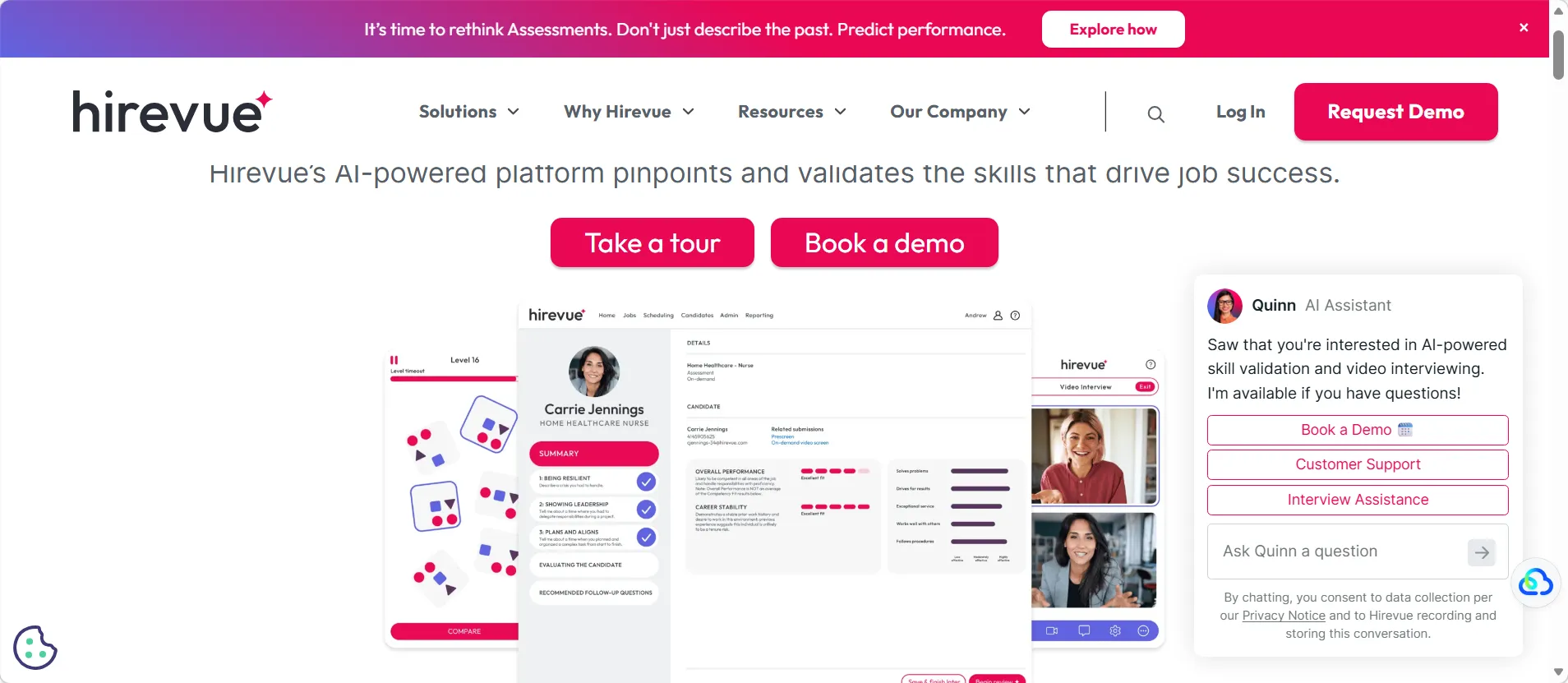
Best for: High-volume hiring and AI-powered video interviewing.
HireVue has become a household name in enterprise recruitment. Its AI video interview platform analyzes candidate responses for content, communication quality, and job-relevant competencies — all without a recruiter needing to watch every single clip.
Key Features:
- Asynchronous video interviews with AI scoring
- Game-based cognitive and behavioral assessments
- Structured interview guides and scoring
- Deep ATS integrations with major enterprise platforms
Strengths: Exceptional for companies hiring at scale. Reduces time-to-interview dramatically and creates consistent evaluation across hiring teams.
Limitations: Premium pricing puts it out of reach for smaller organizations. Some candidates find video-only screening impersonal.
Ideal use case: A retail chain hiring 5,000 seasonal workers — screen everyone through a 10-minute video assessment before any human reviews a single application.
3. TestGorilla
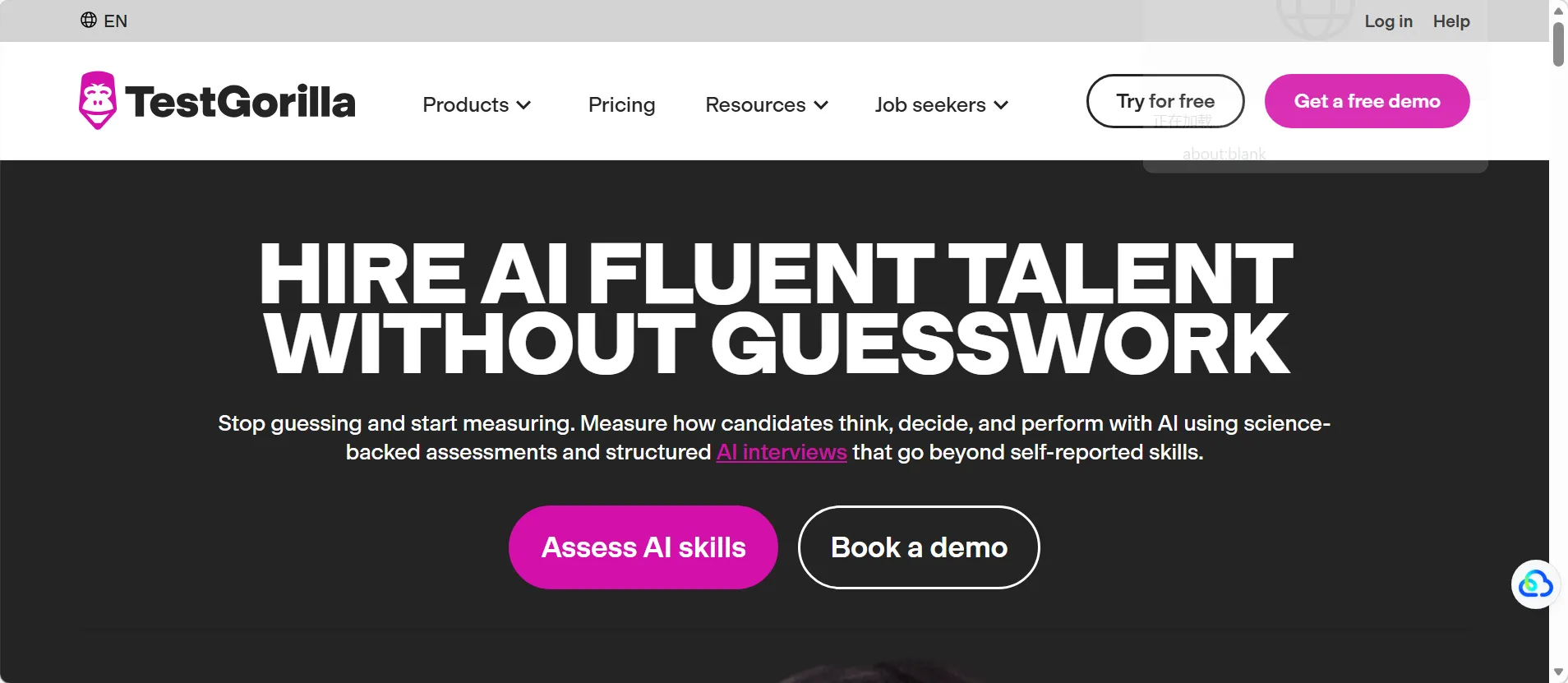
Best for: Broad pre-employment screening across diverse role types.
TestGorilla offers one of the largest pre-built test libraries available, covering cognitive ability, personality, language proficiency, job-specific skills, and even culture-add assessments. It’s particularly popular among growing companies that need flexible screening without building custom tests from scratch.
Key Features:
- 300+ science-backed test modules
- Anti-cheating measures including webcam snapshots and tab-switching detection
- Candidate ranking and score comparison dashboards
- ATS integration with Greenhouse, Lever, and others
Strengths: Fast to deploy, broad test coverage, good candidate experience. Works well for companies hiring across multiple departments simultaneously.
Limitations: Tests are standardized, so highly specialized roles may need supplemental custom assessments.
Ideal use case: A SaaS startup scaling its sales and support teams — run personality, cognitive, and role-specific tests in one assessment link.
4. iMocha
Best for: Enterprise skills intelligence and workforce planning.
iMocha goes beyond basic screening — it’s a full skills intelligence platform. With over 3,000 skills tests across technical, functional, and behavioral domains, it’s one of the most comprehensive libraries available. Large enterprises use it not just for hiring, but for internal skills gap analysis and L&D planning.
Key Features:
- 3,000+ ready-to-use skills assessments
- AI-powered skills gap analysis and workforce benchmarking
- Coding simulators and live coding assessments
- Integration with SAP SuccessFactors, Workday, and major HCMs
Strengths: Unmatched depth for technical and functional skill areas. Strong analytics for workforce-wide skills visibility — not just hiring.
Limitations: Can be complex to configure for smaller teams without dedicated HR tech support.
Ideal use case: A financial services firm auditing the technical skills of its 2,000-person IT department while simultaneously screening external candidates.
5. HackerRank
Best for: Technical and engineering hiring.
HackerRank is the go-to platform when you’re hiring developers, data scientists, or any role where code quality is the measure of fit. Candidates write real code in a realistic environment, and AI scores their submissions on correctness, efficiency, and style.
Key Features:
- Coding challenges in 40+ programming languages
- Project-based and take-home assessments
- Plagiarism detection and real-time monitoring
- Technical interview platform with collaborative coding environment
Strengths: Trusted by top tech companies worldwide. Assessments reflect real-world engineering scenarios rather than theoretical puzzles.
Limitations: Limited usefulness outside of technical roles. Not designed for behavioral or soft-skill evaluation.
Ideal use case: A fintech company hiring 20 backend engineers — test actual coding ability before spending time on phone screens.
6. Harver
Best for: Predictive hiring and high-volume frontline recruitment.
Harver specializes in volume hiring — think call centers, retail, logistics, hospitality. Its AI uses predictive modeling to identify which candidates are most likely to succeed and stay in a role, reducing both time-to-hire and early attrition.
Key Features:
- Situational judgment tests and role simulations
- Automated reference checking
- Predictive analytics and retention modeling
- Candidate self-selection tools (realistic job previews)
Strengths: Uniquely strong at predicting post-hire performance and retention for frontline roles. Helps candidates self-select out if the role isn’t right for them, saving recruiter time.
Limitations: Best results require calibration with your historical hiring data, which takes time to build.
Ideal use case: A logistics company hiring 1,000 warehouse associates annually — use predictive scores to prioritize candidates most likely to stay beyond 90 days.
Comparison Table
| Tool | Best For | Assessment Types | AI Capabilities | Best Fit Recruiter |
|---|---|---|---|---|
| OnlineExamMaker | Flexible skill & knowledge testing | MCQ, short answer, coding, scenario | AI question generation, auto-grading, proctoring | HR managers, trainers, educators |
| HireVue | High-volume video interviewing | Video, cognitive, behavioral | AI video scoring, structured interviews | Enterprise, volume hiring teams |
| TestGorilla | Broad pre-employment screening | Cognitive, personality, job skills, language | AI scoring, anti-cheat detection | Growing companies, multi-role hiring |
| iMocha | Enterprise skills intelligence | Technical, functional, behavioral, coding | Skills gap analysis, benchmarking | Large enterprise HR and L&D teams |
| HackerRank | Technical & engineering hiring | Coding challenges, take-home projects | AI code scoring, plagiarism detection | Tech recruiters, engineering teams |
| Harver | Predictive frontline hiring | Situational judgment, simulations, references | Predictive retention modeling | High-volume frontline recruiters |
How to Choose the Right Platform
No single tool wins for every team. The right choice depends on what you’re actually hiring for:
- For technical hiring — go deep with HackerRank or iMocha, where coding simulations and skills libraries do the heavy lifting.
- For high-volume frontline roles — Harver’s predictive modeling or HireVue’s async video screening will save the most recruiter time.
- For general hiring across multiple role types — TestGorilla’s broad library or OnlineExamMaker‘s flexible AI-generated assessments give you the most versatility.
- For teams that build their own assessments — OnlineExamMaker’s AI Question Generator is genuinely hard to beat for speed and customization.
One practical tip: start with one role family before rolling out company-wide. Pilot the platform on a single job type, calibrate your scoring thresholds, and gather feedback from both recruiters and candidates before scaling. The best platforms reward thoughtful configuration — they don’t just run themselves out of the box.
Conclusion
The days of manually reviewing hundreds of identical applications are numbered. AI skill assessment software doesn’t just save time — it makes your hiring process more defensible, more consistent, and ultimately more fair.
Whether you’re a solo recruiter screening applicants for a growing startup or an HR team managing thousands of roles across a global enterprise, there’s a platform on this list that fits your workflow. The key is matching the tool to your actual hiring goals — not just the feature checklist — and then giving it enough time to deliver real results.
Start with what your biggest bottleneck is. Too many unqualified applicants? Start with screening-focused tools. Struggling to evaluate technical depth? Look at coding assessment platforms. Need to reduce early turnover? Predictive tools like Harver are built exactly for that problem.
Good hiring is a skill. The right software just makes it a lot less exhausting.