Every instructor, trainer, or HR manager has faced the same quiet dilemma at some point: should I give them a clock or give them room to think? The choice between a timed exam and an open-duration test sounds like a logistics question, but it’s really a pedagogical one. It shapes what students practice, how anxious they feel, and — most importantly — whether the score actually tells you something meaningful.
This article breaks down both formats honestly, maps them to specific assessment goals, and shows you how tools like OnlineExamMaker make it surprisingly easy to run either one well.
- What Do We Mean by “Timed” vs. “Open-Duration”?
- The Case for Timed Exams
- The Real Costs of Time Pressure
- The Case for Open-Duration and Open-Book Tests
- Challenges and Misconceptions About Open-Duration Tests
- Matching Format to Your Assessment Goals
- Equity, Accessibility, and Student Experience
- How OnlineExamMaker Supports Both Formats
- How to Set Up Timed or Open-Duration Tests in OnlineExamMaker
- Practical Decision Framework
- Choosing Format as a Pedagogical Act
What Do We Mean by “Timed” vs. “Open-Duration”?
Let’s get the definitions straight before we argue about anything.
Timed exams run inside a fixed window — typically 1 to 3 hours — standardized for everyone. They’re usually closed-book, often proctored, and designed so that each student works under the same constraints at the same time. Think of a 90-minute midterm in a lecture hall, or a certification test with a countdown timer.
Open-duration tests give students a wider window — 24 to 72 hours, or even a full week — to complete their work asynchronously. They’re frequently open-book or open-web, submitted digitally, and assessed on quality of thinking rather than speed of recall. A take-home case analysis in a business program is a classic example.
There are also hybrids: long-but-timed exams, quizzes with flexible start times, or open-book tests that still require completion within two hours. The design space is broader than most people realize.
The Case for Timed Exams
Timed exams have survived this long for good reasons — not just inertia.
From a logistics standpoint, they are genuinely efficient. Large cohorts can be assessed simultaneously, results come in on a predictable schedule, and conditions are standardized. For HR managers running employee certification programs across hundreds of people, or manufacturing enterprises verifying safety procedure knowledge, that uniformity is not trivial.
From a learning standpoint, timed exams work well when:
- You’re testing basic factual recall or procedural fluency (e.g., calculations, formulas, definitions)
- Speed itself is part of the skill — emergency response, customer service scripts, or timed assembly tasks
- You want to sample a broad content domain quickly with MCQs or short answers
- You’re preparing students for a high-stakes certification that is itself timed
Students often report that timed exams, for all their stress, do build a useful skill: working under pressure. That’s not nothing. In professional contexts, the ability to retrieve information quickly and make decisions without unlimited deliberation has real value.
The Real Costs of Time Pressure

Here’s where the honest conversation gets uncomfortable. Research is fairly consistent that time pressure can undermine validity — meaning the score measures something other than what you intended.
When students are racing a clock, the exam can end up measuring:
- Test-taking speed and stamina
- Anxiety management
- Familiarity with question formats and tricks
…rather than conceptual understanding or critical thinking. If your goal is to know whether a student understands how a process works, a stressed 60-second answer may not give you that signal clearly.
There’s also an equity dimension that’s hard to ignore. Strict time limits can disproportionately affect students who process language more slowly, those with anxiety disorders or learning disabilities, and learners whose first language isn’t the test language. Accommodations help, but they require formal documentation, add administrative complexity, and don’t address all the gaps.
The Case for Open-Duration and Open-Book Tests
Open-duration tests tend to get dismissed as “easy” — which is both unfair and inaccurate. When well-designed, they can be harder in the ways that actually matter.
Research and teaching-center guidance consistently show that open-book and open-web assessments:
- Reduce test anxiety significantly without reducing rigor
- Allow for questions at higher cognitive levels — application, analysis, synthesis, evaluation
- Mirror professional reality, where information is usually available but must be interpreted and applied
- Support students with disabilities or caregiving responsibilities who benefit from flexible timing
There’s also a compelling academic integrity argument. When questions require original reasoning, integration of ideas, and genuine judgment, the value of copying or outsourcing drops sharply. The question itself becomes the defense.
Open-duration formats work especially well for:
- Case analyses, design problems, and written arguments
- Programming assignments where the process matters
- Courses emphasizing critical thinking or research skills
- Training programs focused on applied competency rather than rote knowledge
Challenges and Misconceptions About Open-Duration Tests
Let’s not romanticize the open-book format either. There are real pitfalls.
Students often under-prepare. Knowing the exam is open-book can create a false sense of security. Students may skip deep study, then spend precious exam time hunting through disorganized notes — which costs more time than it saves.
Question design requires more effort. Low-level open-book questions (What is the definition of X?) are nearly pointless, since students can look up the answer in seconds. You have to design questions that demand thinking, not just retrieval.
Integrity risks shift rather than disappear. Take-home exams can invite unauthorized collaboration or contract cheating if tasks are generic or reused across cohorts. Clear expectations, varied prompts, and thoughtful monitoring are essential.
Matching Format to Your Assessment Goals
The right format depends almost entirely on what you’re actually trying to measure. Ask yourself:
- Is speed part of the skill? If yes, use a timed exam.
- Do I want recall or transfer? Recall → timed; Transfer → open-duration.
- Am I preparing students for a timed high-stakes test? Then practice with timed conditions.
- Do I want students to demonstrate depth of understanding? Open-duration gives them room to show that.
| Dimension | Timed Exam | Open-Duration Test |
|---|---|---|
| Primary focus | Recall, fluency, speed | Application, analysis, synthesis |
| Typical question types | MCQ, short answer, calculations | Essays, case studies, design tasks |
| Stress profile | Higher — performance under pressure | Lower — but risk of procrastination |
| Logistics | Standardized, easy to schedule | Flexible, requires clear submission rules |
| Integrity concerns | Proctoring needed for high stakes | Question design is the main safeguard |
| Equity impact | Can disadvantage slower processors | More inclusive by default |
| Best for | Certification, drills, sampling breadth | Deep learning, applied competency |
Equity, Accessibility, and Student Experience
Exam duration decisions don’t exist in a vacuum. They intersect with disability accommodations, technology access, caregiving responsibilities, language proficiency, and socioeconomic context.
A student managing a chronic illness, parenting a young child, or working a full-time job while completing a certification course experiences a timed exam very differently from a traditional full-time student in a quiet testing center. That’s not an argument against timed exams — it’s an argument for intentionality.
Practical strategies that help:
- Offer flexible start windows rather than a single synchronized exam time
- Use shorter, lower-stakes timed quizzes for practice and formative feedback
- Pair a timed component with an open-duration project so students can demonstrate mastery in more than one mode
- Be transparent about why you chose the format — students appreciate knowing the rationale
How OnlineExamMaker Supports Both Formats
OnlineExamMaker is an online exam and quiz platform built for instructors, trainers, HR managers, and organizations that need to assess people at scale — without the chaos of paper logistics or the rigidity of legacy testing software.
What makes it worth looking at is that it doesn’t force you to choose a philosophy. Whether you want a strict 45-minute timed quiz or a flexible 48-hour open-duration assessment, the platform handles both cleanly — and it’s available as either a cloud-based SaaS (free to start) or an on-premise solution for organizations that need full data ownership, which matters a lot for enterprise and HR use cases.
Create Your Next Quiz/Exam Using AI in OnlineExamMaker
How to Set Up Timed or Open-Duration Tests in OnlineExamMaker
Getting an exam live in OnlineExamMaker takes less time than most people expect. Here’s how the two formats look in practice:
Setting Up a Timed Exam
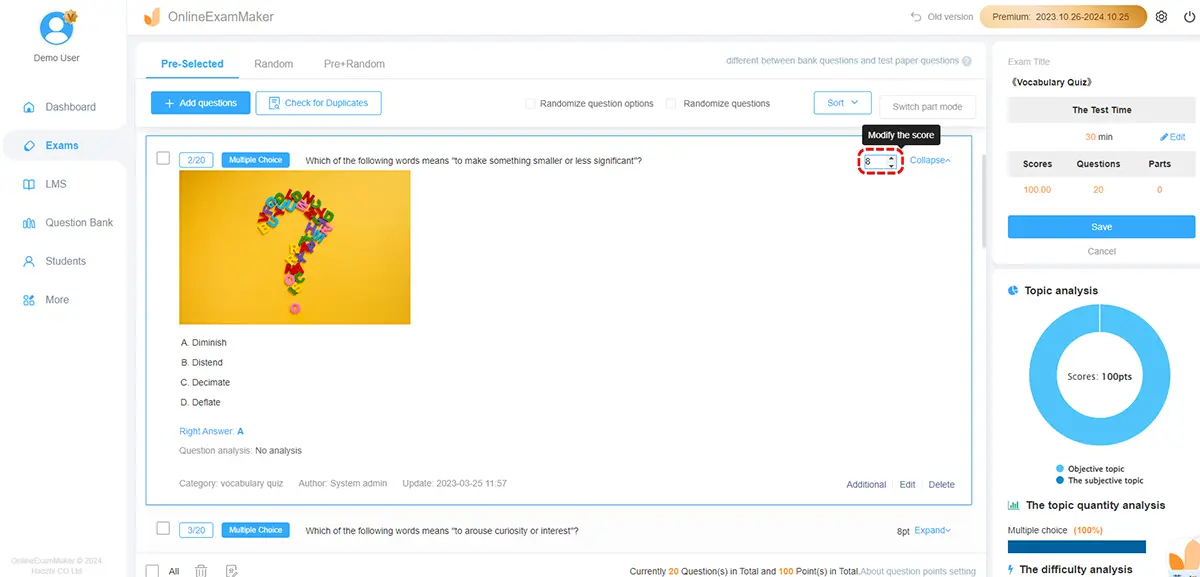
- Create your question bank. Use the AI Question Generator to build MCQs, short-answer, or true/false questions from your topic or document. Review and adjust as needed.
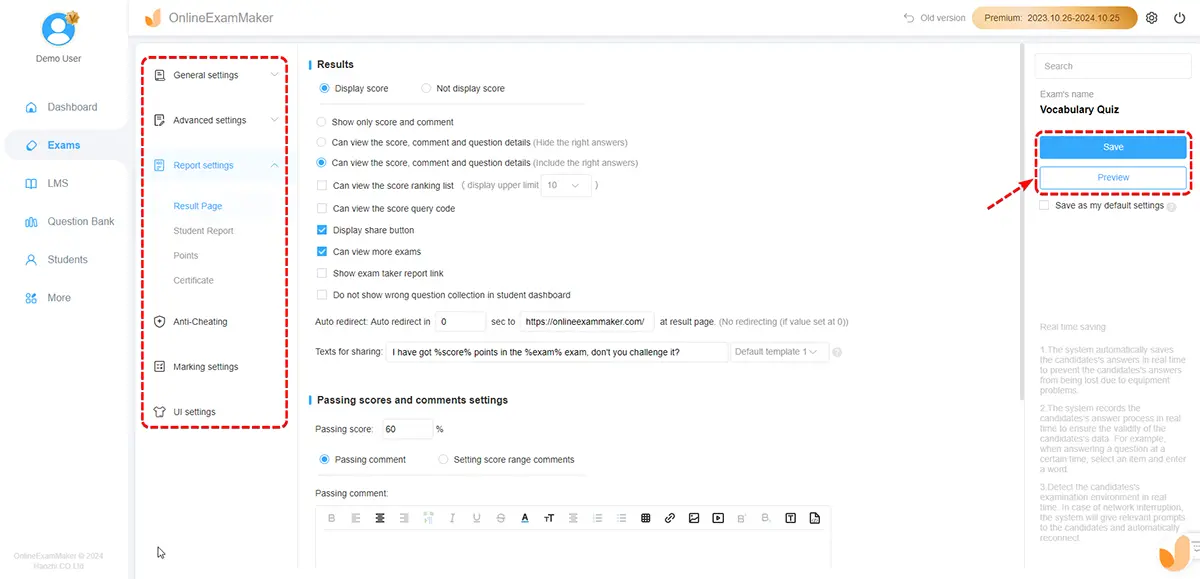
- Configure exam settings. Set a fixed duration (e.g., 60 minutes). Enable the countdown timer so students see time remaining throughout.
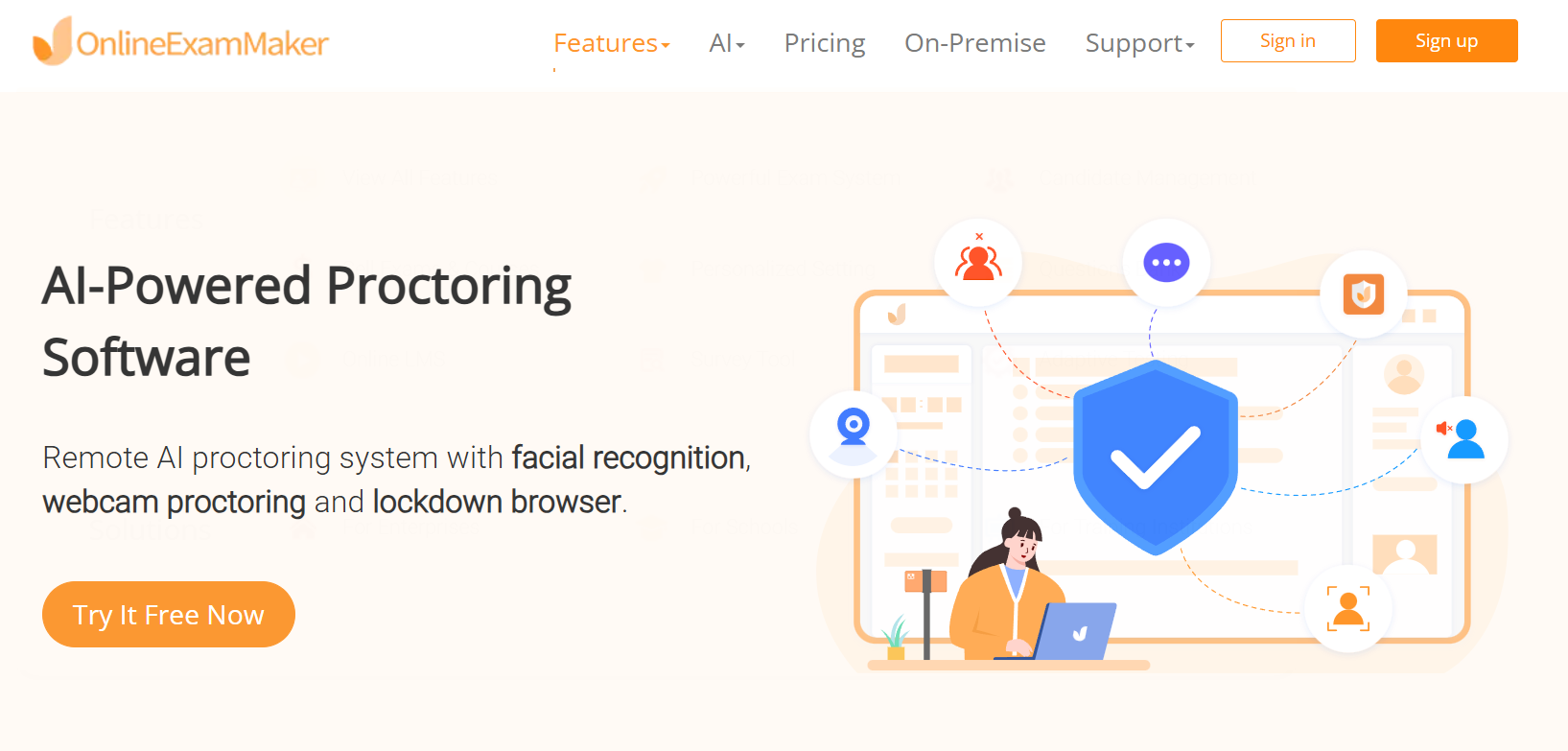
- Enable proctoring. For high-stakes situations, turn on AI Webcam Proctoring to monitor for tab switching, multiple faces, or absence from the frame.
- Set a start window. Choose whether all students start simultaneously or within a defined window (e.g., any 2-hour block within a 4-hour period). The latter adds flexibility without sacrificing the timed format.
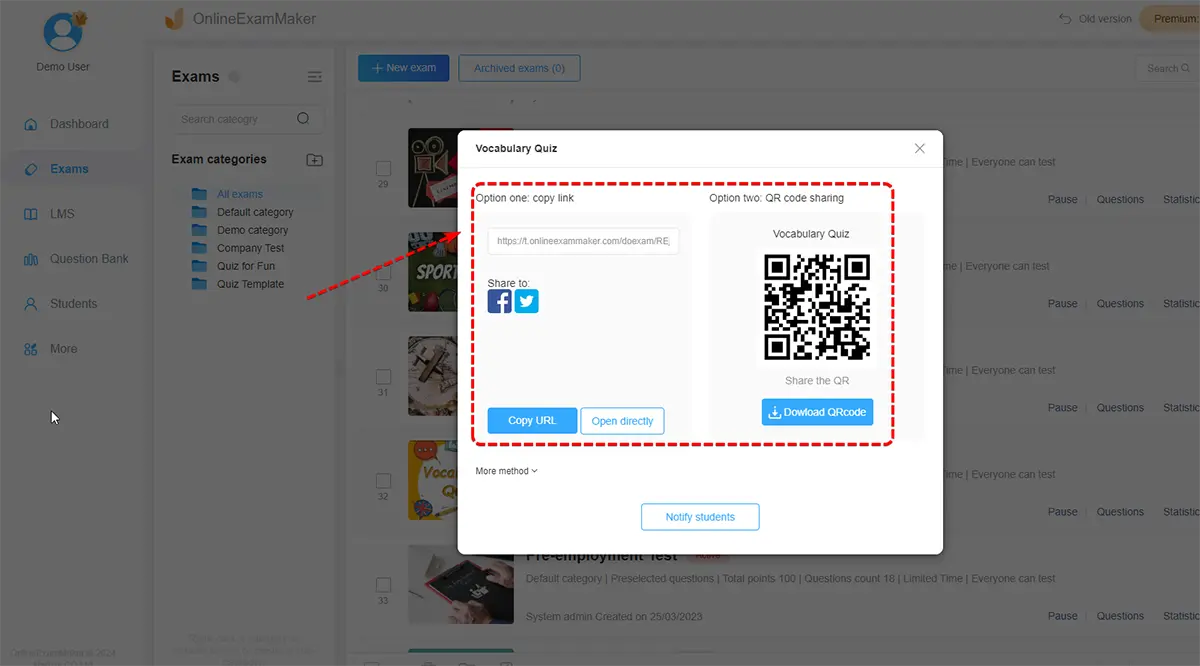
- Publish and share. Send the exam link. Results and auto-graded scores populate your dashboard in real time.
- Design higher-order questions. Focus on case-based prompts, scenario analysis, or multi-step problems. The AI Question Generator can help draft these — just specify that you want application-level or analysis-level questions.
- Disable the countdown timer. Set an availability window instead (e.g., the exam is open from Monday 8 AM to Wednesday 11:59 PM).
- Allow resource access. Since open-book is the intent, configure settings to permit reference materials. You may still want to restrict copy-paste from outside the exam to keep responses original.
- Use Automatic Grading for objective components. For open-ended responses, review them manually using the grading dashboard, which organizes submissions cleanly for efficient review.
- Share results and feedback. Students can receive their scores and feedback automatically upon completion, which closes the learning loop faster than traditional grading cycles.
- What is the primary skill being assessed? Recall → timed. Application/analysis → open-duration.
- Does speed matter for this skill in real life? If yes, use a timed format. If no, don’t penalize slow thinkers.
- How high are the stakes? Higher stakes warrant more integrity controls — timed + proctored, or carefully designed open-duration tasks.
- What are the equity considerations? Think about who might be disadvantaged by a strict clock before you default to one.
- What’s your cohort size and logistics capacity? Large groups often benefit from timed exams for scheduling simplicity; smaller groups have more flexibility.
Setting Up an Open-Duration Test
Practical Decision Framework
Before committing to a format, run through this short checklist:
When in doubt, consider a blended approach: a short timed component for breadth and fluency, plus an open-duration task for depth. Many effective assessments use exactly this structure — and OnlineExamMaker lets you run both within the same course environment.
Choosing Format as a Pedagogical Act
There is no universally superior exam format. That answer is boring, but it’s true. A timed exam is not inherently unfair, and an open-duration test is not inherently rigorous. What matters is alignment — between the format and the skill, the format and the learner, the format and the stakes.
The instructors and trainers who get this right tend to share one habit: they treat exam format as a deliberate design choice, not a logistical default. They ask what they’re really trying to learn about their students, and they choose — or blend — formats accordingly.
If you’re ready to try that in practice, OnlineExamMaker gives you the tools to build, deploy, and grade both formats without needing a dedicated tech team or a complicated setup. Start with one exam, see how it feels, and iterate from there. That’s the same advice good assessment design gives for any learning goal: try, observe, and improve.