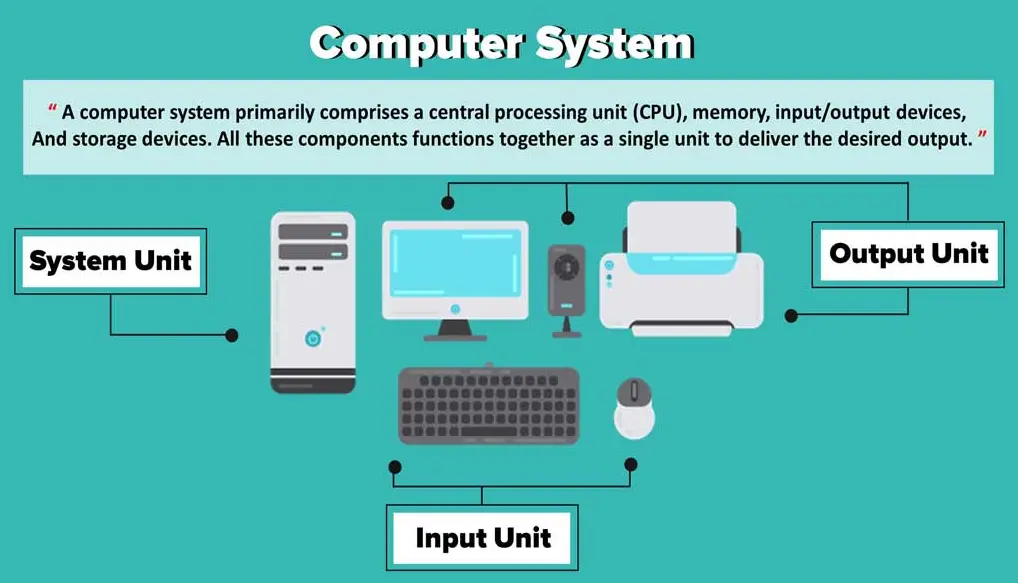
Computer systems are intricate networks of hardware and software components designed to process, store, and manage data efficiently. At their core, they include the central processing unit (CPU), which executes instructions; memory modules like RAM for temporary data handling; storage devices such as hard drives or SSDs for long-term data retention; and input/output peripherals like keyboards, mice, screens, and printers. These elements work in harmony under the guidance of an operating system, which manages resources and facilitates user interactions. Computer systems range from personal devices like laptops and smartphones to complex setups like servers and supercomputers, enabling tasks from everyday computing to advanced scientific simulations, data analysis, and artificial intelligence applications. Their evolution has revolutionized industries, communication, and daily life by providing speed, accuracy, and scalability in information processing.
Table of Contents
- Part 1: Create A Computer Systems Quiz in Minutes Using AI with OnlineExamMaker
- Part 2: 20 Computer Systems Quiz Questions & Answers
- Part 3: Save Time and Energy: Generate Quiz Questions with AI Technology
Part 1: Create A Computer Systems Quiz in Minutes Using AI with OnlineExamMaker
When it comes to ease of creating a Computer Systems skills assessment, OnlineExamMaker is one of the best AI-powered quiz making software for your institutions or businesses. With its AI Question Generator, just upload a document or input keywords about your assessment topic, you can generate high-quality quiz questions on any topic, difficulty level, and format.
Overview of its key assessment-related features:
● AI Question Generator to help you save time in creating quiz questions automatically.
● Share your online exam with audiences on social platforms like Facebook, Twitter, Reddit and more.
● Instantly scores objective questions and subjective answers use rubric-based scoring for consistency.
● Simply copy and insert a few lines of embed codes to display your online exams on your website or WordPress blog.
Automatically generate questions using AI
Part 2: 20 Computer Systems Quiz Questions & Answers
or
1. Question: What is the primary function of the CPU in a computer system?
A. To store data permanently
B. To process instructions and perform calculations
C. To display output on the screen
D. To provide power to the system
Answer: B
Explanation: The CPU, or Central Processing Unit, executes instructions from programs and performs the majority of processing tasks.
2. Question: Which component of a computer system is volatile and loses its content when power is turned off?
A. Hard disk drive
B. RAM
C. ROM
D. SSD
Answer: B
Explanation: RAM (Random Access Memory) is volatile memory, meaning it stores data temporarily while the computer is running and clears when powered off.
3. Question: What does an operating system primarily manage in a computer?
A. Internet browsing
B. Hardware resources and software applications
C. Word processing
D. Graphics rendering
Answer: B
Explanation: An operating system manages hardware components, memory, and processes to ensure efficient operation of software applications.
4. Question: In binary representation, what is the decimal equivalent of the binary number 1010?
A. 8
B. 10
C. 12
D. 14
Answer: B
Explanation: Binary 1010 equals 1*8 + 0*4 + 1*2 + 0*1 = 10 in decimal.
5. Question: Which storage device uses spinning disks to read and write data?
A. SSD
B. USB flash drive
C. HDD
D. RAM
Answer: C
Explanation: HDD (Hard Disk Drive) uses magnetic rotating disks to store and retrieve data.
6. Question: What is the purpose of a motherboard in a computer system?
A. To connect all internal components
B. To provide external ports only
C. To run software applications
D. To cool the CPU
Answer: A
Explanation: The motherboard is the main circuit board that connects the CPU, memory, and other components, allowing them to communicate.
7. Question: Which of the following is an input device?
A. Monitor
B. Printer
C. Keyboard
D. Speakers
Answer: C
Explanation: A keyboard allows users to input data and commands into the computer.
8. Question: What type of software translates high-level programming code into machine code?
A. Operating system
B. Compiler
C. Web browser
D. Database
Answer: B
Explanation: A compiler converts source code written in a high-level language into executable machine code.
9. Question: In a computer network, what does IP stand for?
A. Internet Protocol
B. Internal Processor
C. Information Processor
D. Integrated Program
Answer: A
Explanation: IP (Internet Protocol) is a set of rules for routing and addressing packets of data so they can travel across networks.
10. Question: What is the boot process in a computer?
A. Shutting down the system
B. Loading the operating system into memory
C. Deleting files
D. Running antivirus scans
Answer: B
Explanation: The boot process initializes hardware and loads the operating system from storage into RAM to start the computer.
11. Question: Which memory is fastest and located closest to the CPU?
A. Hard drive
B. Cache memory
C. RAM
D. ROM
Answer: B
Explanation: Cache memory is a small, high-speed memory that stores frequently used data for quick CPU access.
12. Question: What is the role of registers in a CPU?
A. To store large amounts of data
B. To hold data temporarily during processing
C. To connect to external devices
D. To display graphics
Answer: B
Explanation: Registers are small, fast storage locations within the CPU that temporarily hold data and instructions for immediate use.
13. Question: Which bus in a computer system transfers data between the CPU and memory?
A. Address bus
B. Data bus
C. Control bus
D. Expansion bus
Answer: B
Explanation: The data bus carries actual data between the CPU, memory, and other components.
14. Question: What does BIOS stand for in computer systems?
A. Basic Input Output System
B. Binary Input Output Software
C. Built-in Operating System
D. Basic Interface for Operations
Answer: A
Explanation: BIOS (Basic Input Output System) is firmware that initializes hardware during the boot process and provides runtime services.
15. Question: What is virtual memory in an operating system?
A. Physical RAM installed in the computer
B. A technique using hard drive space as an extension of RAM
C. A type of CPU cache
D. External storage devices
Answer: B
Explanation: Virtual memory allows the OS to use disk space as if it were additional RAM when physical memory is insufficient.
16. Question: Which process allows a computer to run multiple programs simultaneously?
A. Single-tasking
B. Multitasking
C. Booting
D. Compiling
Answer: B
Explanation: Multitasking enables the OS to switch between multiple tasks or programs, giving the illusion of simultaneous execution.
17. Question: What is a file system in computer storage?
A. A method to organize and manage files on storage devices
B. A type of software application
C. A network protocol
D. A CPU component
Answer: A
Explanation: A file system structures how data is stored, accessed, and managed on devices like hard drives.
18. Question: Which technology ensures data security by converting it into a code?
A. Compression
B. Encryption
C. Defragmentation
D. Formatting
Answer: B
Explanation: Encryption transforms readable data into a secure format using algorithms, protecting it from unauthorized access.
19. Question: What is cloud computing?
A. Storing data on a local hard drive
B. Using remote servers over the internet for data storage and processing
C. Running software on a personal computer
D. Printing documents wirelessly
Answer: B
Explanation: Cloud computing delivers services like storage and computing power via the internet from remote servers.
20. Question: Which protocol is used for sending emails?
A. HTTP
B. FTP
C. SMTP
D. TCP
Answer: C
Explanation: SMTP (Simple Mail Transfer Protocol) is specifically designed for sending and relaying email messages between servers.
or
Part 3: Save Time and Energy: Generate Quiz Questions with AI Technology
Automatically generate questions using AI