- Why Timed First Aid Tests Matter
- Step 1: Plan Your Test and Question Bank
- Step 2: Set Up OnlineExamMaker and Add Questions
- Step 3: Build and Configure the Timed Exam
- Step 4: Preview, Publish, and Deliver
- Step 5: Analyze Results and Improve Training
- Best Practices for First Aid Knowledge Assessment
Why Timed First Aid Tests Actually Matter
Cardiac arrest has a survival window measured in minutes. A colleague might know — vaguely — that CPR involves chest compressions, but does that knowledge hold up under pressure, with a crowd watching and a clock ticking? That gap is exactly what timed testing is designed to reveal.
OnlineExamMaker is an online exam platform that lets trainers, HR managers, and educators build professional, timed assessments without needing an IT department. Here’s how to go from zero to a published first aid test in five steps.
Step 1: Plan Your Test and Question Bank
Start with a clear objective: what should a learner be able to do after passing this test? Anchor your questions around specific, observable skills — correct CPR compression rate, AED pad placement, bleeding control technique, and how to communicate clearly with emergency dispatchers.
Cover the full emergency spectrum in your question bank:
- CPR & AED — compression depth, rescue breaths, AED steps
- Bleeding & Shock — direct pressure, tourniquet use, recognition
- Choking & Burns — back blows vs. abdominal thrusts, cooling methods
- Emergency Communication — what to say, what information to give
Mix simple recall questions with scenario-based items that test decision-making under time pressure — those are the ones that separate prepared responders from the rest.
Create Your Next Quiz/Exam Using AI in OnlineExamMaker
Step 2: Set Up OnlineExamMaker and Add Questions
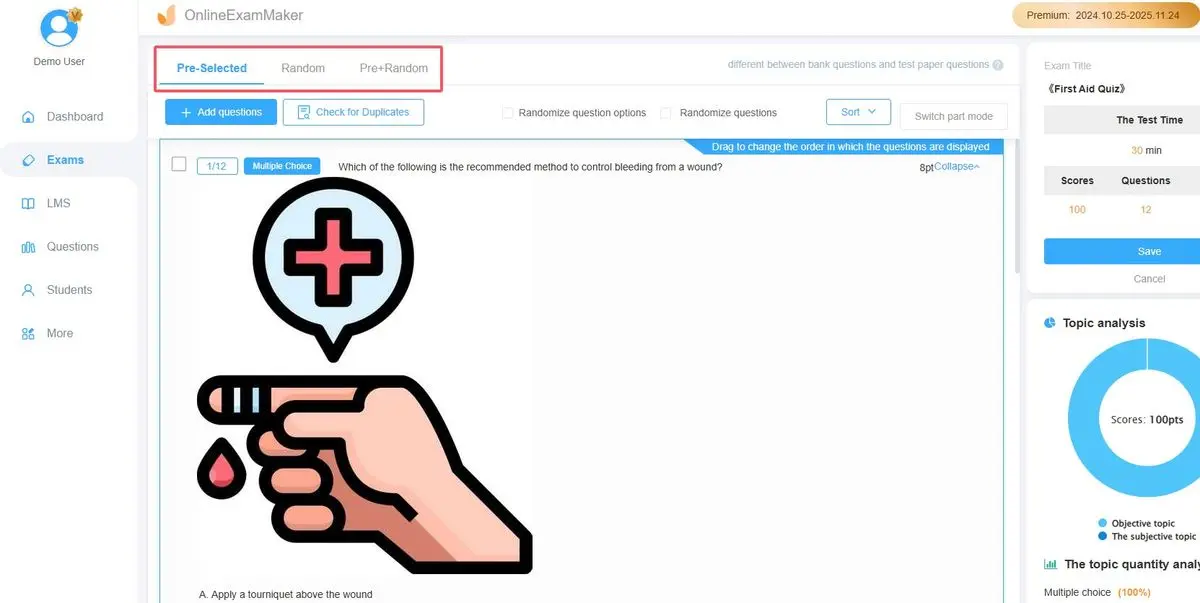
Sign up at OnlineExamMaker and go to the Question Bank section first. Think of it as your ingredient pantry — build it once, reuse it across every test you create.
You have three ways to add questions: bulk import from Word or Excel (fastest if you have existing content), manual entry for precision on critical scenarios, or the AI question generator — useful for drafts, but always review AI-generated first aid content carefully before publishing.
Organize questions into categories like “CPR & AED,” “Bleeding & Shock,” and “Emergency Communication.” This pays off immediately when building balanced exams.
Step 3: Build and Configure the Timed Exam
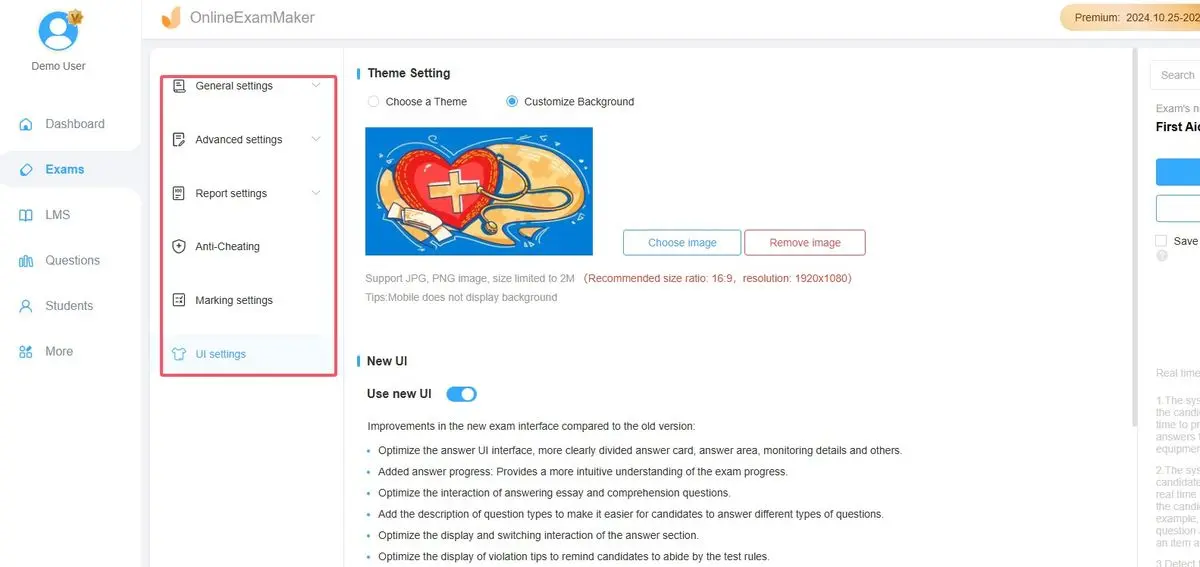
Create a new exam with a clear title — “Workplace First Aid Emergency Response – Timed Assessment” — and pull questions from your bank. A solid 20-question test balances all topic categories and mixes difficulty: roughly 40% easy, 40% moderate, 20% challenging.
Then configure the key settings:
| Setting | Recommendation |
|---|---|
| Time limit | 60–90 sec per MCQ; up to 2 min for scenario questions |
| Auto-submit on expiry | Yes — mirrors real emergency urgency |
| Question randomization | On — prevents answer-sharing in group sessions |
| Backward navigation | Off for realistic pressure; on for practice tests |
| Passing threshold | 70–80%, matching standard first aid programs |
Set an active time window if you want the test available only during a scheduled session or the week following a drill.
Step 4: Preview, Publish, and Deliver
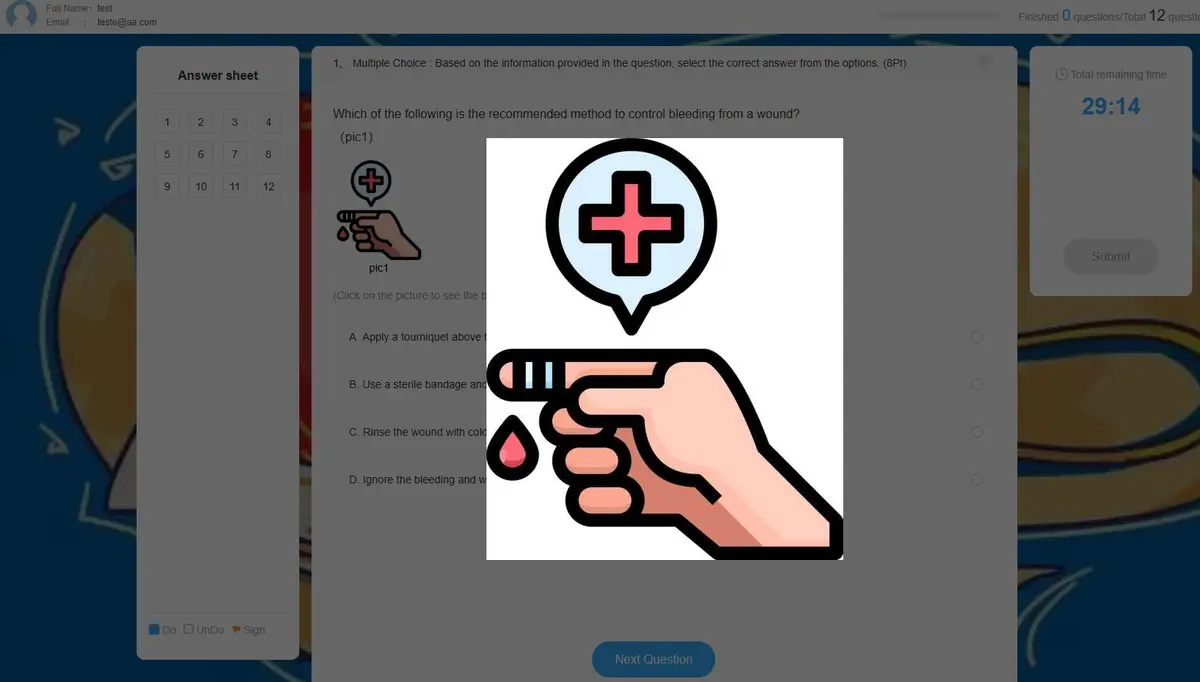
Use the preview function to take the test yourself before anyone else does. Watch the countdown, read every question cold, and ask honestly: is the time limit realistic for someone encountering these scenarios for the first time? Run a quick pilot with 3–5 colleagues and adjust based on their feedback.
Once satisfied, publish. OnlineExamMaker generates a shareable link and QR code. The QR code is particularly useful during live drills — participants scan, start, and complete a 10-minute post-drill assessment with zero logistics overhead.
Step 5: Analyze Results and Improve Training
After your cohort completes the test, dig into topic-level analytics. If 80% of your team answered CPR questions correctly but only 45% got emergency communication right, that’s your next training focus — not another CPR refresher.
Check completion rates too. If many participants ran out of time, your limit may be too tight or your scenario questions too wordy. Refine, re-pilot, republish. Make this an annual habit, and update your question bank whenever first aid guidelines change.
Best Practices for Effective Timed First Aid Exams
- Use plain language. “Unconscious and not breathing” beats medical jargon for a general workforce.
- Weight critical questions higher. A question about CPR compression depth matters more than a trivia question — assign points accordingly.
- Tie scenarios to real settings. “In the break room on the 3rd floor…” is more engaging and realistic than a generic prompt.
- Review annually. CPR and first aid best practices evolve — keep your question bank current.
