Here is a sobering fact: over one-third of all workplace injuries happen to employees with less than one year on the job. New hires haven’t yet built the reflexive hazard awareness experienced workers take for granted — and they are often too eager to impress to ask questions or slow down.
The result is a dangerous, entirely preventable knowledge gap. Poor safety onboarding leads to OSHA citations, costly workers’ compensation claims, and lasting damage to team morale. This guide walks HR managers, safety officers, supervisors, and manufacturing team leads through a clear, step-by-step approach to building new-hire safety training that genuinely works.
- Step 1: Clarify Your Goals and Scope
- Step 2: Analyze Hazards and Training Needs
- Step 3: Cover the Core Safety Topics
- Step 4: Design a Structured Training Program
- Step 5: Use OnlineExamMaker to Assess and Track Training
- Step 6: Reinforce Safety Culture and Schedule Refreshers
- Adapting Safety Training for Different Work Environments
- Conclusion
Step 1: Clarify Your Goals and Scope
Before you write a single slide or film a single video, get specific about what you are actually trying to achieve. Vague goals produce vague training — and vague training leaves dangerous gaps.
Start by asking these questions:
- What types of injuries are most common among your new hires?
- Which OSHA standards apply to your industry and job roles?
- What company-specific policies must every employee know on day one?
- Which departments or roles need job-specific modules beyond the general orientation?
A warehouse operative needs lockout/tagout awareness and forklift pedestrian safety. A remote worker needs home-office ergonomics and lone-worker protocols. One generic program serving everyone equally is a recipe for disengaged learners and missed hazards.
Step 2: Analyze Hazards and Training Needs
Think of this as your research phase — skip it and your training will miss the mark. Start with a general workplace hazard assessment covering universal risks: slips, trips, falls, ergonomic strain, fire safety, and emergency exit access.
Then go deeper with Job Hazard Analyses (JHAs) for high-risk roles — documenting each task, its specific hazards, and the safe practices required. Pull your incident and near-miss reports too. Injury trends are a goldmine for prioritization, and real examples make training feel relevant rather than theoretical.
Step 3: Cover the Core Safety Topics
Regardless of role, every new hire needs this common baseline before starting work:
| Topic | What to Cover |
|---|---|
| Emergency Procedures | Alarms, evacuation routes, assembly points, emergency contacts |
| Hazard Communication | Labels, safety data sheets (SDS), OSHA HazCom basics |
| Personal Protective Equipment | When required, correct fit, care and storage |
| Physical Hazards | Slips/trips/falls, safe lifting, ergonomics, ladder use |
| Incident Reporting | How to report injuries and near misses; right to stop unsafe work |
| Company Safety Philosophy | Responsibilities, reporting culture, who to contact for support |
A helpful mental model: the “Four Ps” — People, Places, PPE, and Personal Accountability. Simple enough to remember on day one, sticky enough to apply on day 365.
Step 4: Design a Structured Training Program
Nobody learns from a four-hour slide marathon — spread training deliberately across the first weeks on the job:
- Day 1: Core policies, emergency procedures, and a guided facility walk-through
- Week 1: Role-specific hazard training, PPE fitting and practice, mentor assignment
- 30/60/90 days: Follow-up modules, knowledge checks, and supervisor check-ins
Mix delivery formats: in-person demonstrations, short video segments, hands-on equipment practice, and bite-sized microlearning modules. Use sign-off checklists to ensure every new hire gets consistent coverage — not just whoever happens to be around on orientation day.
Assign each new hire a trained safety mentor for the first few weeks. The mentor’s job is to reinforce procedures in real time, model safe behaviors, and answer questions new employees might feel embarrassed to raise in a group. This single step dramatically reduces the gap between classroom learning and on-the-job reality.
Step 5: Use OnlineExamMaker to Assess and Track Training
OnlineExamMaker is a professional online assessment platform built to help you create, deliver, and track safety training evaluations at scale — no IT support or complicated setup required.
How to Create a Safety Assessment with OnlineExamMaker
- Build your quiz: Create multiple-choice, true/false, and scenario-based questions covering emergency procedures, PPE usage, and hazard reporting. Use the AI Question Generator to rapidly produce a full question bank directly from your existing training materials.
- Automate grading: Automatic Grading scores results instantly and flags anyone below the passing threshold — saving hours of manual review and ensuring prompt retraining.
- Protect assessment integrity: For high-stakes certifications like forklift operation or chemical handling, AI Webcam Proctoring monitors quiz sessions and keeps your compliance records credible.
- Track completion in real time: The live dashboard shows who has completed which modules — essential for OSHA audits, insurance reviews, and annual compliance reporting.
- Issue completion certificates: Automatically generate branded, downloadable certificates after each module, building a documented training trail for every employee.
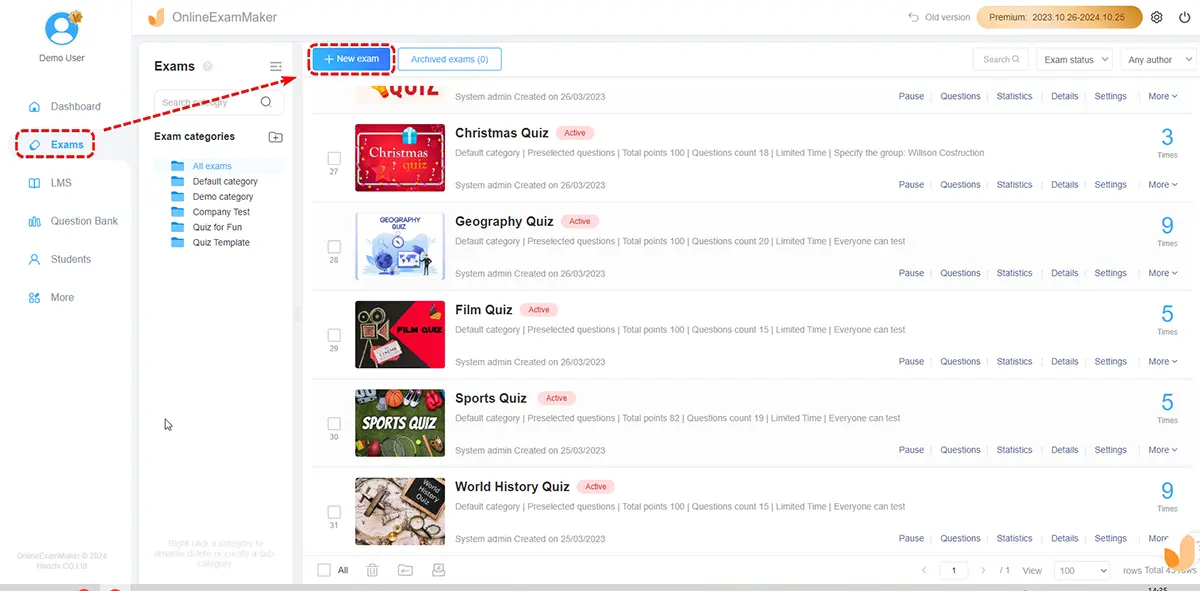
Ready to modernize your safety training?
Try OnlineExamMaker for free — build your first workplace safety assessment in minutes, track completions in real time, and keep your compliance records airtight.
Create Your Next Quiz/Exam Using AI in OnlineExamMaker
Step 6: Reinforce Safety Culture and Schedule Refreshers
Training is a tool. Culture determines whether it gets used. New employees take their cues from leadership — if a manager walks past a hazard without addressing it, that silence communicates more than any orientation video.
Set clear expectations from day one: safety performance is just as important as productivity. Celebrate near-miss reports as wins. Share real examples where a sharp observation prevented injury. Make speaking up feel safe — employees who fear being seen as slow or difficult will quietly skip the very precautions designed to protect them.
Back this up with a safety training matrix mapping required topics, roles, and training timelines. Schedule regular toolbox talks to reinforce key points between formal sessions, and update all materials whenever equipment, processes, or regulations change.
Adapting Safety Training for Different Work Environments
The underlying principles are universal — but hazards differ dramatically by setting. Tailor your program with environment-specific modules:
- Office: Ergonomics, slip and trip prevention, emergency procedures, and psychosocial risks like workplace stress
- Industrial/Warehouse: Machine guarding, forklift and pedestrian zones, PPE, lockout/tagout, and manual material handling
- Remote/Hybrid: Home-office ergonomics, lone-worker communication protocols, and off-site incident reporting
A strong core module with targeted role-specific additions is all it takes — no need to rebuild from scratch.
Conclusion
Effective new-hire safety training is a system, not a single event. It begins with hazard assessment, moves through deliberate design and engaging delivery, and continues with consistent reinforcement and ongoing improvement. Organizations that get this right don’t just record fewer injuries — they build more confident employees and stronger safety cultures.
Start with a solid first-day safety checklist. Document everything. Ask new hires for feedback — they often notice hazards veterans stopped seeing long ago. And use tools like OnlineExamMaker to make assessment and compliance tracking manageable at any scale.
Your newest employees are your most vulnerable. Give them the knowledge, tools, and confidence to work safely from the moment they walk through your door — because that is not just good compliance. That is good leadership.