Online exam platforms have made it easier than ever for teachers, trainers, HR managers, and enterprise teams to run assessments at scale. ClassMarker is one of the more popular choices — and for good reason. It’s fast to set up, reasonably priced for occasional use, and doesn’t require any technical know-how. But as your organization grows, or as your compliance requirements tighten, a hosted-only platform can start to feel like a borrowed kitchen: convenient, but not quite yours.
That’s where a self-hosted ClassMarker alternative starts to look attractive. Instead of storing exam data, learner records, and question banks on a third-party server you don’t fully control, you run the software on your own infrastructure. The result? More control, more customization, and fewer surprises.
Here are seven solid reasons why organizations are making the switch.
Every time a learner submits an exam on a hosted platform, their results, personal details, and even the questions themselves live on someone else’s server. For most casual use cases, that’s fine. For a hospital training its staff on patient protocols, or a financial firm running compliance certifications? That’s a harder conversation.
Self-hosting keeps everything — question banks, grades, identifiable user data — inside your own environment. You decide who has access, how long data is retained, and what happens when someone requests deletion. You’re not subject to a vendor’s privacy policy update at 3am on a Tuesday.
Reason 2: Easier Compliance With Industry and Regional Regulations
Regulated industries aren’t just cautious about privacy — they’re legally obligated to be. Education institutions in Europe deal with GDPR. Healthcare organizations in the US navigate HIPAA. Government contractors have their own playbooks. A SaaS exam platform may claim compliance, but you’re still trusting them to stay compliant over time.
With a self-hosted solution, you choose the data center, set the backup schedule, define the audit trail, and control who gets access to logs. That level of specificity is nearly impossible to achieve with a shared-infrastructure hosted tool.
According to eLearning Industry, self-hosting gives organizations the ability to implement their own compliance frameworks rather than adapting workflows to fit a vendor’s limitations.
Reason 3: Deep Branding and UX Customization
There’s a subtle but real difference between an exam that opens on your branded portal and one that loads under a third-party domain with a small logo swap in the corner. Learners notice. Certification recipients notice. Clients notice.
Hosted platforms like ClassMarker offer theming options, but you’re still working inside their interface. With a self-hosted alternative, you can match your exam environment exactly to your website — same fonts, same color system, same navigation patterns, same URL. It doesn’t feel like a detour; it feels like a natural part of your product.
For organizations running paid certifications or professional training programs, this level of brand cohesion directly affects perceived credibility — and conversion rates. A slick, fully branded exam experience says “we built this.” A white-labeled SaaS page says “we rented this.”
Reason 4: Flexible Integrations and Automation
ClassMarker does offer APIs and webhooks, which is useful. But you’re working within their rate limits, their data formats, and — most importantly — their feature roadmap. If you need a workflow they haven’t built yet, you wait.
Self-hosted exam software, on the other hand, can be wired directly into your LMS, HRIS, CRM, or internal portals. Imagine this: a new employee is added to your HR system, they’re automatically enrolled in a role-specific onboarding exam, they complete it, and the results are written back into their employee record — all without manual intervention. That’s not a fantasy; it’s what tight integrations make possible.
As highlighted by eLearning Industry, self-hosting enables organizations to build assessment workflows that fit their existing systems, rather than bending their systems to fit an exam tool.
Reason 5: Cost Structure and Scalability on Your Terms
Hosted exam platforms often charge per attempt, per user, or per credit. That’s manageable when you’re running a handful of tests a month. It becomes a very different calculation when you’re running 10,000 employee certifications annually — or when exam season hits and usage spikes 4x for three weeks.
Self-hosting shifts costs toward infrastructure and licensing, which are more predictable over time. You scale your server capacity to match your actual usage peaks — not your vendor’s pricing tiers. For high-volume testing environments, the economics of self-hosting almost always win in the long run.
Coursevector’s analysis on self-hosting costs makes this point clearly: the upfront investment in self-hosted infrastructure pays back quickly when usage volume is consistent or high.
Reason 6: Reliability, Performance, and Exam Security Under Your Control
Shared cloud infrastructure means shared risk. When a hosted exam platform has downtime — even for 20 minutes — every organization on that platform is affected. If your 500-person certification window is open that afternoon, you have a problem you didn’t cause and can’t fix.
Self-hosting lets you architect redundancy specifically around your exam schedule. You can set up monitoring, load balancing, and failover systems that are tuned to your needs — not averaged across thousands of customers.
Security gets a similar upgrade. With self-hosted software, you can add layers that a public SaaS platform simply can’t offer: VPN-restricted access, SSO tied to your identity provider, internal-only delivery, and custom network rules. Testportal’s comparison page reinforces this point — exam integrity is much harder to guarantee when the platform is public by default.
Reason 7: Long-Term Strategic Independence From Vendors
Here’s a scenario no one plans for: your exam platform raises prices by 40%, removes a feature you depend on, or gets acquired and pivots away from education. What’s your plan?
Vendor lock-in is a real strategic risk, especially when your assessment program is central to onboarding, compliance, or product certification. A self-hosted platform gives you control over update cadence, feature priorities, and long-term roadmap. You’re not at the mercy of an external product team.
As eLearning Industry points out, owning your hosting environment means you can build a durable training or certification program without the risk of forced migration every time a vendor changes direction.
When a Self-Hosted ClassMarker Alternative Makes Sense
How to Get Started With OnlineExamMaker Self-Hosted
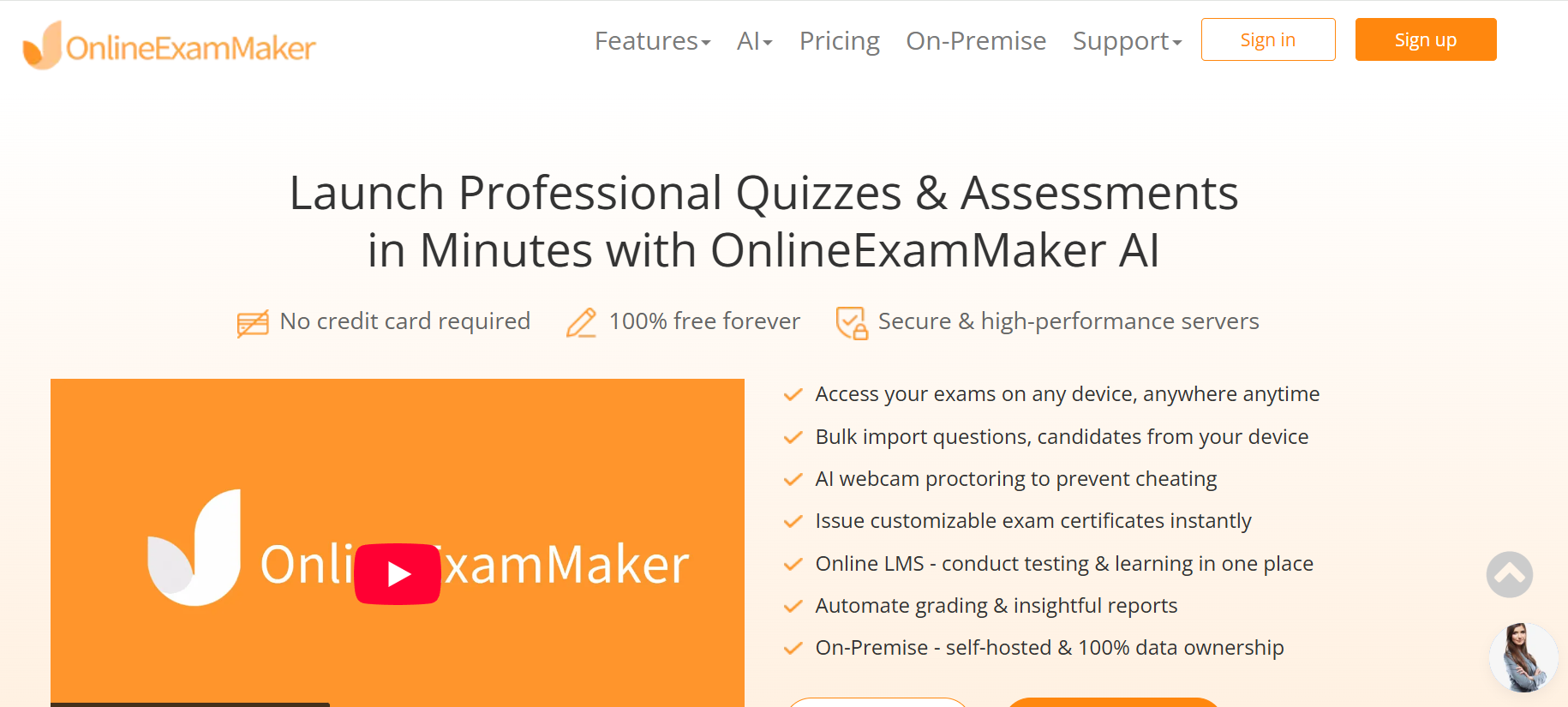
One platform worth serious consideration is OnlineExamMaker — an exam and quiz platform that offers both a cloud-hosted SaaS option and a full on-premise, self-hosted deployment. That dual-mode approach is rare and genuinely useful: you can start in the cloud, then migrate to self-hosted when your organization is ready, without switching platforms entirely.
Here’s what makes it a strong self-hosted ClassMarker alternative specifically:
100% data ownership — your exam data, question banks, and results stay entirely within your infrastructure.
AI Question Generator — build question banks fast using AI that creates questions from uploaded documents, topics, or keywords. Huge time-saver for trainers and curriculum designers.
Automatic Grading — results are scored instantly, including support for open-ended questions. No more manual marking queues.
AI Webcam Proctoring — built-in anti-cheating tools using AI webcam monitoring, tab-switch detection, and randomized question pools. Serious exam integrity without a separate proctoring subscription.
Custom branding — your domain, your logo, your colors. The exam experience looks like yours from start to finish.
Flexible integrations — connect with your existing HR, LMS, or training systems.
Create Your Next Quiz/Exam Using AI in OnlineExamMaker
Set up your server environment — the platform supports standard Linux/Windows server setups. Documentation walks you through dependencies and configuration.
Configure your domain and SSL — point your subdomain (e.g., exams.yourcompany.com) to the server and enable HTTPS.
Import or build your question banks — use the AI Question Generator to accelerate this step significantly.
Set up user management — connect your SSO or LDAP, or manage users directly within the platform.
Run a pilot exam — test with a small group, review the results dashboard, and confirm everything is working as expected before going org-wide.
Most teams are running live exams within a day of setup. And because OnlineExamMaker keeps the admin interface clean and intuitive, you won’t need to train your HR team on complicated software.
Conclusion
ClassMarker and platforms like it are genuinely useful tools. For teams running occasional tests without heavy compliance requirements, they do the job cleanly. But for organizations that need to own their data, meet regulatory standards, integrate deeply with existing systems, and project a consistent brand — a self-hosted solution is the more durable choice.
The decision isn’t about which platform has more features. It’s about who’s in control. With a self-hosted ClassMarker alternative like OnlineExamMaker, that answer is clear: you are.
Evaluate your total cost of ownership, your data sensitivity, and your integration requirements. If any of those factors are pulling you toward more control — it’s worth taking a closer look at what self-hosting can offer.