- Why Question Types Matter in Teaching and Training
- 1. Closed Questions
- 2. Open Questions
- 3. Divergent Questions
- 4. Convergent Questions
- 5. Referential Questions
- 6. Probing Questions
- 7. Leading Questions
- 8. Focal Questions
- 9. Affective Questions
- 10. Application Questions
- Building Your Question Bank with OnlineExamMaker
- Quick Reference: 10 Question Types at a Glance
- Final Thoughts
Why Question Types Matter in Teaching and Training

Ask any experienced teacher what separates a forgettable lesson from one that sticks — more often than not, it comes down to the questions. Not just how many you ask, but which kinds you reach for and when.
Questioning is one of the most powerful tools in an educator’s toolkit. It drives active learning, uncovers gaps in understanding, and pushes learners to think rather than just receive. Yet many teachers and corporate trainers still rely on the same two or three question types, leaving the rest of the toolkit untouched.
According to research on classroom questioning strategies, skilled educators who deliberately vary their question types see measurably higher engagement and retention — across subjects, age groups, and formats. Whether you’re leading a high school classroom, running a compliance training for a manufacturing team, or onboarding new HR hires, this knowledge translates directly into better outcomes.
Here are the 10 question types every educator and trainer should know — with real examples and the specific moments when each one earns its place.
1. Closed Questions
What they are: Closed questions have one correct, factual answer — typically a yes/no or a specific recall response.
Example: “Is 10 a multiple of 2?” or “What year was the company founded?”
When to use them: These are your go-to for quick knowledge checks at the start of a session. Use them to confirm that learners have the prerequisite understanding before moving on. They’re also great for attendance warm-ups, quiz openers, and compliance checkpoints where accurate recall is the goal.
They’re fast, easy to grade, and leave little room for ambiguity — which is both their strength and their limitation. Use them to check the baseline, not to build it.
2. Open Questions
What they are: Open questions invite elaboration. There’s no single right answer — learners must explain, analyze, or reflect.
Example: “How might we solve this equation differently?” or “What other approaches could the team have taken here?”
When to use them: Deploy open questions during discussions, group work, or when you want to build critical thinking and creative reasoning. They slow down the pace of a lesson — intentionally — and invite learners to articulate what they actually understand (or don’t).
For HR managers running workshops, open questions during case study debrief sessions can reveal how team members actually think about workplace problems, not just what they’ve memorized.
3. Divergent Questions
What they are: Divergent questions have no single correct answer. They’re designed to generate multiple valid perspectives and spark broad exploration.
Example: “What common theme might connect these historical events?” or “What could go wrong if we implemented this policy?”
When to use them: Brainstorming sessions, creative problem-solving workshops, and scenarios where you want to surface diverse viewpoints. In manufacturing training, divergent questions like “What are all the ways this process could be improved?” can surface insights from frontline workers that management never considered.
4. Convergent Questions
What they are: The logical counterpart to divergent questions. Convergent questions narrow multiple ideas down toward a single best answer, testing a learner’s ability to analyze and synthesize.
Example: “Given everything we’ve discussed, what one word best describes this leadership style?”
When to use them: Use them at the end of a discussion or problem-solving session to bring focus back. They’re particularly effective after brainstorming — they force learners to evaluate, prioritize, and commit to a conclusion rather than leaving everything open-ended.
5. Referential Questions
What they are: These are questions the teacher genuinely doesn’t know the answer to — they invite personal opinions, real experiences, or individual perspectives.
Example: “How do you personally use math in your day-to-day work?” or “What’s the biggest communication challenge in your team right now?”
When to use them: Referential questions are powerful for building rapport and connecting abstract concepts to real life. Trainers who use them effectively report that learners feel genuinely heard — which dramatically increases engagement. According to classroom research, this type of question is especially effective in adult learning environments where participants bring meaningful experience to the table.
6. Probing Questions
What they are: Follow-up questions that dig deeper into a learner’s initial response. They push for clarification, evidence, or further reasoning.
Example: After a learner answers, ask: “What led you to that conclusion?” or “Can you walk me through your reasoning?”
When to use them: Probing questions are most effective after an initial answer that’s on the right track but lacks depth. They signal to the learner — and to the rest of the group — that surface-level answers aren’t quite enough. Think of them as your tool for elevating discussion from what to why.
7. Leading Questions
What they are: Questions that guide a learner toward a specific answer, often by embedding a hint or logical stepping stone.
Example: “If 5 + 5 = 10, doesn’t it follow that 10 − 5 = 5?”
When to use them: Use them carefully — and sparingly. Leading questions shine when a learner is stuck and needs scaffolding to reach the answer themselves rather than being told outright. They preserve the sense of discovery while reducing frustration. In corporate training, they’re useful for guiding teams through complex policy logic without lecturing.
8. Focal Questions
What they are: Questions that require a learner to take and justify a central position on a topic.
Example: “How did the French Revolution fundamentally reshape the concept of democracy?” or “What makes this safety protocol the most critical one on the floor?”
When to use them: Focal questions are made for debates, Socratic seminars, and written assessment tasks. They demand that learners construct an argument — not just recall facts. For educators aiming to develop higher-order thinking, focal questions are among the most valuable tools available.
9. Affective Questions
What they are: Questions targeting emotions, values, and personal attitudes rather than knowledge or logic.
Example: “How do you feel after successfully solving a difficult problem?” or “What values are most important to you when making decisions under pressure?”
When to use them: These belong in social-emotional learning sessions, team culture workshops, and any training that touches on behavior change. Research consistently shows that learning with emotional resonance is retained longer. Affective questions create that resonance.
They’re also underused in corporate HR training — and that’s a missed opportunity. When employees connect new information to their own values and experiences, adoption rates climb.
10. Application Questions
What they are: Questions that ask learners to take a concept and apply it in a real-world or hypothetical practical scenario.
Example: “How could this theory apply to a challenge you’re currently facing at work?”
When to use them: These are your session-closing powerhouses. Application questions bridge the gap between knowing and doing — which is, after all, the entire point of training. They work especially well in professional development and vocational contexts, where the transfer of learning to the workplace is the ultimate measure of success.
Building Your Question Bank with OnlineExamMaker
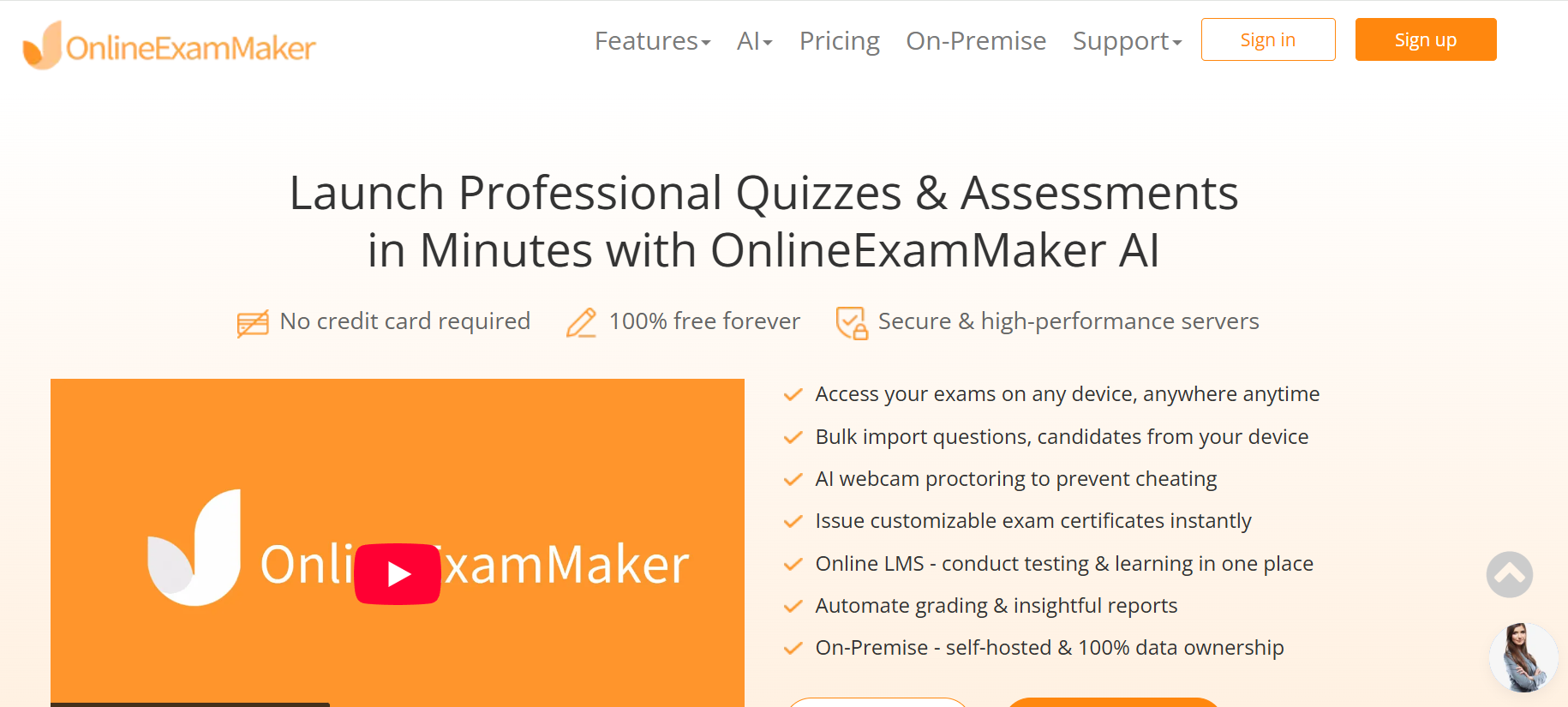
Knowing your question types is one thing. Deploying them at scale — across a department, a school year, or a company-wide training program — is where most educators and trainers hit a practical wall.
That’s where OnlineExamMaker comes in. It’s a comprehensive online assessment platform built specifically for educators, trainers, HR teams, and enterprise organizations who need to create, manage, and analyze assessments without spending hours on logistics.
At the heart of the platform is a robust assessment creator that supports all the question types covered in this article — from simple closed questions and multiple choice, to open-ended responses, fill-in-the-blank, and scenario-based application questions. You can build entire assessments from scratch, or draw from a structured question bank that grows alongside your content library.
One of the standout features is the AI Question Generator, which allows you to generate high-quality questions from any topic or uploaded material in seconds. For trainers managing tight schedules and diverse content, this is a genuine time-saver — not a gimmick.
Create Your Next Quiz/Exam Using AI in OnlineExamMaker
Once assessments go live, Automatic Grading handles the scoring — including partial-credit and complex question formats — so you get results instantly and can focus your energy on analysis rather than administration. For large manufacturing teams or HR departments running compliance assessments for hundreds of employees, this alone can save dozens of hours per cycle.
OnlineExamMaker also includes AI Webcam Proctoring for high-stakes assessments where integrity matters. The system monitors test-takers in real time, flagging unusual behavior automatically — without requiring a human proctor on the other end.
Whether you’re a teacher building end-of-unit quizzes, a corporate trainer running quarterly competency assessments, or an HR manager tracking certification compliance across multiple sites, OnlineExamMaker is built to make the whole process smoother, smarter, and more scalable.
Quick Reference: 10 Question Types at a Glance
| Question Type | Purpose | Best Used For | Example |
|---|---|---|---|
| Closed | Check factual recall | Opening quizzes, prerequisites | “Is 10 a multiple of 2?” |
| Open | Encourage elaboration | Discussions, critical thinking | “How else could we approach this?” |
| Divergent | Generate multiple perspectives | Brainstorming, creative sessions | “What themes connect these events?” |
| Convergent | Focus on one best answer | Wrap-ups, analysis tasks | “What one word describes this style?” |
| Referential | Invite personal experience | Building rapport, adult learners | “How do you use this daily?” |
| Probing | Deepen reasoning | Follow-up after initial answers | “What led you to that conclusion?” |
| Leading | Scaffold learning | Guiding stuck learners | “If A = B, wouldn’t B = A too?” |
| Focal | Justify a central position | Debates, written assessments | “How did X reshape Y?” |
| Affective | Surface emotions and values | SEL, behavior change training | “How do you feel when you succeed?” |
| Application | Connect concepts to practice | Session wrap-ups, vocational training | “How would you use this at work?” |
Final Thoughts
There’s no single “best” question type — only the right question for the right moment. The educators and trainers who get the best results aren’t necessarily the ones with the most knowledge. They’re the ones who ask the most intentional questions.
Start by picking two or three question types you don’t currently use and experimenting with them in your next low-stakes session. Notice what shifts in the room. You might be surprised how much a single well-placed probing question or affective prompt can change the quality of a conversation.
And when you’re ready to put all 10 types to work in structured assessments, OnlineExamMaker gives you the tools to build, deploy, and analyze them — at any scale, for any audience.