- Why AI Is Reshaping Talent Acquisition
- What to Look for in an AI HR Evaluation Tool
- 10 Best AI-Powered HR Evaluation Tools
- Tool Comparison by Use Case
- How to Choose the Right Tool for Your Team
- Risks and Best Practices
- Conclusion
Hiring used to be a lot of gut feeling, a tall stack of resumes, and a lot of hoping for the best. Today, HR teams are moving faster, screening smarter, and making decisions with real data behind them. The difference? AI.
Whether you’re filling 10 roles or 1,000, AI-powered HR evaluation tools are no longer a nice-to-have — they’re quickly becoming the standard. From automated skills assessments to AI video interview analysis, these platforms help you find the right people faster, with less guesswork and more consistency.
This article covers 10 of the best AI-powered HR evaluation tools available right now — what they do, who they’re best for, and how to pick the right one for your team.
Why AI Is Reshaping Talent Acquisition
The numbers tell a compelling story. According to Juicebox, AI-driven recruiting tools can reduce time-to-hire significantly while improving candidate quality — two metrics every hiring team obsesses over.
Here’s what AI actually brings to the table:
- Faster screening: Instead of manually reviewing hundreds of applications, AI ranks and filters candidates in seconds.
- Better matching: Algorithms factor in skills, experience, and even historical hiring success to surface stronger candidates.
- More consistent evaluations: Structured AI-driven interviews reduce the variability that comes from different interviewers having different standards.
- Less manual work: Scheduling, follow-ups, and status updates can all be automated, freeing recruiters for higher-value conversations.
- Reduced bias (when used well): The right tools — with the right guardrails — can help reduce unconscious bias in shortlisting and evaluation.
Of course, AI is not magic. It works best as a powerful assistant to your team, not a replacement for human judgment. More on that later.
What to Look for in an AI HR Evaluation Tool
Before jumping into the list, here’s a quick framework for evaluating any tool in this space. According to TTMS, the best platforms typically cover:
- Candidate screening accuracy and ranking quality
- Support for skills-based and competency-based assessments
- Interview transcription, summarization, and scoring
- Integrations with your ATS or HRIS
- Compliance, privacy, and fairness controls
- Analytics and reporting dashboards
Keep these in mind as you read through the tools below.
10 Best AI-Powered HR Evaluation Tools
These tools span the full talent acquisition lifecycle — from sourcing and screening, to interviewing, skills testing, and pipeline management. There’s something here for every team size and hiring style.
1. OnlineExamMaker — Best for AI-Driven Skills Assessment and Candidate Testing
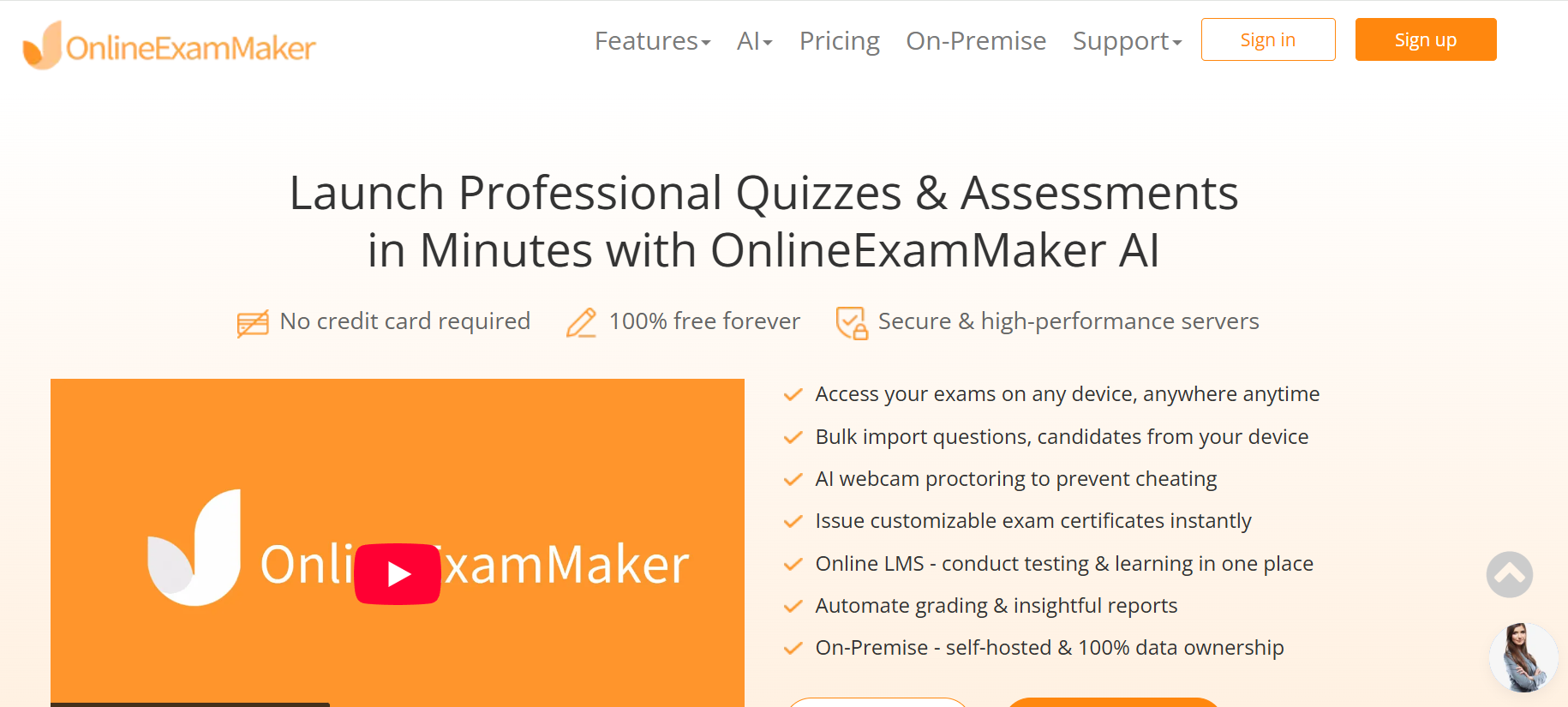
If your hiring process depends on actually knowing what a candidate can do — not just what they say on a resume — OnlineExamMaker deserves a serious look. It’s an AI-powered assessment platform built for HR teams, trainers, and enterprises that want objective, skills-first evaluation at scale.
What makes it stand out in a crowded market? A few things.
First, its AI Question Generator lets you create role-specific assessments in minutes. Instead of spending hours manually building question banks, HR teams can generate relevant, customizable questions for any role — technical, operational, or behavioral — almost instantly. That’s time back in your day.
Second, Automatic Grading means results are ready as soon as the candidate finishes. No waiting on a human reviewer to score open-ended answers. The AI handles it, and your team gets clean, consistent data across every candidate.
Third — and this is a big one for enterprise hiring — AI Webcam Proctoring ensures the integrity of every assessment. The system monitors candidates during the test, flagging suspicious behavior and keeping your evaluation process honest. For high-stakes hiring, that matters.
OnlineExamMaker is available both as a cloud-based SaaS platform (free to start) and as an on-premise solution for organizations that need full data ownership — a rare and valuable option for regulated industries like finance, healthcare, and government.
Create Your Next Quiz/Exam Using AI in OnlineExamMaker
2. HiredScore — Best for Resume Screening and Talent Matching
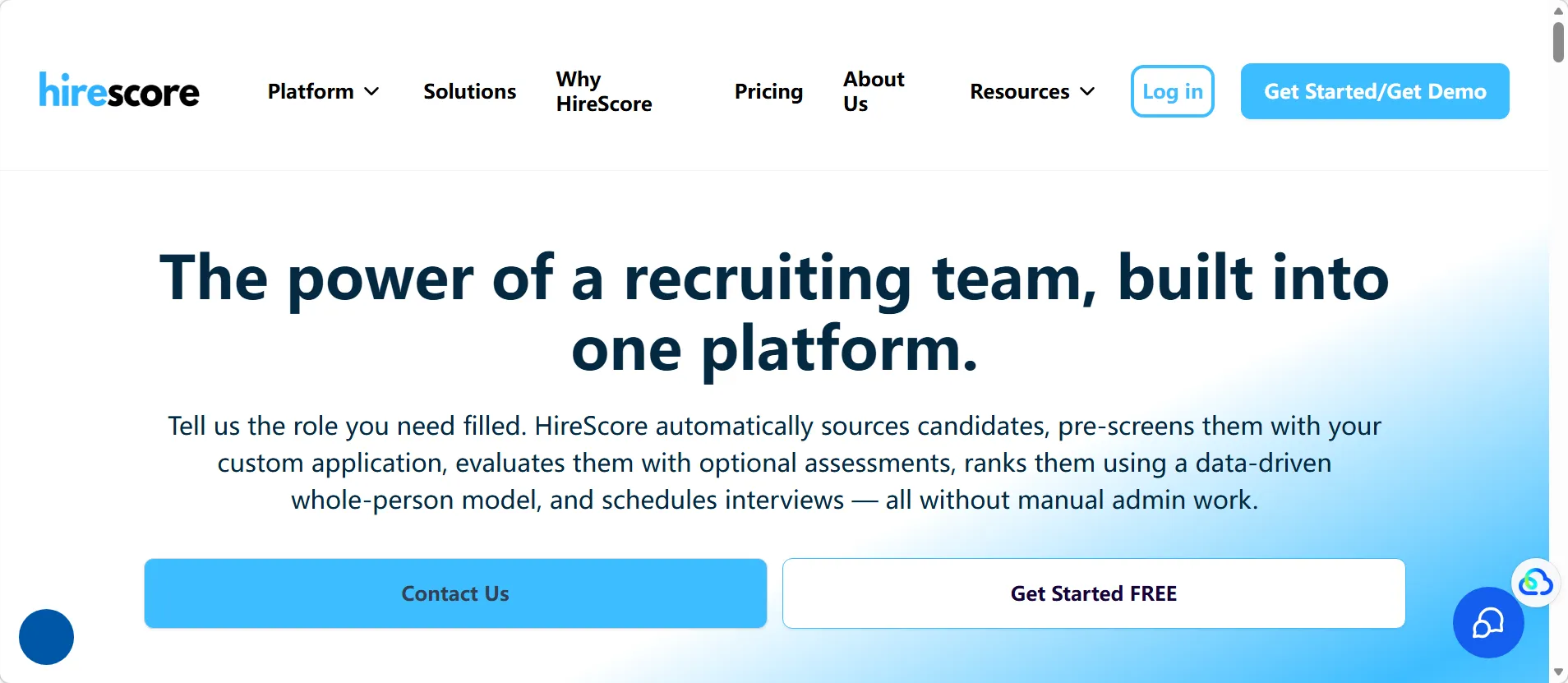
HiredScore uses AI to automatically rank and prioritize applicants based on fit, helping recruiters focus energy on the most promising candidates. It’s particularly strong at rediscovering past applicants buried in your ATS who might be a great fit for a new role. The platform puts a strong emphasis on fairness and compliance, which makes it a solid choice for enterprise teams navigating complex hiring regulations.
3. Workday Talent Acquisition with HiredScore AI — Best for Enterprise HCM Integration
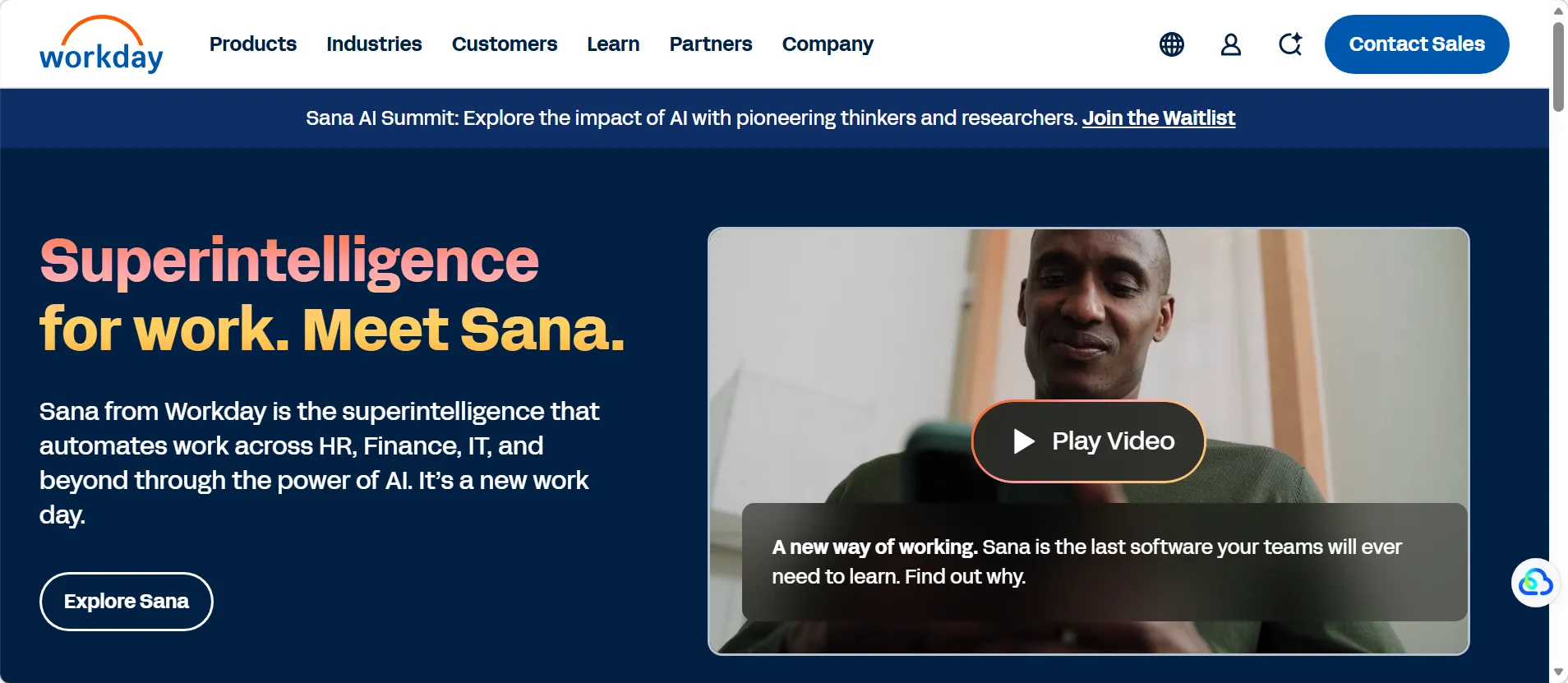
For organizations already running on Workday, the native HiredScore AI integration offers candidate prioritization, intelligent discovery, and recruiter guidance without switching platforms. According to Redbrick Labs, it’s one of the most seamless ways to embed AI into an existing enterprise hiring workflow. If you’re already deep in the Workday ecosystem, this is the natural next step.
4. HireVue — Best for AI Video Interviewing
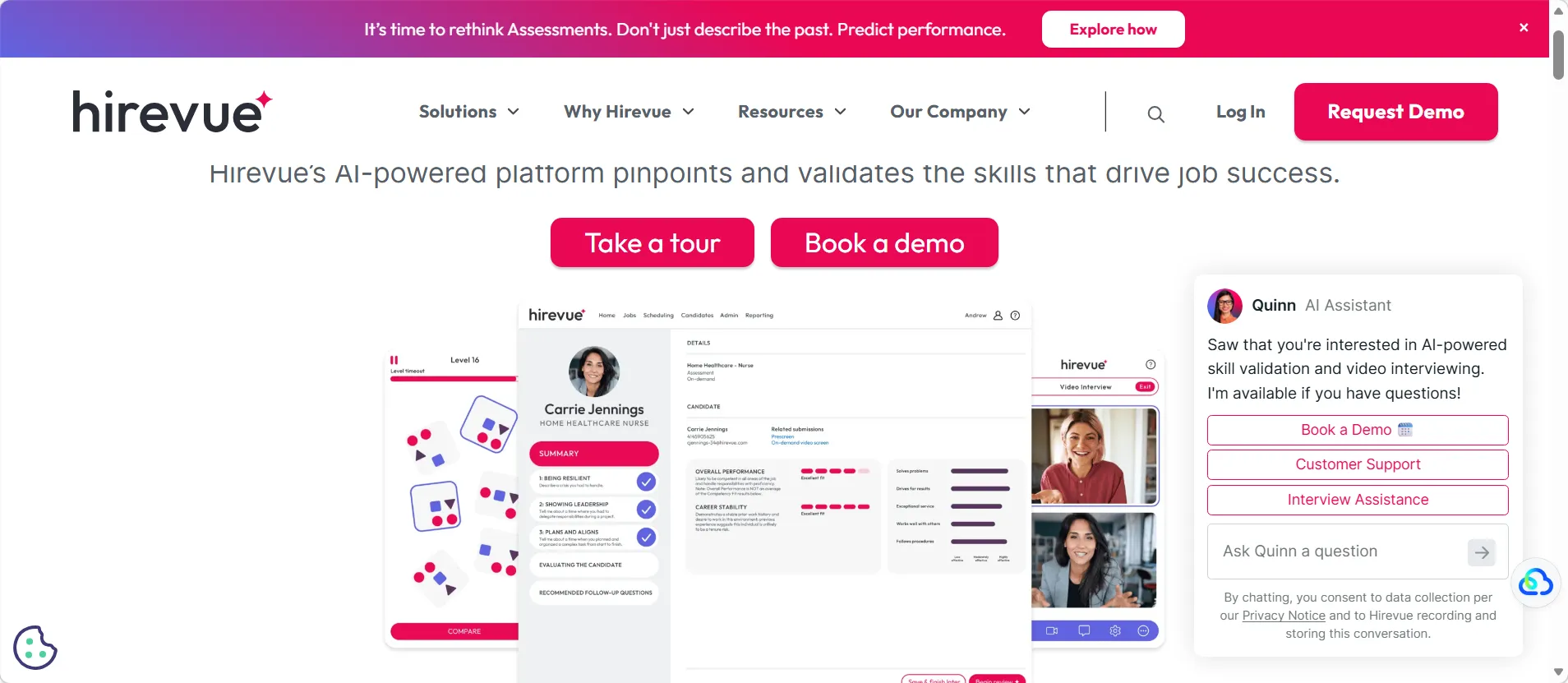
HireVue is one of the most well-known names in AI-powered interviewing. It enables asynchronous video interviews where candidates record responses to structured questions, and the AI analyzes and scores those responses for consistency and competency alignment. It’s widely used for high-volume hiring — think graduate recruitment drives and large-scale retail or logistics hiring — where evaluating every candidate in real time simply isn’t feasible.
5. Paradox — Best for Conversational Recruiting Automation
Paradox’s AI assistant “Olivia” handles candidate communication, screening questions, interview scheduling, and FAQ responses through a conversational chatbot interface. It’s remarkably good at reducing drop-off in high-volume hiring funnels — particularly for hourly, retail, and service sector roles where speed and candidate experience are everything. Per Juicebox, Paradox excels at keeping candidates engaged and moving through the pipeline without recruiter bottlenecks.
6. Eightfold AI — Best for Talent Intelligence and Internal Mobility
Eightfold goes beyond external hiring — it maps skills across your entire workforce, helping you identify internal candidates ready for promotion or redeployment alongside external applicants. Its deep skills graph is particularly powerful for enterprises doing workforce planning or building future-fit talent pipelines. As noted by Greenhouse, Eightfold is a strong fit for large organizations that think about talent holistically, not just one hire at a time.
7. SeekOut — Best for Sourcing Specialized Talent
Technical roles, niche skill sets, and hard-to-fill positions — SeekOut is built for exactly these challenges. It uses AI-powered search across publicly available candidate data to help recruiters build targeted pipelines of passive candidates who’d otherwise be invisible. It’s a strong choice for engineering, research, and specialized professional hiring where the talent pool is genuinely small.
8. Gem — Best for Pipeline Analytics and Candidate CRM
Gem functions as a CRM for recruiting — tracking candidates across the pipeline, automating outreach sequences, and giving recruiting teams visibility into funnel performance and forecast accuracy. For in-house teams managing large pipelines, Gem brings the kind of structured workflow discipline that’s usually associated with sales operations, applied directly to talent acquisition.
9. Beamery — Best for Long-Term Talent Relationship Building
Beamery is a talent lifecycle platform focused on nurturing candidate relationships over time, not just filling immediate openings. It supports career-site personalization, talent community engagement, and long-term pipeline development — making it ideal for enterprise and global hiring programs where employer brand and candidate experience are strategic priorities.
10. Canditech — Best for Job Simulations and Realistic Role Testing
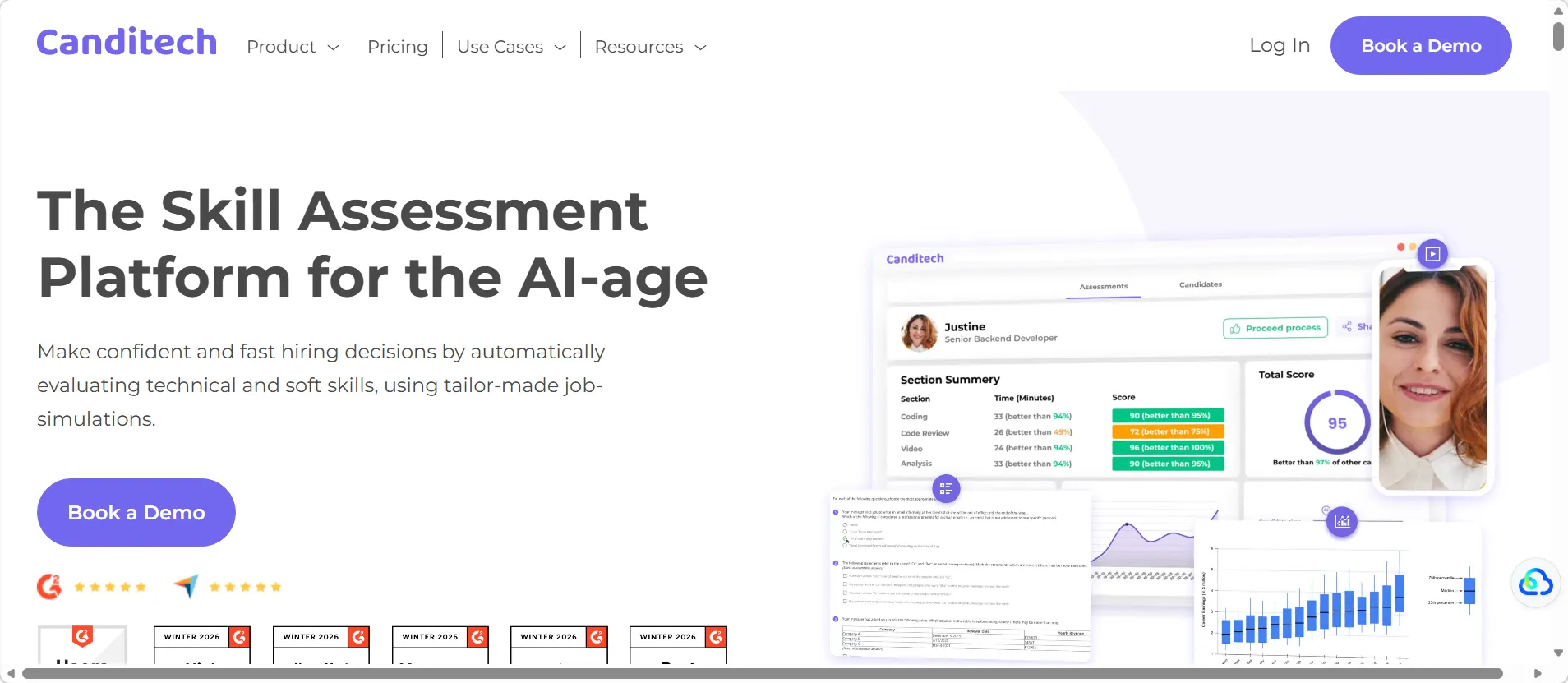
Canditech lets candidates complete realistic work samples — actual tasks they’d encounter on the job — rather than generic aptitude tests. This is particularly valuable for technical roles, creative positions, and any job where doing is a much better signal than telling. It’s a natural fit for skills-based hiring programs that want to move beyond resume screening.
Tool Comparison by Use Case
| Use Case | Best Tools |
|---|---|
| Skills assessment & testing | OnlineExamMaker, Canditech |
| Resume screening & ranking | HiredScore, Workday + HiredScore AI |
| Video & async interviewing | HireVue |
| Conversational recruiting | Paradox |
| Talent intelligence & internal mobility | Eightfold AI |
| Sourcing passive & specialist candidates | SeekOut |
| Recruiter CRM & pipeline analytics | Gem |
| Talent community & nurture | Beamery |
How to Choose the Right Tool for Your Team
There’s no universal answer — the right tool depends on where your hiring bottlenecks actually are. A few practical pointers:
- If you’re skills-first: Start with OnlineExamMaker or Canditech. Objective assessments beat gut feel every time.
- If you’re enterprise and already on Workday: The HiredScore integration is the path of least resistance.
- If you’re doing high-volume hourly hiring: Paradox’s conversational automation will save your team enormous time.
- If sourcing is your problem: SeekOut and Eightfold AI are purpose-built for finding candidates who aren’t raising their hands.
- If you need better pipeline visibility: Gem brings the analytics discipline that most recruiting teams sorely lack.
The smartest approach? Run a pilot. Pick one tool that addresses your biggest current pain point, test it on a real hiring cycle, and measure the difference before expanding.
Risks and Best Practices
AI tools are powerful, but they’re not infallible. A few things worth keeping front of mind:
- Don’t automate the final decision. AI should inform and support human judgment, not replace it.
- Audit for fairness. Review whether your tools are producing equitable outcomes across candidate groups.
- Train your team. Recruiters and hiring managers need to understand what the AI is actually measuring — and what it’s not.
- Check compliance. Privacy regulations around AI in hiring vary by jurisdiction. Know the rules where you operate.
- Use structured criteria. AI is only as good as the framework it’s scoring against. Define what “good” looks like before you let an algorithm decide.
Conclusion
The best HR teams in 2026 aren’t choosing between human and AI — they’re combining both. AI handles the scale, the consistency, and the data crunching. Humans bring context, relationship, and the final call.
Whether you need better skills assessments, smarter screening, faster scheduling, or deeper pipeline analytics, there’s a tool on this list built for exactly that problem. Start with the one that addresses your biggest current gap, run a structured pilot, and build from there.
And if you’re serious about skills-first hiring, OnlineExamMaker is worth exploring first — it’s one of the few platforms that combines AI-powered question creation, automatic grading, and secure remote proctoring in a single package, with a free tier that lets you get started without any commitment.