Image that two people sitting down to take the same first aid course. One is a seasoned nurse who could bandage a wound in the dark. The other has never touched a first aid kit in their life. Under a traditional course structure, they watch the same videos, click through the same slides, and answer the same quiz questions — at exactly the same pace.
That doesn’t make a lot of sense, does it?
This is the gap that adaptive learning is designed to close. Powered by AI, adaptive learning systems watch how you perform, pick up on where you hesitate, and quietly reshape your learning path in real time. For first aid training — where knowing the right step at the right moment can be the difference between life and death — that kind of personalisation isn’t just convenient. It’s genuinely important.
- Why One-Size-Fits-All First Aid Training Falls Short
- What Adaptive Learning Actually Means
- How AI Builds a Personalised First Aid Learning Path
- What Changes Inside an Adaptive First Aid Course
- Two Learners, One Course, Different Journeys
- Benefits for Trainers and HR Managers
- How to Create Adaptive First Aid Tests with OnlineExamMaker
- Limitations Worth Knowing
- The Future of First Aid Training
Why One-Size-Fits-All First Aid Training Falls Short
Most first aid courses are built around a fixed sequence. Module one, module two, module three — everyone marches in step. The problem? Learners arrive with wildly different starting points. Some have taken CPR courses before. Others have a healthcare background. A new warehouse employee might never have thought about tourniquets until today.
When the course doesn’t adapt to those differences, a few things happen. Experienced learners get bored and disengage. Beginners feel rushed and fall behind. Everyone ends up somewhere in the middle — which is exactly the wrong place when real emergencies don’t come with a warm-up lap.
First aid is a high-stakes skill. Forgetting the compression depth for CPR or mishandling an airway scenario isn’t a small error. This is why targeted, individualised practice matters far more than simply finishing a fixed module on time.
What Adaptive Learning Actually Means
Let’s clear up some terminology before going further, because “personalised learning” and “adaptive learning” get used interchangeably — but they’re not quite the same thing.
- Personalised learning is the broader goal: tailoring education to an individual’s needs, preferences, and pace.
- Adaptive learning is the engine that makes it happen automatically — collecting data, spotting patterns, and adjusting the next lesson, question, or scenario in real time.
Think of it like a GPS. A regular course is a printed map — same route for everyone. An adaptive system is the GPS that recalculates the route the moment you miss a turn or when traffic (your performance) changes. It doesn’t judge you; it just finds the fastest path to your destination.
How AI Builds a Personalised First Aid Learning Path
The AI doesn’t guess. It reads signals. Common inputs include:
- Quiz results — which questions you got right, which you got wrong, and which ones you second-guessed
- Response speed — hesitation can signal uncertainty even when the answer is technically correct
- Confidence self-ratings — some platforms ask “how confident are you?” after each topic
- Scenario choices — in branching simulations, the decisions you make reveal how you think under pressure
- Repeated mistakes — patterns matter; missing the same step three times tells the system something important
Based on those signals, the system responds. Mastered bleeding control? Skip ahead. Struggling with the recovery position? Here are two more practice runs. Flying through easy scenarios? Let’s dial up the difficulty. The path reshapes itself around you — not around a syllabus designer’s assumptions about what order things should go in.
What Changes Inside an Adaptive First Aid Course
In practical terms, here is what adaptive learning looks like inside a first aid training programme:
| Feature | Traditional Course | Adaptive Course |
|---|---|---|
| Content sequence | Fixed for all learners | Reordered based on knowledge gaps |
| Topic depth | Same depth for everyone | Expanded where weak, condensed where strong |
| Difficulty | Uniform difficulty level | Scales with learner performance in real time |
| Feedback | End-of-module score | Immediate, targeted after every attempt |
| Practice format | Same exercises for all | Virtual tutors, chatbots, branching scenarios |
The feedback loop deserves special mention. Instead of waiting until the end of a module to find out you’ve been performing CPR compressions at the wrong depth, an adaptive system flags it immediately and gives you a corrective drill before you move on. Errors get fixed while the memory is still fresh — not two weeks later when you’ve already moved on.
Two Learners, One Course, Different Journeys
Let’s make this concrete with a short example.
Learner A — Sarah, a new retail employee with no prior first aid experience. The system detects she’s hesitant on basic wound care and gives her step-by-step guided walkthroughs. Her CPR module repeats twice with a coaching overlay before the system allows her to progress. She finishes slower but exits with solid foundational skills.
Learner B — Marcus, a gym supervisor who completed a first aid course two years ago. He breezes through the basics, and the system knows it. Instead of making him sit through content he’s already mastered, it fast-tracks him to complex multi-casualty scenarios and decision-making simulations that actually challenge him. He finishes faster and at a higher competency level.
Same course. Same learning objectives. Completely different journeys — and both learners are better prepared because of it.
Benefits for Trainers and HR Managers
If you’re a trainer, workplace safety officer, or HR professional responsible for first aid compliance across a team, adaptive learning offers some very practical advantages:
- Efficiency — Learners spend time on genuine gaps, not on content they’ve already nailed. Training hours go further.
- Engagement — Personalised scenarios feel relevant rather than generic, which keeps attention levels higher throughout.
- Instructor insight — Analytics dashboards can show which skills an entire cohort is struggling with. You can then target live coaching sessions at exactly the right areas rather than guessing.
- Scalability — Adaptive platforms can deliver personalised support to dozens or hundreds of learners simultaneously, without requiring a dedicated instructor for every session.
- Compliance confidence — Automated records showing each learner’s performance history make audit trails far easier to produce.
How to Create Adaptive First Aid Tests with OnlineExamMaker
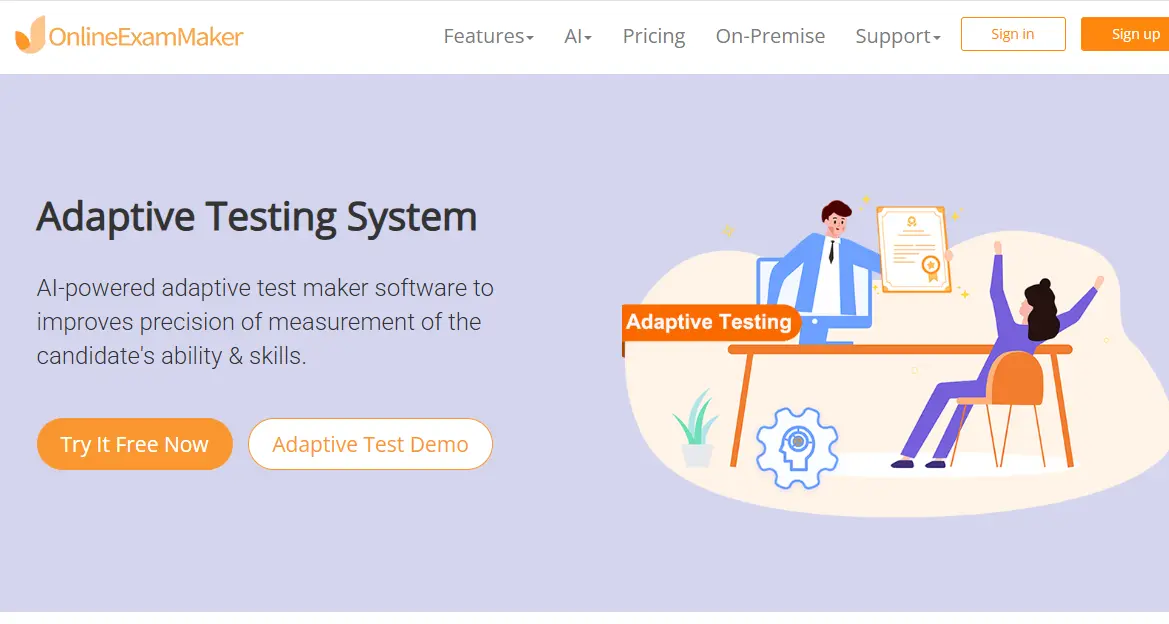
If you’re looking for a ready-to-use platform to build adaptive assessments for your first aid programme, OnlineExamMaker’s Adaptive Testing System is worth a close look. It uses Item Response Theory (IRT) to adjust question difficulty in real time based on each learner’s answers — meaning every person gets a test that accurately reflects their actual ability level, not just their luck on easy questions.
Key features include:
- Dynamic difficulty adjustment (easy, medium, hard question tags)
- Real-time score reports and performance analytics
- Reduced test anxiety — learners aren’t hit with questions way above or below their level
- Fair, bias-minimised assessment across diverse learner backgrounds
- Shorter tests that still deliver reliable results
Step-by-Step: Building an Adaptive First Aid Test
- Prepare your question bank. Write questions covering core first aid topics — CPR steps, bleeding control, choking response, the recovery position, AED use — and tag each question as easy, medium, or hard.
- Create a new adaptive test. In OnlineExamMaker, go to Exams > Adaptive Tests and click New Exam.
- Select your question categories. Choose which topic areas and question types to include in the adaptive pool.
- Configure general settings. Set the exam window, number of allowed attempts, time limits, and pass/fail thresholds.
- Set your adaptive answer rules. Define the minimum and maximum number of questions per attempt and configure how the system raises or lowers difficulty based on correct or incorrect answers.
- Publish and share. Distribute the test via a link, QR code, email, or SMS. Learners can take it on any device.
The result is a first aid assessment that meets each learner where they are — challenging enough to be meaningful, fair enough to be motivating, and precise enough to give you accurate data on readiness.
Create Your Next Quiz/Exam Using AI in OnlineExamMaker
The trajectory is clear. Conversational AI tutors, realistic branching emergency scenarios, and mobile-friendly microlearning modules are becoming the new standard. Adaptive systems are already moving beyond quiz scores — the next wave will pick up on hesitation timing, scenario decision patterns, and even confidence language to build an even richer picture of learner readiness.
But the most effective first aid training will always be a blend. AI handles the personalisation, the analytics, and the scalable delivery. Humans provide the hands-on coaching, clinical judgment, and practical skill sign-off. Neither replaces the other — and together, they produce learners who are genuinely prepared to act when it counts.
Because in a real emergency, there’s no adaptive algorithm looking over your shoulder. There’s just you, your training, and the next thirty seconds.
Author: Matt Davis

Matt is a content marketing specialist with more than 5 years of experience in content creation, he is glad to share his experience about online education and digital marketing.