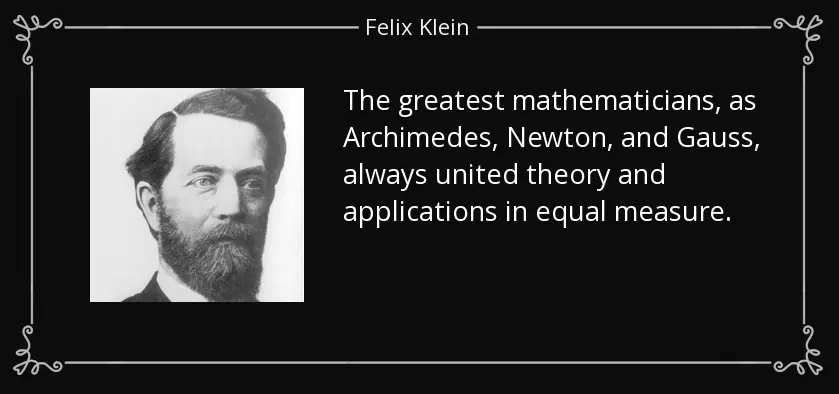
Felix Klein (1849–1925) was a pioneering German mathematician whose work revolutionized geometry, group theory, and mathematical education. Born in Düsseldorf, he studied under prominent mathematicians like Julius Plücker and later became a professor at universities including Erlangen, Leipzig, and Göttingen.
Klein’s most famous contribution is the Erlangen Program (1872), which classified geometries based on transformation groups, providing a unified framework for understanding different types of geometry. He also advanced the study of non-Euclidean geometry, elliptic functions, and the theory of the icosahedron.
In topology, Klein introduced the Klein bottle, a non-orientable surface that cannot exist in three-dimensional space without self-intersection, illustrating key concepts in modern mathematics.
Beyond research, Klein was a dedicated educator and administrator. He reformed mathematics teaching, emphasizing practical applications and interdisciplinary connections, and edited influential journals like the Mathematische Annalen. His legacy includes mentoring figures like David Hilbert and shaping the development of 20th-century mathematics.
Table of Contents
- Part 1: OnlineExamMaker AI Quiz Generator – The Easiest Way to Make Quizzes Online
- Part 2: 20 Felix Klein Quiz Questions & Answers
- Part 3: Save Time and Energy: Generate Quiz Questions with AI Technology
Part 1: OnlineExamMaker AI Quiz Generator – The Easiest Way to Make Quizzes Online
When it comes to ease of creating a Felix Klein skills assessment, OnlineExamMaker is one of the best AI-powered quiz making software for your institutions or businesses. With its AI Question Generator, just upload a document or input keywords about your assessment topic, you can generate high-quality quiz questions on any topic, difficulty level, and format.
What you will like:
● AI Question Generator to help you save time in creating quiz questions automatically.
● Share your online exam with audiences on social platforms like Facebook, Twitter, Reddit and more.
● Display the feedback for correct or incorrect answers instantly after a question is answered.
● Create a lead generation form to collect an exam taker’s information, such as email, mobile phone, work title, company profile and so on.
Automatically generate questions using AI
Part 2: 20 Felix Klein Quiz Questions & Answers
or
1. Question: What was Felix Klein’s birth year?
Options:
A) 1849
B) 1859
C) 1869
D) 1879
Answer: A) 1849
Explanation: Felix Klein was born on April 25, 1849, in Düsseldorf, Germany, marking the beginning of his influential career in mathematics.
2. Question: In which city did Felix Klein primarily conduct his academic work?
Options:
A) Berlin
B) Göttingen
C) Munich
D) Leipzig
Answer: B) Göttingen
Explanation: Klein held a professorship at the University of Göttingen from 1886 until his retirement, where he made significant contributions to geometry and mathematics education.
3. Question: What is the Erlangen Program primarily associated with?
Options:
A) Algebra
B) Geometry
C) Calculus
D) Statistics
Answer: B) Geometry
Explanation: The Erlangen Program, developed by Klein in 1872, classifies geometries based on group theory, emphasizing transformations and symmetry.
4. Question: Which mathematical object is named after Felix Klein?
Options:
A) Möbius strip
B) Klein bottle
C) Torus
D) Riemann sphere
Answer: B) Klein bottle
Explanation: The Klein bottle is a non-orientable surface discovered by Klein, illustrating concepts in topology and demonstrating a surface without distinct inside and outside.
5. Question: What field did Felix Klein contribute to through his work on the icosahedron?
Options:
A) Number theory
B) Group theory
C) Differential equations
D) Probability
Answer: B) Group theory
Explanation: Klein’s work on the icosahedron led to the discovery of the Klein quartic and advanced the understanding of finite groups and symmetry in group theory.
6. Question: Which university did Felix Klein attend as a student?
Options:
A) University of Berlin
B) University of Bonn
C) University of Heidelberg
D) University of Vienna
Answer: A) University of Berlin
Explanation: Klein studied at the University of Berlin under prominent mathematicians like Karl Weierstrass, which shaped his early research in mathematics.
7. Question: What was a key focus of Klein’s later career?
Options:
A) Pure algebra
B) Mathematics education
C) Astrophysics
D) Logic
Answer: B) Mathematics education
Explanation: In his later years, Klein advocated for reforms in mathematics education, emphasizing the teaching of geometry and its applications in schools.
8. Question: Which of the following is a theorem associated with Felix Klein?
Options:
A) Fundamental Theorem of Algebra
B) Klein’s Erlangen theorem
C) Pythagoras theorem
D) Fermat’s Last Theorem
Answer: B) Klein’s Erlangen theorem
Explanation: Klein’s Erlangen theorem provides a framework for understanding geometries through group actions, central to his program.
9. Question: What type of geometry did Klein help develop?
Options:
A) Euclidean geometry
B) Non-Euclidean geometry
C) Projective geometry
D) Both B and C
Answer: D) Both B and C
Explanation: Klein contributed to non-Euclidean and projective geometries, integrating them into his broader classification system via group theory.
10. Question: In what year did Felix Klein die?
Options:
A) 1925
B) 1915
C) 1935
D) 1945
Answer: A) 1925
Explanation: Felix Klein passed away on June 22, 1925, leaving a legacy in mathematics that influenced modern geometry and education.
11. Question: Which mathematical society did Felix Klein help establish?
Options:
A) American Mathematical Society
B) German Mathematical Society
C) Royal Society
D) French Academy of Sciences
Answer: B) German Mathematical Society
Explanation: Klein was a founding member of the German Mathematical Society in 1890, promoting mathematical research and collaboration in Germany.
12. Question: What is the primary concept behind Klein’s quartic?
Options:
A) A type of polynomial equation
B) A curve in algebraic geometry
C) A matrix operation
D) A statistical distribution
Answer: B) A curve in algebraic geometry
Explanation: Klein’s quartic is a famous algebraic curve that exemplifies symmetry and was studied in the context of his work on the icosahedral group.
13. Question: Which of Klein’s works influenced the development of relativity?
Options:
A) His geometry texts
B) The Erlangen Program
C) His work on invariants
D) All of the above
Answer: D) All of the above
Explanation: Klein’s ideas on geometry, invariants, and transformations provided foundational concepts that influenced Einstein’s theory of relativity.
14. Question: What was Klein’s nationality?
Options:
A) French
B) German
C) Austrian
D) Swiss
Answer: B) German
Explanation: Born and educated in Germany, Klein was a prominent German mathematician whose work represented the height of 19th-century German mathematics.
15. Question: Which mathematician did Felix Klein collaborate with extensively?
Options:
A) Henri Poincaré
B) David Hilbert
C) Bernhard Riemann
D) All of the above
Answer: D) All of the above
Explanation: Klein collaborated with Poincaré on automorphic functions, Hilbert on various topics, and built upon Riemann’s ideas in geometry.
16. Question: What did Klein’s “Vorlesungen über die Entwicklung der Mathematik im 19. Jahrhundert” cover?
Options:
A) History of mathematics
B) Advanced calculus
C) Quantum mechanics
D) Logic puzzles
Answer: A) History of mathematics
Explanation: This work by Klein provides a historical overview of 19th-century mathematics, reflecting his interest in the evolution of the field.
17. Question: In Klein’s classification, what role do transformation groups play?
Options:
A) They define geometric properties
B) They solve differential equations
C) They apply to physics only
D) They are irrelevant to geometry
Answer: A) They define geometric properties
Explanation: In the Erlangen Program, transformation groups determine the invariants and structure of different geometries.
18. Question: Which award did Felix Klein receive for his contributions?
Options:
A) Nobel Prize
B) Copley Medal
C) Fields Medal
D) None, as they didn’t exist in his time
Answer: D) None, as they didn’t exist in his time
Explanation: Many modern awards like the Fields Medal were established after Klein’s era, though he was highly recognized in his lifetime.
19. Question: What is a key feature of the Klein four-group?
Options:
A) It is abelian
B) It is non-commutative
C) It has infinite elements
D) It is used in calculus
Answer: A) It is abelian
Explanation: The Klein four-group is an abelian group of order 4, often used in examples of group theory and symmetry.
20. Question: How did Felix Klein’s work impact modern mathematics?
Options:
A) By unifying geometry
B) By advancing educational reforms
C) By influencing topology and algebra
D) All of the above
Answer: D) All of the above
Explanation: Klein’s contributions unified geometric studies, reformed education, and paved the way for developments in topology, algebra, and beyond.
or
Part 3: Save Time and Energy: Generate Quiz Questions with AI Technology
Automatically generate questions using AI