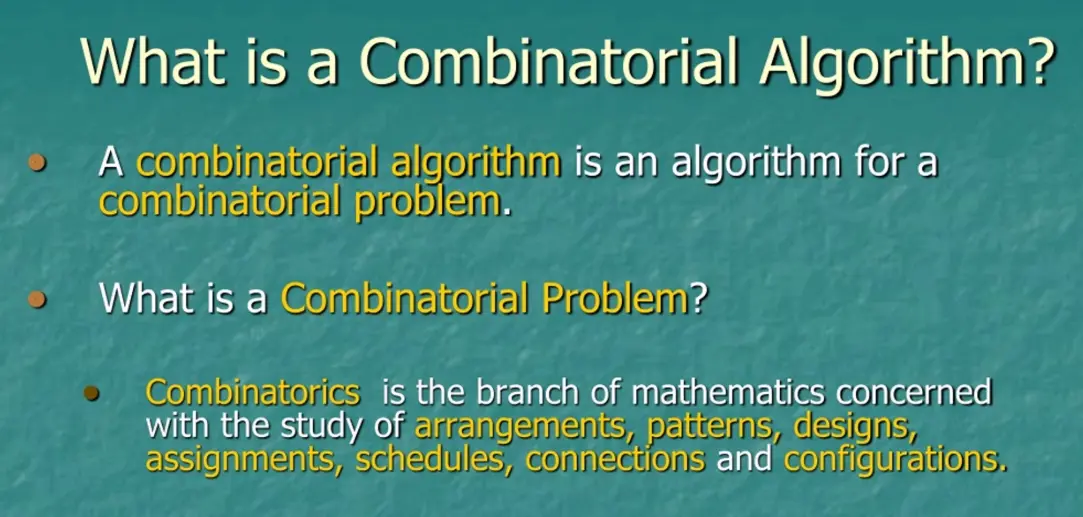
Combinatorial algorithms are computational methods designed to solve problems involving discrete structures, such as sets, graphs, permutations, and combinations. These algorithms focus on tasks like counting possibilities, generating arrangements, searching for optimal solutions, and analyzing combinatorial objects. For instance, they are essential in problems like the traveling salesman problem, where the goal is to find the shortest route visiting a set of cities, or in generating all subsets of a given set. By leveraging techniques such as recursion, dynamic programming, and graph traversal, combinatorial algorithms enable efficient handling of exponential growth in problem sizes, making them crucial in fields like computer science, operations research, and cryptography. Their power lies in transforming complex, discrete decision-making into structured, solvable processes.
Table of Contents
- Part 1: OnlineExamMaker – Generate and Share Combinatorial Algorithms Quiz with AI Automatically
- Part 2: 20 Combinatorial Algorithms Quiz Questions & Answers
- Part 3: AI Question Generator – Automatically Create Questions for Your Next Assessment
Part 1: OnlineExamMaker – Generate and Share Combinatorial Algorithms Quiz with AI Automatically
OnlineExamMaker is a powerful AI-powered assessment platform to create auto-grading Combinatorial Algorithms skills assessments. It’s designed for educators, trainers, businesses, and anyone looking to generate engaging quizzes without spending hours crafting questions manually. The AI Question Generator feature allows you to input a topic or specific details, and it generates a variety of question types automatically.
Top features for assessment organizers:
● Prevent cheating by randomizing questions or changing the order of questions, so learners don’t get the same set of questions each time.
● AI Exam Grader for efficiently grading quizzes and assignments, offering inline comments, automatic scoring, and “fudge points” for manual adjustments.
● Embed quizzes on websites, blogs, or share via email, social media (Facebook, Twitter), or direct links.
● Handles large-scale testing (thousands of exams/semester) without internet dependency, backed by cloud infrastructure.
Automatically generate questions using AI
Part 2: 20 Combinatorial Algorithms Quiz Questions & Answers
or
Question 1:
What is the time complexity of generating all permutations of n distinct elements using a standard algorithm like Heap’s algorithm?
A) O(n!)
B) O(n log n)
C) O(2^n)
D) O(n^2)
Answer: A
Explanation: Generating all permutations requires producing n! outputs, and each permutation takes O(1) extra work beyond the generation, leading to O(n!) time complexity.
Question 2:
In the context of combinatorial algorithms, which method is commonly used to solve the N-Queens problem?
A) Greedy algorithm
B) Backtracking
C) Dynamic programming
D) Divide and conquer
Answer: B
Explanation: Backtracking explores all possible configurations by incrementally building solutions and abandoning those that fail constraints, making it ideal for the N-Queens problem.
Question 3:
What is the primary purpose of the inclusion-exclusion principle in combinatorial algorithms?
A) To count the number of elements in the union of multiple sets
B) To sort arrays efficiently
C) To find the shortest path in a graph
D) To generate random subsets
Answer: A
Explanation: The inclusion-exclusion principle corrects for overcounting when calculating the size of the union of sets by adding and subtracting intersections.
Question 4:
Which combinatorial algorithm is used to find the minimum spanning tree in a weighted, undirected graph?
A) Dijkstra’s algorithm
B) Kruskal’s algorithm
C) Bellman-Ford algorithm
D) Floyd-Warshall algorithm
Answer: B
Explanation: Kruskal’s algorithm sorts the edges by weight and adds the smallest edges that do not form a cycle, using a disjoint-set data structure for efficiency.
Question 5:
In generating combinations, what does C(n, k) represent?
A) The number of permutations of n items taken k at a time
B) The number of ways to choose k items from n without regard to order
C) The total number of subsets of a set with n elements
D) The factorial of n divided by k
Answer: B
Explanation: C(n, k), or the binomial coefficient, calculates the number of ways to select k elements from a set of n elements where the order does not matter.
Question 6:
Which algorithm is typically used for the subset sum problem, a classic combinatorial optimization problem?
A) Binary search
B) Dynamic programming
C) Quick sort
D) Breadth-first search
Answer: B
Explanation: Dynamic programming solves the subset sum problem by building a table of possible sums from subsets, checking if the target sum can be achieved.
Question 7:
What is the time complexity of the brute-force approach for the Traveling Salesman Problem with n cities?
A) O(n)
B) O(n^2)
C) O(2^n)
D) O(n!)
Answer: D
Explanation: The brute-force method evaluates all possible tours, which is (n-1)!/2 for undirected graphs, leading to O(n!) complexity.
Question 8:
In graph theory, which combinatorial algorithm detects cycles in an undirected graph?
A) Depth-first search
B) Linear search
C) Merge sort
D) Binary search
Answer: A
Explanation: Depth-first search can detect cycles by tracking visited nodes and parent nodes; if a visited node is encountered that is not the parent, a cycle exists.
Question 9:
What does the term “backtracking” mean in combinatorial algorithms?
A) Reversing the steps of a forward algorithm
B) Searching by building candidates and abandoning failures
C) Sorting data in reverse order
D) Recursing infinitely until a base case
Answer: B
Explanation: Backtracking involves constructing solutions incrementally and removing those that fail to satisfy constraints, like in solving Sudoku or permutations.
Question 10:
Which data structure is most efficient for implementing a disjoint-set (union-find) in combinatorial algorithms like Kruskal’s?
A) Array
B) Linked list
C) Binary tree
D) Hash table
Answer: A
Explanation: An array-based implementation with path compression and union by rank makes disjoint-set operations nearly O(1) on average.
Question 11:
In combinatorial designs, what is a Latin square?
A) A square matrix filled with symbols, each occurring exactly once per row and column
B) A grid representing a graph
C) A matrix of prime numbers
D) A sorted array of elements
Answer: A
Explanation: A Latin square is an n × n array filled with n different symbols, each occurring exactly once in each row and exactly once in each column.
Question 12:
Which algorithm is used to generate all subsets of a set with n elements?
A) Permutation generation
B) Power set enumeration
C) Bubble sort
D) Binary search
Answer: B
Explanation: Power set enumeration uses bit manipulation or recursion to generate 2^n subsets by considering each element’s inclusion or exclusion.
Question 13:
What is the role of pruning in backtracking algorithms?
A) To reduce the search space by eliminating unpromising branches
B) To sort the input data
C) To increase the number of iterations
D) To add more constraints
Answer: A
Explanation: Pruning in backtracking discards partial solutions that cannot lead to a valid complete solution, improving efficiency.
Question 14:
In the knapsack problem, which variant is a combinatorial optimization problem?
A) 0-1 Knapsack
B) Fractional Knapsack
C) Greedy Knapsack
D) Dynamic Knapsack
Answer: A
Explanation: The 0-1 Knapsack problem requires selecting items without fractions, making it a combinatorial problem solved via dynamic programming or branch and bound.
Question 15:
What is the time complexity of computing the binomial coefficient C(n, k) using dynamic programming?
A) O(1)
B) O(n)
C) O(k * n)
D) O(n^2)
Answer: C
Explanation: Dynamic programming builds a table for Pascal’s triangle, requiring O(k * n) time to compute C(n, k) by filling the table up to the required entry.
Question 16:
Which combinatorial algorithm is used for topological sorting in a directed acyclic graph?
A) Breadth-first search
B) Kahn’s algorithm
C) Depth-first search
D) Both B and C
Answer: D
Explanation: Both Kahn’s algorithm (using indegree) and DFS (using finishing times) can perform topological sorting on DAGs.
Question 17:
In generating permutations, what does the next permutation algorithm do?
A) Generates the next lexicographically greater permutation
B) Sorts the array in ascending order
C) Reverses the array
D) Generates all permutations at once
Answer: A
Explanation: The next permutation algorithm rearranges numbers into the lexicographically next greater permutation, useful for iterative generation.
Question 18:
What is a Hamiltonian path in graph theory?
A) A path that visits each vertex exactly once
B) A cycle that visits each edge exactly once
C) The shortest path between two vertices
D) A tree spanning all vertices
Answer: A
Explanation: A Hamiltonian path is a combinatorial structure that traverses each vertex in a graph exactly once, often solved using backtracking.
Question 19:
Which technique is used in combinatorial algorithms to avoid recomputing subproblems?
A) Memoization
B) Recursion
C) Iteration
D) Sorting
Answer: A
Explanation: Memoization stores the results of expensive function calls and returns the cached result when the same inputs occur again, as in dynamic programming.
Question 20:
In the context of combinatorial explosion, what strategy is used to mitigate it in algorithms like branch and bound?
A) Pruning the search tree
B) Increasing the input size
C) Using recursion without limits
D) Generating all possibilities
Answer: A
Explanation: Branch and bound mitigates combinatorial explosion by pruning branches of the search tree that cannot produce a better solution than the current best.
or
Part 3: AI Question Generator – Automatically Create Questions for Your Next Assessment
Automatically generate questions using AI