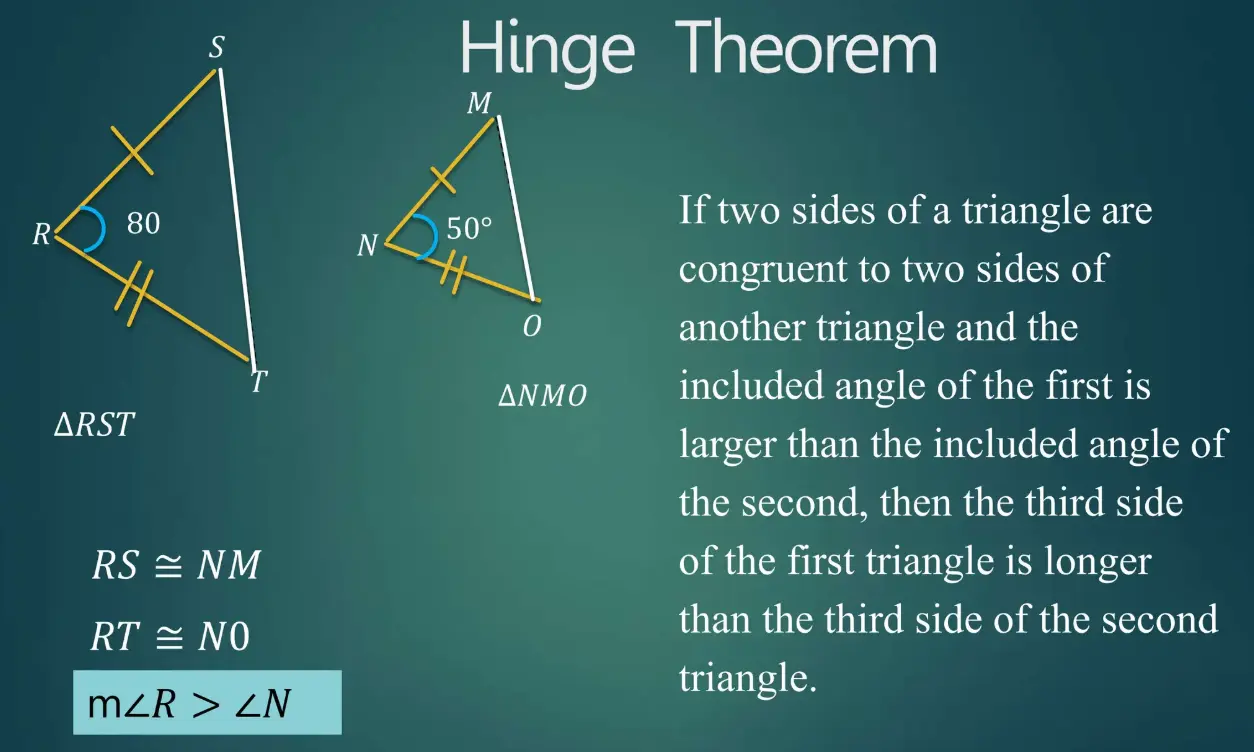
The Hinge Theorem, also known as the Unequal Sides Theorem or SSS Inequality Theorem, is a principle in geometry that applies to triangles. It states that if two triangles have two pairs of sides that are equal in length, but the angles between those sides (the included angles) are not equal, then the triangle with the larger included angle will have a longer side opposite that angle. For example, in triangles ABC and DEF, if AB = DE, AC = DF, and angle A > angle D, then BC > EF. This theorem helps compare the sizes of triangles and understand how angles affect side lengths.
Table of Contents
- Part 1: Best AI Quiz Making Software for Creating A Hinge Theorem Quiz
- Part 2: 20 Hinge Theorem Quiz Questions & Answers
- Part 3: AI Question Generator – Automatically Create Questions for Your Next Assessment
Part 1: Best AI Quiz Making Software for Creating A Hinge Theorem Quiz
OnlineExamMaker is a powerful AI-powered assessment platform to create auto-grading Hinge Theorem skills assessments. It’s designed for educators, trainers, businesses, and anyone looking to generate engaging quizzes without spending hours crafting questions manually. The AI Question Generator feature allows you to input a topic or specific details, and it generates a variety of question types automatically.
Top features for assessment organizers:
● Combines AI webcam monitoring to capture cheating activities during online exam.
● Enhances assessments with interactive experience by embedding video, audio, image into quizzes and multimedia feedback.
● Once the exam ends, the exam scores, question reports, ranking and other analytics data can be exported to your device in Excel file format.
● API and SSO help trainers integrate OnlineExamMaker with Google Classroom, Microsoft Teams, CRM and more.
Automatically generate questions using AI
Part 2: 20 Hinge Theorem Quiz Questions & Answers
or
1. In triangles ABC and DEF, AB = DE, BC = EF, and angle B > angle E. Which statement is true?
A. AC > DF
B. AC < DF
C. AC = DF
D. No comparison can be made
Answer: A
Explanation: According to the Hinge Theorem, if two sides of one triangle are equal to two sides of another triangle and the included angle is larger in the first triangle, then the third side opposite the larger angle is longer. Here, angle B is larger than angle E, so AC > DF.
2. For triangles PQR and STU, PQ = ST, QR = TU, and angle Q = angle T. What can be concluded about PR and SU?
A. PR > SU
B. PR < SU
C. PR = SU
D. PR and SU cannot be compared
Answer: C
Explanation: The Hinge Theorem applies when the included angles are unequal. Since angle Q equals angle T, and the other sides are equal, the triangles are congruent by SAS, so PR = SU.
3. In triangles XYZ and LMN, XY = LM, YZ = MN, and angle Y > angle M. Which side is longer?
A. XZ
B. LN
C. XZ and LN are equal
D. Cannot determine
Answer: A
Explanation: The Hinge Theorem states that the side opposite the larger included angle is longer. With angle Y > angle M, XZ (opposite angle Y) is longer than LN (opposite angle M).
4. Triangles ABC and DEF have AB = DE, BC = EF, and angle B < angle E. What is true about AC and DF?
A. AC > DF
B. AC < DF
C. AC = DF
D. No conclusion
Answer: B
Explanation: By the Hinge Theorem, if the included angle in the second triangle is larger, the side opposite it is longer. Since angle E > angle B, DF > AC.
5. For triangles JKL and MNO, JK = MN, KL = NO, and angle K > angle N. Compare JL and MO.
A. JL > MO
B. JL < MO
C. JL = MO
D. Insufficient information
Answer: A
Explanation: The Hinge Theorem indicates that a larger included angle results in a longer opposite side when two sides are equal. Thus, JL > MO.
6. In triangles RST and UVW, RS = UV, ST = VW, and angle S < angle V. Which is longer?
A. RT
B. UW
C. RT and UW are equal
D. Cannot compare
Answer: B
Explanation: According to the Hinge Theorem, the side opposite the larger included angle is longer, so UW (opposite angle V) is longer than RT (opposite angle S).
7. Triangles PQR and STU have PQ = ST, QR = TU, and angle Q > angle T. What about PR and SU?
A. PR > SU
B. PR < SU
C. PR = SU
D. No relation
Answer: A
Explanation: The Hinge Theorem confirms that with equal sides and a larger included angle in triangle PQR, PR is longer than SU.
8. For triangles ABC and DEF, AB = DE, BC = EF, and angle B = angle E. Compare AC and DF.
A. AC > DF
B. AC < DF
C. AC = DF
D. Cannot determine
Answer: C
Explanation: Equal included angles with equal adjacent sides mean the triangles are congruent by SAS, so AC = DF, as per the Hinge Theorem's conditions.
9. In triangles GHI and JKL, GH = JK, HI = KL, and angle H > angle K. Which side is greater?
A. GI
B. JL
C. GI and JL are equal
D. No comparison
Answer: A
Explanation: The Hinge Theorem states that the side opposite the larger angle is longer, so GI > JL.
10. Triangles MNO and PQR have MN = PQ, NO = QR, and angle N < angle Q. Compare MO and PR.
A. MO > PR
B. MO < PR
C. MO = PR
D. Cannot compare
Answer: B
Explanation: With angle Q larger than angle N, the Hinge Theorem indicates that PR (opposite angle Q) is longer than MO (opposite angle N).
11. For triangles ABC and DEF, AB = DE, BC = EF, and angle B > angle E. What about AC and DF?
A. AC > DF
B. AC < DF
C. AC = DF
D. Unrelated
Answer: A
Explanation: The Hinge Theorem applies: a larger included angle means a longer opposite side, so AC > DF.
12. In triangles XYZ and LMN, XY = LM, YZ = MN, and angle Y = angle M. Compare XZ and LN.
A. XZ > LN
B. XZ < LN
C. XZ = LN
D. No conclusion
Answer: C
Explanation: Equal included angles and sides indicate congruence by SAS, so XZ = LN.
13. Triangles PQR and STU have PQ = ST, QR = TU, and angle Q < angle T. Which is longer?
A. PR
B. SU
C. PR and SU are equal
D. Cannot determine
Answer: B
Explanation: By the Hinge Theorem, the side opposite the larger angle is longer, so SU > PR.
14. For triangles JKL and MNO, JK = MN, KL = NO, and angle K < angle N. Compare JL and MO.
A. JL > MO
B. JL < MO
C. JL = MO
D. Insufficient data
Answer: B
Explanation: The Hinge Theorem shows that MO (opposite the larger angle N) is longer than JL.
15. In triangles RST and UVW, RS = UV, ST = VW, and angle S > angle V. What about RT and UW?
A. RT > UW
B. RT < UW
C. RT = UW
D. No relation
Answer: A
Explanation: A larger included angle in triangle RST means RT is longer than UW.
16. Triangles ABC and DEF have AB = DE, BC = EF, and angle B < angle E. Compare AC and DF.
A. AC > DF
B. AC < DF
C. AC = DF
D. Cannot compare
Answer: B
Explanation: The Hinge Theorem indicates that DF is longer due to the larger angle E.
17. For triangles GHI and JKL, GH = JK, HI = KL, and angle H < angle K. Which side is longer?
A. GI
B. JL
C. GI and JL are equal
D. No comparison
Answer: B
Explanation: With angle K larger, JL (opposite angle K) is longer than GI.
18. In triangles MNO and PQR, MN = PQ, NO = QR, and angle N > angle Q. Compare MO and PR.
A. MO > PR
B. MO < PR
C. MO = PR
D. Cannot determine
Answer: A
Explanation: The Hinge Theorem states that MO is longer because angle N is larger.
19. Triangles XYZ and LMN have XY = LM, YZ = MN, and angle Y < angle M. What about XZ and LN?
A. XZ > LN
B. XZ < LN
C. XZ = LN
D. No conclusion
Answer: B
Explanation: LN is longer than XZ due to the larger included angle M.
20. For triangles PQR and STU, PQ = ST, QR = TU, and angle Q > angle T. Which is true?
A. PR > SU
B. PR < SU
C. PR = SU
D. Cannot compare
Answer: A
Explanation: According to the Hinge Theorem, the side opposite the larger angle Q is longer, so PR > SU.
or
Part 3: AI Question Generator – Automatically Create Questions for Your Next Assessment
Automatically generate questions using AI