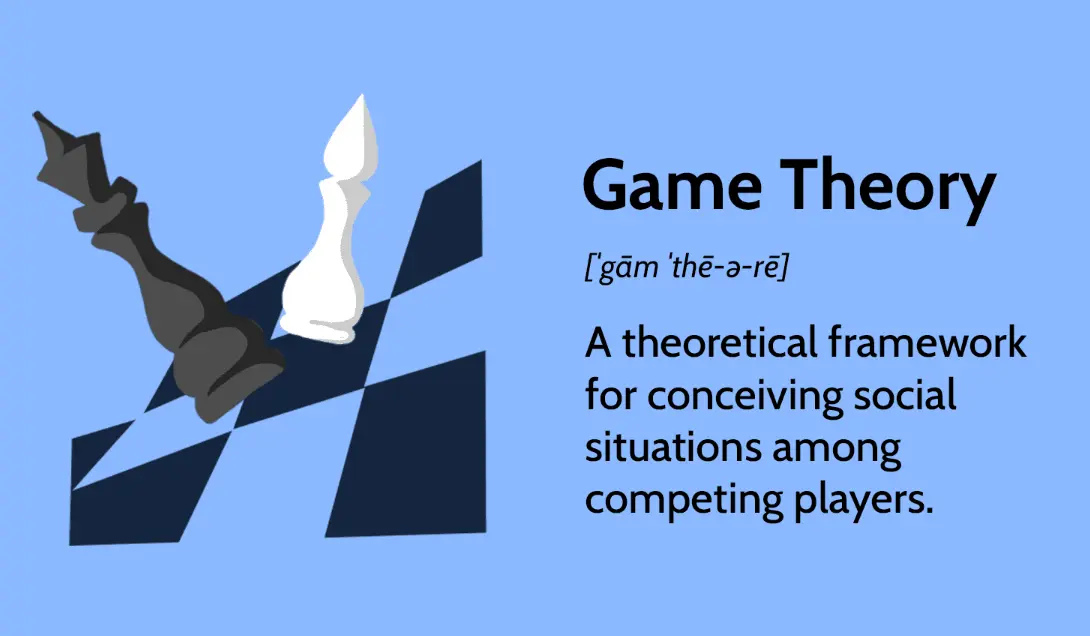
Game Theory is a branch of mathematics that studies strategic interactions among rational decision-makers, where the outcome for each participant depends on the actions of all involved. Originating in the mid-20th century, it was formalized by John von Neumann and Oskar Morgenstern in their 1944 book, *Theory of Games and Economic Behavior*. The field analyzes situations modeled as “games,” which consist of players, strategies, and payoffs.
Key concepts include:
– Players: Individuals or entities making decisions.
– Strategies: The possible actions each player can take.
– Payoffs: The outcomes or rewards resulting from the combination of strategies.
– Nash Equilibrium: A stable state where no player can improve their payoff by unilaterally changing their strategy.
– Dominant Strategy: A strategy that yields the best payoff for a player regardless of others’ actions.
– Prisoner’s Dilemma: A classic example illustrating how individual self-interest can lead to suboptimal collective outcomes, often used to model conflicts in economics and politics.
Games are classified into types such as:
– Zero-sum games: One player’s gain equals another’s loss, like in chess.
– Non-zero-sum games: Total gains can vary, allowing for cooperation, as in business negotiations.
– Cooperative vs. Non-cooperative games: The former allows binding agreements, while the latter does not.
Applications of Game Theory are vast:
– In economics, it models market competition, auctions, and pricing strategies.
– In biology, it explains evolutionary behaviors, such as animal conflicts or mating strategies.
– In political science, it analyzes voting systems, international relations, and bargaining.
– In computer science, it’s used for algorithm design, artificial intelligence, and network security.
Overall, Game Theory provides tools to predict and influence outcomes in competitive or collaborative scenarios, making it essential for understanding human behavior and decision-making in complex systems.
Table of Contents
- Part 1: OnlineExamMaker AI Quiz Maker – Make A Free Quiz in Minutes
- Part 2: 20 Game Theory Quiz Questions & Answers
- Part 3: OnlineExamMaker AI Question Generator: Generate Questions for Any Topic
Part 1: OnlineExamMaker AI Quiz Maker – Make A Free Quiz in Minutes
Still spend a lot of time in editing questions for your next Game Theory assessment? OnlineExamMaker is an AI quiz maker that leverages artificial intelligence to help users create quizzes, tests, and assessments quickly and efficiently. You can start by inputting a topic or specific details into the OnlineExamMaker AI Question Generator, and the AI will generate a set of questions almost instantly. It also offers the option to include answer explanations, which can be short or detailed, helping learners understand their mistakes.
What you may like:
● Automatic grading and insightful reports. Real-time results and interactive feedback for quiz-takers.
● The exams are automatically graded with the results instantly, so that teachers can save time and effort in grading.
● LockDown Browser to restrict browser activity during quizzes to prevent students searching answers on search engines or other software.
● Create certificates with personalized company logo, certificate title, description, date, candidate’s name, marks and signature.
Automatically generate questions using AI
Part 2: 20 Game Theory Quiz Questions & Answers
or
1. Question: In Game Theory, what is a Nash Equilibrium?
A. A strategy where one player maximizes their payoff regardless of others.
B. A set of strategies where no player can benefit by unilaterally changing their strategy.
C. A game with equal payoffs for all players.
D. A cooperative agreement between players.
Answer: B
Explanation: Nash Equilibrium occurs when each player’s strategy is optimal given the strategies of the other players, meaning no one can improve their outcome by changing their own strategy alone.
2. Question: In the Prisoner’s Dilemma, what is the likely outcome if both players act rationally and non-cooperatively?
A. Both confess.
B. Both remain silent.
C. One confesses and the other remains silent.
D. They cooperate to minimize sentences.
Answer: A
Explanation: In the Prisoner’s Dilemma, confessing is the dominant strategy for each player, leading to both confessing and receiving a suboptimal outcome compared to mutual silence.
3. Question: What defines a dominant strategy in a game?
A. A strategy that is always better than any other, regardless of opponents’ actions.
B. A strategy chosen randomly.
C. A strategy that works only in cooperative games.
D. A strategy that minimizes losses.
Answer: A
Explanation: A dominant strategy yields a higher payoff for a player no matter what strategies the other players choose, making it the best option in all scenarios.
4. Question: In a zero-sum game, what is the relationship between players’ payoffs?
A. One player’s gain is another’s loss.
B. Both players gain equally.
C. Players share payoffs equally.
D. Payoffs are independent.
Answer: A
Explanation: In zero-sum games, the total payoff is constant, so any gain by one player directly results in an equivalent loss for the other.
5. Question: What is a mixed strategy in Game Theory?
A. A strategy where players randomize their choices.
B. A strategy that is purely cooperative.
C. A fixed strategy for all rounds.
D. A strategy based on past outcomes only.
Answer: A
Explanation: A mixed strategy involves players choosing actions probabilistically to keep opponents uncertain, often used in games without a pure strategy equilibrium.
6. Question: In the Battle of the Sexes game, what type of equilibrium might exist?
A. Multiple Nash Equilibria.
B. A single dominant strategy equilibrium.
C. No equilibrium.
D. Only mixed strategy equilibria.
Answer: A
Explanation: The Battle of the Sexes has two pure Nash Equilibria, where both players prefer to coordinate but have different preferences for which outcome occurs.
7. Question: What is the key assumption in non-cooperative Game Theory?
A. Players act independently without binding agreements.
B. Players always share information.
C. Players must cooperate to win.
D. Games are always repeated.
Answer: A
Explanation: Non-cooperative Game Theory assumes players make decisions based on their own interests without enforceable contracts or communication.
8. Question: In a repeated Prisoner’s Dilemma, what strategy can promote cooperation?
A. Tit-for-tat.
B. Always defect.
C. Always cooperate.
D. Random choice.
Answer: A
Explanation: Tit-for-tat starts with cooperation and then mirrors the opponent’s previous move, encouraging long-term cooperation by punishing defection.
9. Question: What is a payoff matrix used for in Game Theory?
A. To represent the outcomes of different strategy combinations.
B. To show player communication.
C. To calculate random events.
D. To enforce cooperation.
Answer: A
Explanation: A payoff matrix outlines the payoffs for each player based on the strategies chosen, allowing analysis of equilibria and optimal play.
10. Question: In the Stag Hunt game, what does the stag represent?
A. A high-payoff cooperative outcome.
B. A low-payoff individual outcome.
C. A guaranteed win.
D. A mixed strategy.
Answer: A
Explanation: In the Stag Hunt, hunting a stag requires cooperation for a high reward, while hunting a hare provides a lower but certain individual payoff, highlighting coordination risks.
11. Question: What is subgame perfect equilibrium?
A. An equilibrium that holds in every subgame of a larger game.
B. A Nash Equilibrium in the first round only.
C. A cooperative equilibrium.
D. A random strategy equilibrium.
Answer: A
Explanation: Subgame perfect equilibrium refines Nash Equilibrium by ensuring that strategies are optimal not just overall, but in every possible subgame, eliminating non-credible threats.
12. Question: In Evolutionary Game Theory, what role does the replicator dynamic play?
A. It models how strategies evolve based on their success.
B. It ensures immediate cooperation.
C. It calculates fixed payoffs.
D. It predicts random outcomes.
Answer: A
Explanation: The replicator dynamic describes how strategies with higher payoffs become more prevalent over time, simulating evolution in populations.
13. Question: What is common knowledge in Game Theory?
A. Information that all players know and know that others know.
B. Secret strategies.
C. Payoffs that are hidden.
D. Random events.
Answer: A
Explanation: Common knowledge is essential for rational play, as it means facts are mutually understood at all levels, affecting how players anticipate each other’s actions.
14. Question: In a Bayesian game, what do players have?
A. Incomplete information about others’ types.
B. Complete knowledge of all strategies.
C. Fixed payoffs.
D. No uncertainty.
Answer: A
Explanation: Bayesian games involve uncertainty about players’ types or private information, requiring players to use beliefs (like probabilities) to make decisions.
15. Question: What is the outcome in the Ultimatum Game if the proposer offers a fair split?
A. The responder accepts.
B. The responder rejects.
C. No equilibrium.
D. The game ends immediately.
Answer: A
Explanation: In the Ultimatum Game, a fair offer (e.g., 50-50 split) is typically accepted because it meets the responder’s expectations for fairness, leading to mutual benefit.
16. Question: In a public goods game, what is the typical problem?
A. Free-riding.
B. Over-contribution.
C. Forced cooperation.
D. Equal sharing.
Answer: A
Explanation: Players have an incentive to free-ride by not contributing while benefiting from others’ contributions, leading to under-provision of the public good.
17. Question: What characterizes a cooperative game in Game Theory?
A. Players can form binding agreements.
B. Players act independently.
C. No communication is allowed.
D. Payoffs are zero-sum.
Answer: A
Explanation: Cooperative games allow players to negotiate and enforce coalitions or agreements, unlike non-cooperative games where binding deals are not possible.
18. Question: In the Dictator Game, what does the dictator decide?
A. How to allocate the entire amount.
B. A fair split.
C. Based on responder’s input.
D. Randomly.
Answer: A
Explanation: The dictator has full control over the allocation, often keeping most or all for themselves, highlighting issues of altruism and fairness.
19. Question: What is a pure strategy Nash Equilibrium?
A. A set of definite strategies where no player wants to deviate.
B. A randomized strategy.
C. A cooperative plan.
D. An evolving strategy.
Answer: A
Explanation: In a pure strategy Nash Equilibrium, players choose specific actions that are best responses to each other, with no incentive to switch.
20. Question: In auction theory, what is a first-price sealed-bid auction?
A. Bidders submit bids without knowing others, and the highest bidder pays their bid.
B. Bidders know all bids and negotiate.
C. The lowest bid wins.
D. Bids are revealed publicly first.
Answer: A
Explanation: In a first-price sealed-bid auction, participants submit secret bids, and the winner pays exactly what they bid, influencing bidding strategies based on valuation.
or
Part 3: OnlineExamMaker AI Question Generator: Generate Questions for Any Topic
Automatically generate questions using AI