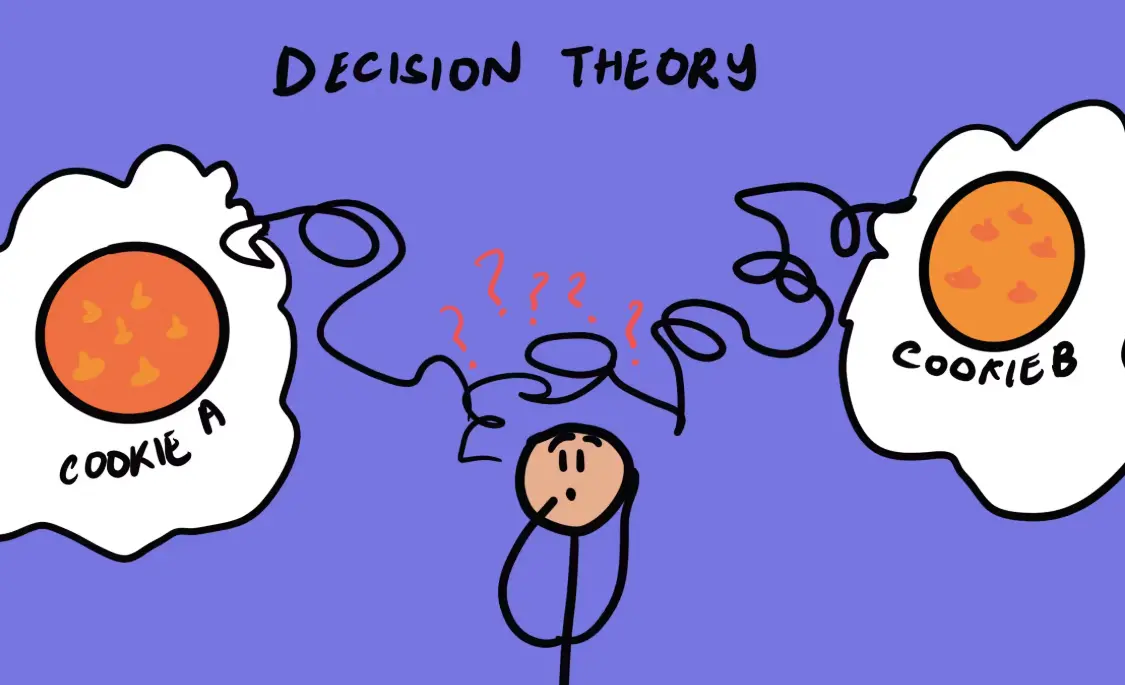
Decision Theory is a multidisciplinary field that studies how individuals and organizations make choices under conditions of uncertainty and risk. It combines elements of mathematics, economics, philosophy, psychology, and computer science to analyze decision-making processes.
At its core, Decision Theory distinguishes between normative (how decisions ought to be made for optimal outcomes), descriptive (how decisions are actually made in practice), and prescriptive (how to improve decision-making) approaches.
Key concepts include:
– Utility and Preferences: Decisions are evaluated based on utility, a measure of value or satisfaction. Utility theory assumes individuals aim to maximize their expected utility when facing choices.
– Probability and Risk: Incorporating probabilities helps assess outcomes. For instance, expected utility theory weighs the utility of possible results by their likelihood, as formalized by figures like Daniel Bernoulli in the 18th century.
– Rational Choice Models: These assume decision-makers are rational actors who consistently rank options and select the one with the highest expected value. However, real-world biases, such as loss aversion or overconfidence, often deviate from this ideal.
Historically, Decision Theory evolved from early probability work by Blaise Pascal and Pierre de Fermat in the 17th century, through John von Neumann and Oskar Morgenstern’s 1944 book *Theory of Games and Economic Behavior*, which introduced game theory and expected utility. Later developments included behavioral insights from psychologists like Daniel Kahneman and Amos Tversky, challenging traditional rationality assumptions.
Applications span various fields:
– Economics: In microeconomics for consumer choice and in finance for investment decisions.
– Artificial Intelligence: For algorithms in machine learning, robotics, and autonomous systems.
– Public Policy: To evaluate policies, such as in healthcare or environmental decisions, using cost-benefit analysis.
– Personal Life: Everyday choices, like buying insurance or career planning, often rely on intuitive decision frameworks.
Despite its strengths, Decision Theory faces criticisms, such as overlooking emotional or ethical factors in human behavior. Ongoing research integrates these elements, blending it with behavioral economics and cognitive science to create more realistic models.
Table of Contents
- Part 1: OnlineExamMaker – Generate and Share Decision Theory Quiz with AI Automatically
- Part 2: 20 Decision Theory Quiz Questions & Answers
- Part 3: OnlineExamMaker AI Question Generator: Generate Questions for Any Topic
Part 1: OnlineExamMaker – Generate and Share Decision Theory Quiz with AI Automatically
OnlineExamMaker is a powerful AI-powered assessment platform to create auto-grading Decision Theory skills assessments. It’s designed for educators, trainers, businesses, and anyone looking to generate engaging quizzes without spending hours crafting questions manually. The AI Question Generator feature allows you to input a topic or specific details, and it generates a variety of question types automatically.
Top features for assessment organizers:
● Prevent cheating by randomizing questions or changing the order of questions, so learners don’t get the same set of questions each time.
● AI Exam Grader for efficiently grading quizzes and assignments, offering inline comments, automatic scoring, and “fudge points” for manual adjustments.
● Embed quizzes on websites, blogs, or share via email, social media (Facebook, Twitter), or direct links.
● Handles large-scale testing (thousands of exams/semester) without internet dependency, backed by cloud infrastructure.
Automatically generate questions using AI
Part 2: 20 Decision Theory Quiz Questions & Answers
or
1. Question: In decision theory, what is the expected utility of an action?
A) The maximum possible outcome of the action
B) The average utility weighted by the probabilities of outcomes
C) The minimum possible outcome of the action
D) The total utility without considering probabilities
Answer: B
Explanation: Expected utility is calculated by summing the utilities of all possible outcomes, each multiplied by its probability, providing a way to evaluate decisions under uncertainty.
2. Question: Which criterion involves selecting the option with the best worst-case outcome?
A) Maximax
B) Maximin
C) Expected value
D) Minimax regret
Answer: B
Explanation: The maximin criterion focuses on the worst possible outcome for each option and chooses the one with the highest of those worst outcomes, emphasizing risk aversion.
3. Question: If a decision maker is risk-averse, they will prefer:
A) A gamble with high variance
B) A certain outcome over a gamble with the same expected value
C) Options with maximum possible gains
D) Uncertain outcomes regardless of utility
Answer: B
Explanation: Risk-averse individuals value certainty and will choose a guaranteed outcome if it equals the expected value of a risky alternative, due to their preference for avoiding potential losses.
4. Question: In a decision matrix, what does the expected monetary value (EMV) represent?
A) The total profit from all outcomes
B) The weighted average of monetary outcomes based on probabilities
C) The difference between best and worst outcomes
D) The minimum monetary loss
Answer: B
Explanation: EMV is the sum of each monetary outcome multiplied by its probability, helping to quantify the average financial return of a decision under uncertainty.
5. Question: What is the primary difference between normative and descriptive decision theory?
A) Normative focuses on actual behavior, while descriptive deals with ideals
B) Normative prescribes how decisions should be made, while descriptive explains how they are made
C) Both are the same and interchangeable
D) Descriptive involves probabilities, while normative does not
Answer: B
Explanation: Normative decision theory outlines rational decision-making processes, whereas descriptive theory studies real-world behaviors, often revealing deviations from rationality.
6. Question: In game theory, a Nash equilibrium occurs when:
A) Players cooperate fully
B) No player can benefit by changing their strategy unilaterally
C) All players achieve the maximum payoff
D) The game is zero-sum
Answer: B
Explanation: A Nash equilibrium is a set of strategies where each player’s choice is optimal given the choices of others, meaning no one has an incentive to deviate alone.
7. Question: Why might someone use the minimax regret criterion?
A) To maximize gains
B) To minimize the potential for regret by considering the difference between chosen and best outcomes
C) To ignore probabilities entirely
D) To focus only on the best-case scenarios
Answer: B
Explanation: Minimax regret involves selecting the option that minimizes the maximum regret, which is the difference between the payoff of the best possible action and the chosen action for each state.
8. Question: What role does a utility function play in decision theory?
A) It measures absolute wealth
B) It assigns values to outcomes based on personal preferences
C) It eliminates the need for probabilities
D) It only applies to financial decisions
Answer: B
Explanation: A utility function quantifies an individual’s preferences for different outcomes, allowing for the comparison of choices that involve risk or uncertainty.
9. Question: In a decision tree, branches represent:
A) Final outcomes only
B) Probabilities and decisions at each node
C) Monetary values exclusively
D) Regret calculations
Answer: B
Explanation: Decision trees use branches to illustrate possible decisions, uncertainties (with probabilities), and outcomes, aiding in visualizing the decision-making process.
10. Question: What is bounded rationality?
A) Making perfectly rational decisions with unlimited resources
B) The idea that decision makers have limits in information and cognitive ability
C) Always choosing the option with the highest expected value
D) Ignoring all risks in decision making
Answer: B
Explanation: Bounded rationality recognizes that people make satisfactory decisions rather than optimal ones due to constraints like time, information, and mental capacity.
11. Question: How does the Allais paradox challenge expected utility theory?
A) It shows that people always follow expected utility
B) It demonstrates inconsistencies in preferences under risk, violating expected utility axioms
C) It proves that probabilities are irrelevant
D) It only applies to certain outcomes
Answer: B
Explanation: The Allais paradox reveals that individuals may not adhere to the independence axiom of expected utility theory, as their choices depend on the presence of other options.
12. Question: In decision theory, opportunity cost is:
A) The direct cost of an action
B) The value of the next best alternative forgone
C) Always zero in rational decisions
D) Only relevant for financial investments
Answer: B
Explanation: Opportunity cost represents the benefits lost from not choosing the best alternative, influencing decisions by highlighting trade-offs.
13. Question: What is the difference between risk and uncertainty in decision theory?
A) Risk involves known probabilities, while uncertainty does not
B) They are the same concept
C) Uncertainty always has higher payoffs
D) Risk is subjective, while uncertainty is objective
Answer: A
Explanation: Risk pertains to situations where probabilities of outcomes are known, whereas uncertainty involves unknown probabilities, making decisions more challenging.
14. Question: Why is the concept of discounting important in long-term decisions?
A) It increases the value of future outcomes
B) It accounts for the time value of money, reducing the weight of future benefits
C) It eliminates the need for probabilities
D) It only applies to investments
Answer: B
Explanation: Discounting reflects that people prefer immediate rewards over future ones, so future outcomes are valued less in present terms.
15. Question: In multi-attribute utility theory, decisions are based on:
A) A single attribute only
B) Trade-offs between multiple attributes like cost and quality
C) Ignoring all attributes except price
D) Random selection
Answer: B
Explanation: This theory evaluates options by considering and weighting multiple attributes, allowing for a comprehensive assessment of preferences.
16. Question: What does the St. Petersburg paradox illustrate?
A) That people always seek high expected value
B) The discrepancy between theoretical infinite expected value and actual willingness to pay
C) That gambles are always rational
D) Probabilities are not important
Answer: B
Explanation: The paradox shows that while a gamble has an infinite expected value mathematically, people are unwilling to pay a high amount to play, due to risk aversion.
17. Question: How does prospect theory differ from expected utility theory?
A) It is identical to expected utility
B) It incorporates loss aversion and reference points, emphasizing perceived gains and losses
C) It ignores probabilities
D) It only applies to certain outcomes
Answer: B
Explanation: Prospect theory accounts for psychological factors like overweighting small probabilities and loss aversion, which expected utility theory does not.
18. Question: In Bayesian decision theory, prior probabilities are:
A) Always equal to 1
B) Initial beliefs updated with new evidence
C) Final probabilities after decisions
D) Irrelevant to decision making
Answer: B
Explanation: Priors represent initial probabilities that are revised using Bayes’ theorem when new information arrives, improving decision accuracy.
19. Question: What is the key assumption of rational choice theory?
A) Decisions are always emotional
B) Individuals make choices that maximize their utility
C) All options have equal value
D) Probabilities are ignored
Answer: B
Explanation: Rational choice theory assumes that decision makers select the option that provides the greatest net benefit or utility, based on available information.
20. Question: When is the expected value criterion most appropriate?
A) For decisions involving extreme risk aversion
B) When probabilities are known and the decision maker is risk-neutral
C) Only for certain outcomes
D) In situations with no alternatives
Answer: B
Explanation: The expected value criterion works best for risk-neutral individuals who focus on the average outcome, as it simply multiplies outcomes by their probabilities.
or
Part 3: OnlineExamMaker AI Question Generator: Generate Questions for Any Topic
Automatically generate questions using AI