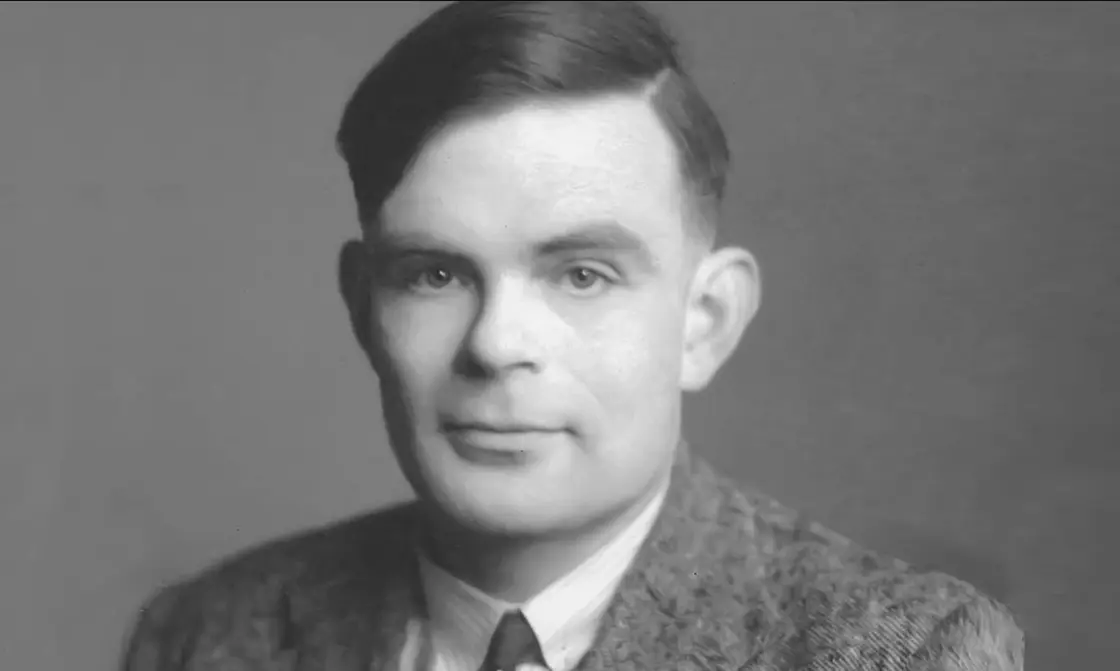
Alan Turing (1912–1954) was a pioneering British mathematician, logician, and computer scientist whose work laid the foundations of modern computing and artificial intelligence. Born in London, Turing studied at King’s College, Cambridge, and later at Princeton University, where he earned his PhD in 1938.
Turing’s most influential contribution was the concept of the “Turing machine,” a theoretical device introduced in his 1936 paper “On Computable Numbers,” which demonstrated the limits of what can be computed algorithmically and established the principles of universal computation. During World War II, he played a crucial role at Bletchley Park, leading efforts to break the German Enigma code using early electromechanical devices like the Bombe, which significantly shortened the war and saved countless lives.
In the post-war era, Turing advanced the field of computer science with his designs for the Automatic Computing Engine (ACE) and his work on programmable computers. He also proposed the “Turing Test” in his 1950 paper “Computing Machinery and Intelligence,” a benchmark for determining a machine’s ability to exhibit intelligent behavior indistinguishable from a human.
Despite his achievements, Turing faced persecution for his homosexuality, leading to his conviction in 1952 and chemical treatment that contributed to his untimely death. His legacy endures as a symbol of innovation and a pioneer in AI and cryptography, influencing fields from software development to modern digital technology. In 2013, he received a posthumous royal pardon, and he is widely regarded as the “father of computer science.”
Table of Contents
- Part 1: OnlineExamMaker AI Quiz Generator – The Easiest Way to Make Quizzes Online
- Part 2: 20 Alan Turing Quiz Questions & Answers
- Part 3: Save Time and Energy: Generate Quiz Questions with AI Technology
Part 1: OnlineExamMaker AI Quiz Generator – The Easiest Way to Make Quizzes Online
When it comes to ease of creating a Alan Turing skills assessment, OnlineExamMaker is one of the best AI-powered quiz making software for your institutions or businesses. With its AI Question Generator, just upload a document or input keywords about your assessment topic, you can generate high-quality quiz questions on any topic, difficulty level, and format.
What you will like:
● AI Question Generator to help you save time in creating quiz questions automatically.
● Share your online exam with audiences on social platforms like Facebook, Twitter, Reddit and more.
● Display the feedback for correct or incorrect answers instantly after a question is answered.
● Create a lead generation form to collect an exam taker’s information, such as email, mobile phone, work title, company profile and so on.
Automatically generate questions using AI
Part 2: 20 Alan Turing Quiz Questions & Answers
or
Question 1:
What is Alan Turing best known for in the field of computer science?
A) Inventing the first electronic computer
B) Developing the concept of the Turing machine
C) Creating the first programming language
D) Building the first microprocessor
Answer: B
Explanation: The Turing machine is a theoretical model of computation that Turing introduced in 1936, which laid the foundation for modern computer science by defining what is computable.
Question 2:
In which year was Alan Turing born?
A) 1912
B) 1906
C) 1920
D) 1895
Answer: A
Explanation: Alan Turing was born on June 23, 1912, in Maida Vale, London, and he went on to become a pivotal figure in mathematics and computing.
Question 3:
What was the name of the machine that Turing helped decrypt during World War II?
A) Colossus
B) Enigma
C) Bombe
D) Z3
Answer: C
Explanation: Turing played a key role in developing the Bombe machine, which was used to break the Enigma code used by the Germans, significantly aiding the Allied efforts.
Question 4:
Which test did Alan Turing propose to determine if a machine can exhibit intelligent behavior?
A) Intelligence Quotient Test
B) Turing Test
C) Von Neumann Test
D) Artificial Intelligence Benchmark
Answer: B
Explanation: The Turing Test, proposed in 1950, evaluates a machine’s ability to exhibit intelligent behavior equivalent to, or indistinguishable from, that of a human.
Question 5:
What was Alan Turing’s academic background?
A) He studied physics at Oxford
B) He studied mathematics at Cambridge
C) He studied engineering at MIT
D) He studied philosophy at Harvard
Answer: B
Explanation: Turing studied mathematics at King’s College, Cambridge, where he earned his degree and later pursued his PhD at Princeton University.
Question 6:
What significant mathematical problem did Turing address in his 1936 paper?
A) The halting problem
B) Fermat’s Last Theorem
C) The Riemann Hypothesis
D) Euler’s Identity
Answer: A
Explanation: In his paper “On Computable Numbers,” Turing explored the halting problem, proving that there is no general algorithm to solve it for all possible programs.
Question 7:
During World War II, where did Alan Turing work on code-breaking?
A) Bletchley Park
B) Los Alamos
C) The Pentagon
D) Cambridge University
Answer: A
Explanation: Turing worked at Bletchley Park, the center of British code-breaking efforts, where he contributed to decrypting German communications.
Question 8:
What award did Alan Turing receive posthumously in 2013?
A) Nobel Prize in Physics
B) Royal Medal
C) Presidential Medal of Freedom
D) Turing Award
Answer: C
Explanation: In 2013, Alan Turing was awarded the Presidential Medal of Freedom by U.S. President Barack Obama for his contributions to computer science and wartime efforts.
Question 9:
Which of the following best describes Turing’s universal machine?
A) A machine that can simulate any other Turing machine
B) A physical computer built in the 1940s
C) A programming language for encryption
D) A device for solving mathematical equations
Answer: A
Explanation: The universal Turing machine, as described in Turing’s work, is a single machine that can simulate the behavior of any other Turing machine, demonstrating the principle of programmability.
Question 10:
What was the cause of Alan Turing’s death?
A) Natural causes
B) Suicide by cyanide poisoning
C) Car accident
D) Illness from wartime injuries
Answer: B
Explanation: Turing died on June 7, 1954, from cyanide poisoning, which was ruled a suicide, amid personal struggles including chemical castration as a result of his conviction for homosexuality.
Question 11:
In what year did Alan Turing publish his paper on the “Imitation Game”?
A) 1945
B) 1950
C) 1936
D) 1948
Answer: B
Explanation: Turing’s paper “Computing Machinery and Intelligence,” published in 1950, introduced the concept of the Imitation Game, now known as the Turing Test.
Question 12:
What role did Turing play in the development of early computers?
A) He designed the first stored-program computer
B) He built the ENIAC
C) He invented the transistor
D) He created the first graphical user interface
Answer: A
Explanation: Turing’s ideas influenced the design of the Automatic Computing Engine (ACE), and he contributed to the concept of stored-program computers at the National Physical Laboratory.
Question 13:
Which country was Alan Turing a citizen of?
A) United States
B) Germany
C) United Kingdom
D) France
Answer: C
Explanation: Alan Turing was a British citizen, born and raised in the UK, and he served his country in various capacities, including during World War II.
Question 14:
What field did Turing contribute to beyond computing and cryptography?
A) Biology and morphogenesis
B) Astronomy
C) Chemistry
D) Economics
Answer: A
Explanation: In his later years, Turing worked on mathematical biology, particularly on the chemical basis of morphogenesis, exploring how patterns form in nature.
Question 15:
How did society treat Turing regarding his sexuality?
A) He was celebrated for it
B) He was prosecuted under anti-homosexuality laws
C) It was ignored
D) It helped his career
Answer: B
Explanation: In 1952, Turing was convicted of gross indecency for his homosexual relationship, leading to a choice between imprisonment and chemical castration, which affected his life profoundly.
Question 16:
What is the significance of the Turing Award?
A) It is given for contributions to artificial intelligence
B) It is the highest honor in computer science
C) It recognizes breakthroughs in cryptography
D) It is for mathematical achievements
Answer: B
Explanation: The Turing Award, often called the “Nobel Prize of Computing,” is given by the ACM for major contributions to the computer field, named in honor of Alan Turing.
Question 17:
Which university did Turing attend for his PhD?
A) Oxford University
B) Cambridge University
C) Princeton University
D) Harvard University
Answer: C
Explanation: Turing earned his PhD from Princeton University in 1938, under the supervision of Alonzo Church, where he worked on the foundations of computability.
Question 18:
What was the outcome of Turing’s work on the Enigma code?
A) It shortened the war by several years
B) It had no significant impact
C) It was unsuccessful
D) It was only used after the war
Answer: A
Explanation: Turing’s decryption efforts at Bletchley Park are credited with shortening World War II by enabling the Allies to read German messages and make strategic decisions.
Question 19:
In Turing’s view, what was the key to artificial intelligence?
A) Building machines that can learn from experience
B) Focusing on hardware speed
C) Copying human brain structure exactly
D) Using quantum computing
Answer: A
Explanation: Turing believed that machines could achieve intelligence through learning and adaptation, as outlined in his discussions on machine learning and the Turing Test.
Question 20:
What posthumous pardon did Alan Turing receive?
A) From the British government in 2013
B) From the United Nations in 2000
C) From the U.S. government in 1954
D) None, as he was never convicted
Answer: A
Explanation: In 2013, Queen Elizabeth II granted a posthumous royal pardon to Turing for his 1952 conviction, recognizing the injustice of his treatment.
or
Part 3: Save Time and Energy: Generate Quiz Questions with AI Technology
Automatically generate questions using AI