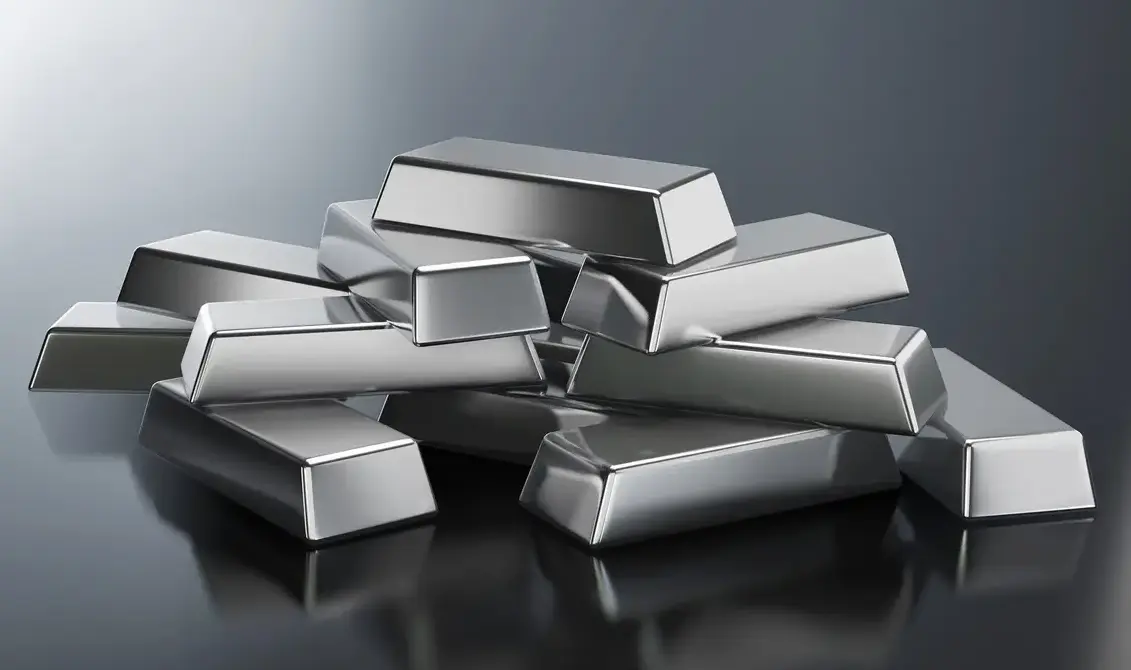
Silver, a chemical element with the symbol Ag and atomic number 47, is a lustrous white metal renowned for its malleability, ductility, and excellent conductivity of heat and electricity. As one of the precious metals, it has been valued for thousands of years, dating back to ancient civilizations like the Egyptians and Romans, who used it for currency, jewelry, and decorative arts.
Physically, silver is the best reflector of visible light, making it ideal for mirrors and optical devices. It is also highly resistant to corrosion, though it tarnishes when exposed to sulfur compounds in the air. Chemically, silver forms compounds like silver nitrate, which is used in photography, medicine, and electronics.
Historically, silver played a pivotal role in trade and economics, serving as the basis for many currencies, including the Spanish dollar that influenced modern coinage. The discovery of vast silver deposits in the Americas during the 16th century fueled global exploration and wealth accumulation.
In modern times, silver’s applications are diverse: it’s essential in electronics for conductive materials in circuits and solar panels; in medicine for antimicrobial properties in wound dressings and water purification; in jewelry and silverware for its aesthetic appeal; and in photography for film development. Its industrial demand continues to grow, driven by renewable energy technologies and electric vehicles.
Economically, silver is traded as a commodity on global markets, often influenced by mining output, industrial needs, and investor sentiment. While not as rare as gold, its price volatility makes it a popular hedge against inflation and economic uncertainty.
Table of Contents
- Part 1: OnlineExamMaker AI Quiz Generator – Save Time and Efforts
- Part 2: 20 Silver Quiz Questions & Answers
- Part 3: Automatically Generate Quiz Questions Using AI Question Generator
Part 1: OnlineExamMaker AI Quiz Generator – Save Time and Efforts
Still spend a lot of time in editing questions for your next Silver assessment? OnlineExamMaker is an AI quiz maker that leverages artificial intelligence to help users create quizzes, tests, and assessments quickly and efficiently. You can start by inputting a topic or specific details into the OnlineExamMaker AI Question Generator, and the AI will generate a set of questions almost instantly. It also offers the option to include answer explanations, which can be short or detailed, helping learners understand their mistakes.
What you may like:
● Automatic grading and insightful reports. Real-time results and interactive feedback for quiz-takers.
● The exams are automatically graded with the results instantly, so that teachers can save time and effort in grading.
● LockDown Browser to restrict browser activity during quizzes to prevent students searching answers on search engines or other software.
● OnlineExamMaker API offers private access for developers to extract your exam data back into your system automatically.
Automatically generate questions using AI
Part 2: 20 Silver Quiz Questions & Answers
or
1. Question: What is the chemical symbol for silver?
A) Ag
B) Si
C) Au
D) Sr
Answer: A) Ag
Explanation: Silver’s chemical symbol is derived from its Latin name, “argentum,” which is commonly abbreviated as Ag in the periodic table.
2. Question: Which group in the periodic table does silver belong to?
A) Alkali metals
B) Halogens
C) Transition metals
D) Noble gases
Answer: C) Transition metals
Explanation: Silver is classified as a transition metal due to its position in the d-block of the periodic table and its metallic properties.
3. Question: What is the atomic number of silver?
A) 29
B) 47
C) 79
D) 50
Answer: B) 47
Explanation: Silver has an atomic number of 47, meaning it has 47 protons in its nucleus.
4. Question: Silver is known for its high electrical conductivity. What property makes it suitable for electrical applications?
A) Low density
B) High melting point
C) Excellent conductivity
D) Reactivity with oxygen
Answer: C) Excellent conductivity
Explanation: Silver has one of the highest electrical and thermal conductivities among metals, making it ideal for wiring and electronics.
5. Question: In what form is silver commonly found in nature?
A) As pure nuggets
B) In compounds like silver sulfide
C) As a gas
D) In organic matter
Answer: B) In compounds like silver sulfide
Explanation: Silver is often found in ores such as argentite (silver sulfide), rather than in its pure form.
6. Question: What color is pure silver?
A) Yellow
B) White-gray
C) Red
D) Green
Answer: B) White-gray
Explanation: In its pure state, silver appears as a lustrous white-gray metal, though it tarnishes over time.
7. Question: Which ancient civilization was known for using silver in coinage?
A) Egyptians
B) Romans
C) Greeks
D) All of the above
Answer: D) All of the above
Explanation: Silver was used for coins by multiple ancient civilizations, including the Egyptians, Romans, and Greeks, due to its durability and value.
8. Question: What is the process called when silver is extracted from its ore using cyanide?
A) Smelting
B) Leaching
C) Electrolysis
D) Refining
Answer: B) Leaching
Explanation: The cyanide process, or leaching, is used to extract silver from low-grade ores by dissolving it in a cyanide solution.
9. Question: Silver iodide is commonly used in which application?
A) Photography
B) Cloud seeding
C) Jewelry
D) Medicine
Answer: B) Cloud seeding
Explanation: Silver iodide is used in cloud seeding to induce rainfall by acting as nuclei for water droplets in clouds.
10. Question: What is the melting point of silver in degrees Celsius?
A) 961°C
B) 1085°C
C) 660°C
D) 1538°C
Answer: A) 961°C
Explanation: Silver has a melting point of approximately 961 degrees Celsius, which is relatively low for a metal.
11. Question: Which alloy is made by combining silver and copper?
A) Brass
B) Sterling silver
C) Bronze
D) Steel
Answer: B) Sterling silver
Explanation: Sterling silver is an alloy typically composed of 92.5% silver and 7.5% copper, making it more durable for jewelry.
12. Question: Silver is resistant to which type of corrosion?
A) Oxidation
B) Tarnishing
C) Rusting
D) It is not resistant to any
Answer: C) Rusting
Explanation: Silver does not rust like iron because it is a noble metal, though it can tarnish when exposed to sulfur compounds.
13. Question: In photography, what role does silver halide play?
A) As a developer
B) As a fixer
C) As a light-sensitive compound
D) As a printer
Answer: C) As a light-sensitive compound
Explanation: Silver halides, like silver bromide, are used in photographic film because they react to light, forming images.
14. Question: What is the primary use of colloidal silver?
A) In electronics
B) As an antimicrobial agent
C) In construction
D) As a fuel
Answer: B) As an antimicrobial agent
Explanation: Colloidal silver is used for its antibacterial properties in various medical and household applications.
15. Question: Silver’s density is approximately how many grams per cubic centimeter?
A) 10.5 g/cm³
B) 7.8 g/cm³
C) 19.3 g/cm³
D) 2.7 g/cm³
Answer: A) 10.5 g/cm³
Explanation: Silver has a density of about 10.5 grams per cubic centimeter, which is higher than most common metals.
16. Question: Which country is the largest producer of silver in the world?
A) United States
B) Mexico
C) China
D) Peru
Answer: D) Peru
Explanation: Peru is currently one of the top producers of silver, largely from its mining operations.
17. Question: What happens when silver reacts with sulfur?
A) It forms silver sulfide
B) It produces hydrogen gas
C) It becomes magnetic
D) It dissolves in water
Answer: A) It forms silver sulfide
Explanation: Silver reacts with sulfur to form silver sulfide, which causes tarnishing on silver objects.
18. Question: Silver nanoparticles are used in which modern technology?
A) Solar panels
B) Antibacterial coatings
C) Car engines
D) Wind turbines
Answer: B) Antibacterial coatings
Explanation: Silver nanoparticles are incorporated into coatings for their ability to kill bacteria, used in medical devices and fabrics.
19. Question: What is the valence electron configuration of silver?
A) 5s1 4d10
B) 4s2 3d10
C) 6s1 4f14 5d10
D) 5s2 4d8
Answer: A) 5s1 4d10
Explanation: Silver’s electron configuration is [Kr] 4d10 5s1, indicating one valence electron in the 5s orbital.
20. Question: Why is silver often plated onto other metals?
A) To increase weight
B) For aesthetic and conductive purposes
C) To make it magnetic
D) To reduce cost
Answer: B) For aesthetic and conductive purposes
Explanation: Silver plating is done to enhance the appearance and improve electrical conductivity of the base metal.
or
Part 3: Automatically generate quiz questions using OnlineExamMaker AI Question Generator
Automatically generate questions using AI