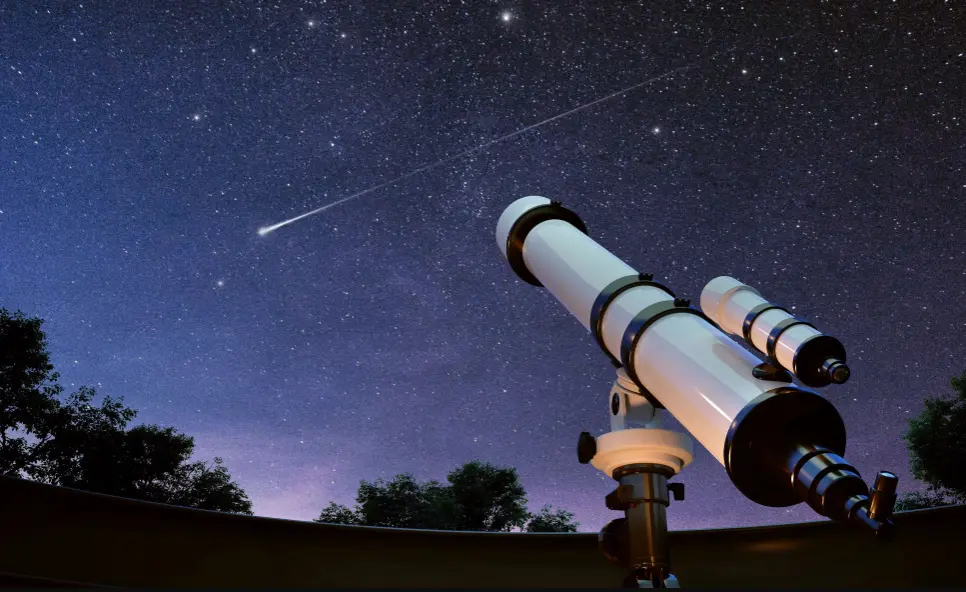
Telescopes are optical instruments designed to observe distant objects by collecting and focusing electromagnetic radiation, such as visible light, from space. They have revolutionized astronomy and our understanding of the universe.
History
The first practical telescope was invented in the early 17th century by Dutch spectacle maker Hans Lippershey, though Galileo Galilei is credited with making significant improvements and using it for astronomical observations in 1609. Over time, telescopes evolved from simple refracting models to more advanced designs, including reflecting telescopes pioneered by Isaac Newton in 1668.
Types of Telescopes
1. Refracting Telescopes: Use lenses to bend and focus light. They are simple and effective for viewing the moon and planets but can suffer from chromatic aberration (color distortion).
2. Reflecting Telescopes: Employ mirrors to collect and focus light, reducing aberrations. Popular designs include the Newtonian reflector and the Cassegrain reflector. These are widely used in professional observatories.
3. Catadioptric Telescopes: Combine lenses and mirrors, such as in Schmidt-Cassegrain or Maksutov designs, offering compact size and versatility for both terrestrial and celestial viewing.
4. Radio Telescopes: Detect radio waves from space rather than visible light. Examples include the Very Large Array (VLA) in New Mexico, used to study phenomena like quasars and pulsars.
5. Space Telescopes: Orbit Earth to avoid atmospheric distortion, such as the Hubble Space Telescope (launched in 1990) and the James Webb Space Telescope (launched in 2021), which observe in various wavelengths including infrared.
How Telescopes Work
Telescopes work by gathering light from distant objects and magnifying the image. The primary components include:
– Objective Lens or Mirror: Collects light and forms an image.
– Eyepiece: Magnifies the image for viewing.
– Mount and Tripod: Stabilizes the telescope for steady observation.
Key principles include magnification (enlarging the image) and resolution (ability to distinguish fine details), which depend on the telescope’s aperture (diameter of the lens or mirror).
Applications
– Astronomy: Used to study stars, galaxies, nebulae, and other celestial bodies.
– Scientific Research: Help in discovering exoplanets, black holes, and cosmic phenomena.
– Education and Hobbyist Use: Accessible for amateur astronomers to explore the night sky.
– Other Fields: Applied in surveillance, wildlife observation, and even military reconnaissance.
Advantages and Limitations
Telescopes provide enhanced visibility of faint objects and detailed views of the cosmos, but factors like atmospheric turbulence, light pollution, and cost can limit their effectiveness. Modern advancements, such as adaptive optics and digital imaging, continue to improve performance.
In summary, telescopes remain essential tools for exploration, bridging human curiosity with the vast unknowns of the universe.
Table of Contents
- Part 1: Best AI Quiz Making Software for Creating A Telescopes Quiz
- Part 2: 20 Telescopes Quiz Questions & Answers
- Part 3: OnlineExamMaker AI Question Generator: Generate Questions for Any Topic
Part 1: Best AI Quiz Making Software for Creating A Telescopes Quiz
Nowadays more and more people create Telescopes quizzes using AI technologies, OnlineExamMaker a powerful AI-based quiz making tool that can save you time and efforts. The software makes it simple to design and launch interactive quizzes, assessments, and surveys. With the Question Editor, you can create multiple-choice, open-ended, matching, sequencing and many other types of questions for your tests, exams and inventories. You are allowed to enhance quizzes with multimedia elements like images, audio, and video to make them more interactive and visually appealing.
Take a product tour of OnlineExamMaker:
● Create a question pool through the question bank and specify how many questions you want to be randomly selected among these questions.
● Build and store questions in a centralized portal, tagged by categories and keywords for easy reuse and organization.
● Simply copy a few lines of codes, and add them to a web page, you can present your online quiz in your website, blog, or landing page.
● Randomize questions or change the order of questions to ensure exam takers don’t get the same set of questions each time.
Automatically generate questions using AI
Part 2: 20 Telescopes Quiz Questions & Answers
or
1. What type of telescope uses lenses to gather and focus light?
A. Reflecting telescope
B. Refracting telescope
C. Radio telescope
D. Catadioptric telescope
Answer: B
Explanation: Refracting telescopes use lenses to bend light rays, making them suitable for observing planets and stars by magnifying images through refraction.
2. Who is credited with building the first practical telescope?
A. Isaac Newton
B. Galileo Galilei
C. Johannes Kepler
D. Hans Lippershey
Answer: D
Explanation: Hans Lippershey is credited with inventing the first practical telescope in 1608, which used lenses to magnify distant objects.
3. What is the primary function of the objective lens in a refracting telescope?
A. To magnify the image
B. To gather light and form an image
C. To focus the eyepiece
D. To block out light
Answer: B
Explanation: The objective lens collects and focuses incoming light to form a real image at the focal point, which is then magnified by the eyepiece.
4. Which telescope type uses a mirror to collect light?
A. Refracting telescope
B. Reflecting telescope
C. Schmidt-Cassegrain telescope
D. Both B and C
Answer: D
Explanation: Reflecting telescopes use mirrors to gather light, and Schmidt-Cassegrain telescopes are a hybrid that also use mirrors in their design.
5. What does the term “aperture” refer to in telescopes?
A. The length of the telescope tube
B. The diameter of the primary lens or mirror
C. The magnification power
D. The weight of the telescope
Answer: B
Explanation: Aperture is the diameter of the telescope’s primary optical element, which determines how much light it can gather and its resolution.
6. Which factor primarily affects a telescope’s ability to resolve fine details?
A. Magnification
B. Focal length
C. Aperture size
D. Eyepiece diameter
Answer: C
Explanation: A larger aperture allows more light to enter and improves the telescope’s resolution, enabling it to distinguish between closely spaced objects.
7. What is a radio telescope used for?
A. Observing visible light from stars
B. Detecting radio waves from celestial objects
C. Magnifying planets with lenses
D. Blocking infrared radiation
Answer: B
Explanation: Radio telescopes detect radio frequency emissions from objects like quasars and pulsars, allowing astronomers to study phenomena not visible in optical wavelengths.
8. In a reflecting telescope, what role does the secondary mirror play?
A. It gathers light initially
B. It reflects light to the eyepiece
C. It magnifies the image
D. It filters out colors
Answer: B
Explanation: The secondary mirror redirects the light focused by the primary mirror toward the eyepiece, making it easier to view the image.
9. What is chromatic aberration in telescopes?
A. Distortion caused by mirrors
B. Color fringing due to lens dispersion
C. Blurring from atmospheric interference
D. Over-magnification of images
Answer: B
Explanation: Chromatic aberration occurs when different colors of light are focused at slightly different points by a lens, causing a rainbow-like effect around bright objects.
10. Which telescope is best for observing faint, deep-sky objects like galaxies?
A. Small refracting telescope
B. Large reflecting telescope
C. Portable radio telescope
D. Solar telescope
Answer: B
Explanation: Large reflecting telescopes have greater light-gathering power due to their mirrors, making them ideal for viewing dim objects in deep space.
11. What is the purpose of a telescope’s eyepiece?
A. To collect light
B. To magnify the image formed by the objective
C. To stabilize the telescope
D. To filter ultraviolet rays
Answer: B
Explanation: The eyepiece magnifies the image produced by the objective lens or mirror, allowing the observer to see details more clearly.
12. How does a catadioptric telescope differ from pure reflecting or refracting telescopes?
A. It uses only lenses
B. It combines lenses and mirrors
C. It uses only mirrors
D. It does not use optics
Answer: B
Explanation: Catadioptric telescopes integrate both lenses and mirrors, providing a compact design with corrected aberrations, such as in Schmidt-Cassegrain models.
13. What is the main advantage of a Dobsonian telescope?
A. High portability
B. Low cost and large aperture
C. Ability to observe radio waves
D. Automatic tracking
Answer: B
Explanation: Dobsonian telescopes are simple, affordable designs that allow for large apertures, making them excellent for amateur astronomers observing deep-sky objects.
14. Why are space telescopes like the Hubble superior to ground-based ones?
A. They are cheaper to build
B. They avoid atmospheric distortion
C. They use smaller apertures
D. They require less maintenance
Answer: B
Explanation: Space telescopes operate above Earth’s atmosphere, eliminating issues like twinkling and absorption, which results in sharper and clearer images.
15. What is the focal length of a telescope?
A. The distance from the eyepiece to the eye
B. The diameter of the lens
C. The distance from the objective to the focal point
D. The total weight of the telescope
Answer: C
Explanation: Focal length is the distance from the objective lens or mirror to the point where it focuses parallel rays of light, affecting magnification and field of view.
16. Which type of telescope is most commonly used for solar observation?
A. Refracting telescope
B. Hydrogen-alpha telescope
C. Radio telescope
D. Newtonian telescope
Answer: B
Explanation: Hydrogen-alpha telescopes are specialized for viewing the sun’s chromosphere by filtering light at the hydrogen-alpha wavelength, ensuring safe observation.
17. How does magnification in a telescope work?
A. By increasing the aperture size
B. By dividing the focal length of the objective by that of the eyepiece
C. By adding more lenses
D. By reducing light intake
Answer: B
Explanation: Magnification is calculated as the ratio of the objective’s focal length to the eyepiece’s focal length, determining how much larger an object appears.
18. What causes spherical aberration in telescopes?
A. Light bending unevenly by a spherical mirror or lens
B. Color separation in lenses
C. Dust on the mirror
D. Incorrect eyepiece alignment
Answer: A
Explanation: Spherical aberration happens when light rays at the edge of a spherical lens or mirror focus at a different point than those at the center, blurring the image.
19. Which telescope design was invented by Isaac Newton?
A. Refracting telescope
B. Reflecting telescope
C. Catadioptric telescope
D. Radio telescope
Answer: B
Explanation: Isaac Newton invented the reflecting telescope in 1668, using a mirror to avoid chromatic aberration issues found in refracting telescopes.
20. What is the key benefit of using adaptive optics in modern telescopes?
A. Increasing the telescope’s size
B. Correcting for atmospheric distortion in real-time
C. Reducing the need for mirrors
D. Enhancing color accuracy
Answer: B
Explanation: Adaptive optics systems adjust the telescope’s mirrors to compensate for the blurring effects of Earth’s atmosphere, improving image sharpness.
or
Part 3: OnlineExamMaker AI Question Generator: Generate Questions for Any Topic
Automatically generate questions using AI