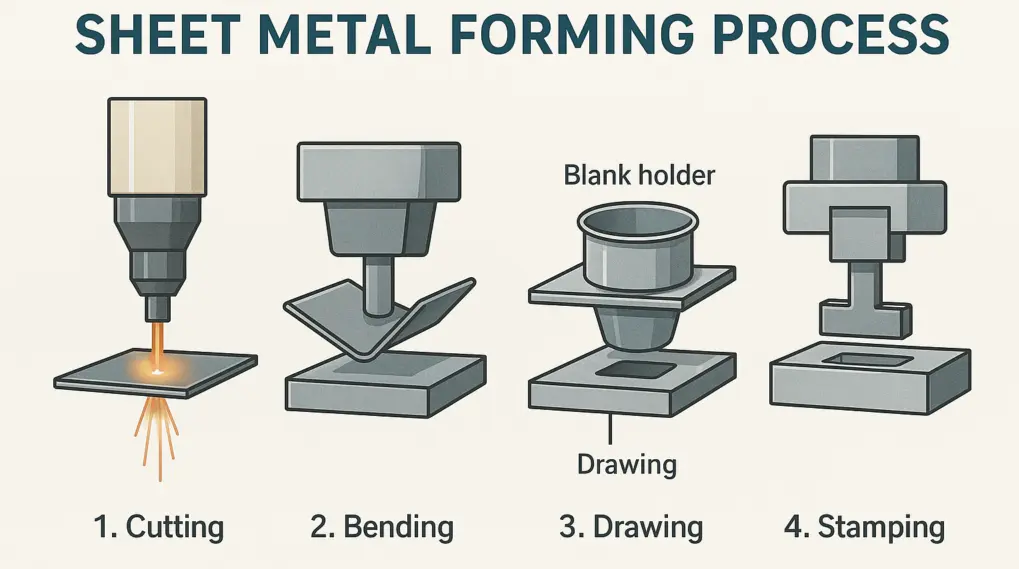
Metal forming is a versatile manufacturing process that shapes metal workpieces through controlled deformation, utilizing techniques such as rolling, forging, extrusion, and drawing. This method alters the metal’s geometry without removing material, resulting in components that are strong, precise, and efficient for applications in industries like automotive, aerospace, and construction. By applying force through tools or dies, metal forming enhances material properties, reduces waste, and enables the production of complex shapes with high repeatability and cost-effectiveness.
Table of Contents
- Part 1: OnlineExamMaker AI Quiz Generator – Save Time and Efforts
- Part 2: 20 Metal Forming Quiz Questions & Answers
- Part 3: Automatically Generate Quiz Questions Using AI Question Generator
Part 1: OnlineExamMaker AI Quiz Generator – Save Time and Efforts
What’s the best way to create a Metal Forming quiz online? OnlineExamMaker is the best AI quiz making software for you. No coding, and no design skills required. If you don’t have the time to create your online quiz from scratch, you are able to use OnlineExamMaker AI Question Generator to create question automatically, then add them into your online assessment. What is more, the platform leverages AI proctoring and AI grading features to streamline the process while ensuring exam integrity.
Key features of OnlineExamMaker:
● Combines AI webcam monitoring to capture cheating activities during online exam.
● Allow the quiz taker to answer by uploading video or a Word document, adding an image, and recording an audio file.
● Automatically scores multiple-choice, true/false, and even open-ended/audio responses using AI, reducing manual work.
● OnlineExamMaker API offers private access for developers to extract your exam data back into your system automatically.
Automatically generate questions using AI
Part 2: 20 Metal Forming Quiz Questions & Answers
or
1. Question: What is the primary deformation mechanism in metal forming processes like rolling?
Options:
A. Tension
B. Compression
C. Shear
D. Torsion
Answer: B
Explanation: Compression is the main mechanism in rolling as it involves reducing the cross-section of metal by applying forces between rolls.
2. Question: Which metal forming process is used to produce long, straight products like rods and wires?
Options:
A. Forging
B. Extrusion
C. Drawing
D. Rolling
Answer: C
Explanation: Drawing pulls metal through a die to reduce its diameter, making it ideal for producing rods and wires.
3. Question: In forging, what type of force is primarily applied to shape the metal?
Options:
A. Tensile force
B. Compressive force
C. Shear force
D. Bending force
Answer: B
Explanation: Forging uses compressive forces to deform metal into desired shapes, improving its mechanical properties.
4. Question: Which process involves forcing metal through a die to create a specific cross-section?
Options:
A. Rolling
B. Extrusion
C. Bending
D. Stamping
Answer: B
Explanation: Extrusion pushes metal through a die, allowing for the creation of complex profiles with a uniform cross-section.
5. Question: What is the main advantage of hot working in metal forming?
Options:
A. Improved surface finish
B. Reduced ductility
C. Lower energy requirements
D. Increased formability
Answer: D
Explanation: Hot working heats the metal above its recrystallization temperature, making it more ductile and easier to form without cracking.
6. Question: Which metal forming technique is commonly used for producing sheet metal components?
Options:
A. Casting
B. Deep drawing
C. Machining
D. Welding
Answer: B
Explanation: Deep drawing forms sheet metal into cups or boxes by stretching it over a punch and into a die.
7. Question: In cold working, what happens to the metal’s strength?
Options:
A. It decreases
B. It remains the same
C. It increases due to work hardening
D. It becomes zero
Answer: C
Explanation: Cold working deforms metal at room temperature, leading to work hardening that increases its strength and hardness.
8. Question: What defect is commonly associated with improper lubrication in metal forming?
Options:
A. Warping
B. Galling
C. Cracking
D. Porosity
Answer: B
Explanation: Galling occurs when metal surfaces seize due to friction, often from inadequate lubrication during forming processes.
9. Question: Which process is ideal for producing seamless tubes?
Options:
A. Rolling
B. Extrusion
C. Forging
D. Spinning
Answer: B
Explanation: Extrusion can produce seamless tubes by forcing metal through a die without any welded seams.
10. Question: What is the purpose of annealing in metal forming?
Options:
A. To increase hardness
B. To relieve internal stresses
C. To add alloys
D. To speed up forming
Answer: B
Explanation: Annealing heats and cools metal slowly to relieve internal stresses and restore ductility after forming.
11. Question: In rolling, what factor primarily determines the final thickness of the metal?
Options:
A. Roll speed
B. Roll diameter
C. Roll gap
D. Metal temperature
Answer: C
Explanation: The roll gap sets the distance between the rolls, directly controlling the thickness of the rolled metal.
12. Question: Which metal forming process involves hammering or pressing metal into shape?
Options:
A. Extrusion
B. Forging
C. Drawing
D. Bending
Answer: B
Explanation: Forging uses hammering or pressing to shape metal, enhancing its grain structure and strength.
13. Question: What is a key disadvantage of cold forming compared to hot forming?
Options:
A. Higher energy use
B. Poor surface finish
C. Limited formability
D. Increased cost
Answer: C
Explanation: Cold forming has limited formability because the metal is less ductile at room temperature, potentially leading to fractures.
14. Question: In extrusion, what type of flow occurs when metal is forced through a die?
Options:
A. Laminar flow
B. Turbulent flow
C. Plastic flow
D. Elastic flow
Answer: C
Explanation: Extrusion involves plastic flow, where the metal deforms permanently under pressure to take the shape of the die.
15. Question: Which material property is most important for successful deep drawing?
Options:
A. High yield strength
B. Good ductility
C. Low density
D. High melting point
Answer: B
Explanation: Good ductility allows the metal to stretch without breaking during the deep drawing process.
16. Question: What causes springback in metal forming?
Options:
A. Elastic recovery
B. Plastic deformation
C. Heat treatment
D. Alloy addition
Answer: A
Explanation: Springback occurs due to the elastic recovery of the metal after the forming forces are removed, causing it to revert partially to its original shape.
17. Question: In which metal forming process is the metal blank cut and shaped in a single operation?
Options:
A. Rolling
B. Stamping
C. Extrusion
D. Forging
Answer: B
Explanation: Stamping uses dies to cut and shape metal blanks in one operation, making it efficient for mass production.
18. Question: What is the primary benefit of using lubricants in metal forming?
Options:
A. To increase friction
B. To reduce tool wear
C. To add color to metal
D. To harden the surface
Answer: B
Explanation: Lubricants minimize friction between the tool and metal, reducing wear on the tools and improving surface quality.
19. Question: Which process is used to form hollow parts like cylinders?
Options:
A. Drawing
B. Spinning
C. Rolling
D. Forging
Answer: B
Explanation: Spinning rotates and shapes a metal disc over a mandrel to form hollow, symmetrical parts like cylinders.
20. Question: How does grain size affect metal forming?
Options:
A. Larger grains improve formability
B. Smaller grains increase strength but reduce ductility
C. Grain size has no effect
D. Only affects hot working
Answer: B
Explanation: Smaller grains in metal increase strength through work hardening but can reduce ductility, making forming more challenging.
or
Part 3: Automatically generate quiz questions using OnlineExamMaker AI Question Generator
Automatically generate questions using AI