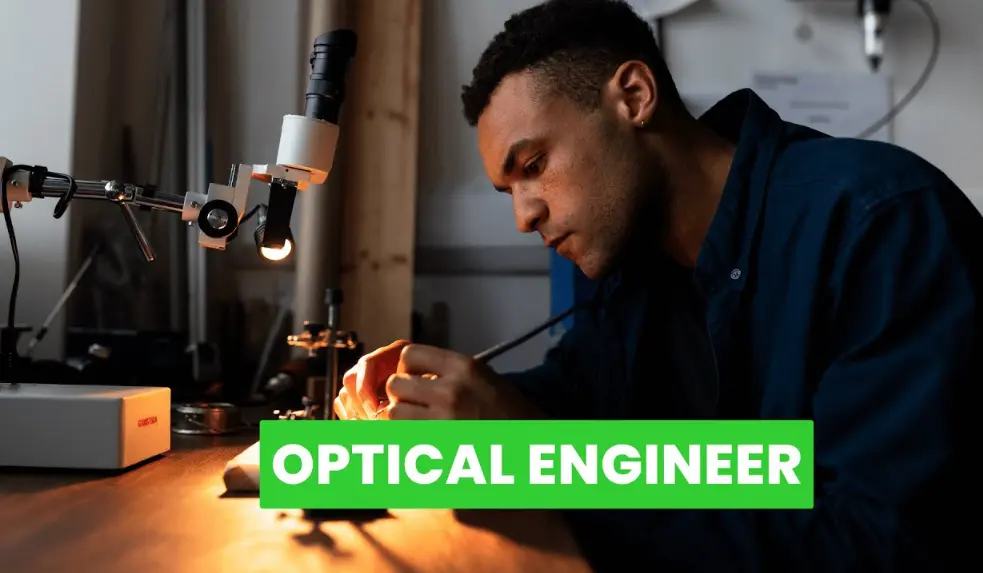
Optical Engineering is a multidisciplinary field that focuses on the design, development, and application of optical systems and devices to manipulate light for practical purposes. It combines principles from physics, engineering, and materials science to control the behavior of light waves, including their generation, propagation, detection, and interaction with matter.
At its core, optical engineering relies on fundamental concepts such as refraction, reflection, diffraction, and interference. Key tools include lenses, mirrors, prisms, and advanced components like lasers and optical fibers. The field applies the laws of optics, including Snell’s Law and Maxwell’s equations, to create systems that manage light efficiently.
Subfields within optical engineering encompass a wide range of applications. For instance, geometric optics deals with ray tracing for imaging systems, while physical optics addresses wave phenomena like polarization and coherence. Other areas include photonics, which involves the generation and manipulation of light particles (photons), and optoelectronics, which integrates optical and electronic devices.
Applications of optical engineering are vast and transformative. In telecommunications, fiber optic cables enable high-speed data transmission over long distances. In medicine, technologies like endoscopes and laser surgery provide minimally invasive procedures. Manufacturing benefits from precision tools such as optical sensors for quality control and lithography for semiconductor fabrication. Additionally, it’s crucial in astronomy for telescopes, in consumer electronics for cameras and displays, and in environmental monitoring for remote sensing.
The field’s evolution has been driven by innovations like the laser in the 1960s and the development of integrated optics. Today, emerging trends include nanophotonics, which explores light at the nanoscale for faster computing, and adaptive optics for real-time correction in telescopes. As demand grows for efficient energy systems and advanced imaging, optical engineering continues to play a pivotal role in technological advancement, bridging science and practical innovation.
Table of Contents
- Part 1: Create A Optical Engineering Quiz in Minutes Using AI with OnlineExamMaker
- Part 2: 20 Optical Engineering Quiz Questions & Answers
- Part 3: Try OnlineExamMaker AI Question Generator to Create Quiz Questions
Part 1: Create A Optical Engineering Quiz in Minutes Using AI with OnlineExamMaker
Are you looking for an online assessment to test the Optical Engineering skills of your learners? OnlineExamMaker uses artificial intelligence to help quiz organizers to create, manage, and analyze exams or tests automatically. Apart from AI features, OnlineExamMaker advanced security features such as full-screen lockdown browser, online webcam proctoring, and face ID recognition.
Recommended features for you:
● Includes a safe exam browser (lockdown mode), webcam and screen recording, live monitoring, and chat oversight to prevent cheating.
● Enhances assessments with interactive experience by embedding video, audio, image into quizzes and multimedia feedback.
● Once the exam ends, the exam scores, question reports, ranking and other analytics data can be exported to your device in Excel file format.
● Offers question analysis to evaluate question performance and reliability, helping instructors optimize their training plan.
Automatically generate questions using AI
Part 2: 20 Optical Engineering Quiz Questions & Answers
or
Question 1:
What is the angle of reflection equal to in the law of reflection?
A) Angle of incidence
B) Angle of refraction
C) Twice the angle of incidence
D) Half the angle of incidence
Answer: A
Explanation: In the law of reflection, the angle of reflection is always equal to the angle of incidence, as light reflects off a surface at the same angle it arrives.
Question 2:
Which lens is thicker at the center than at the edges?
A) Concave lens
B) Convex lens
C) Plano-convex lens
D) Double-concave lens
Answer: B
Explanation: A convex lens is thicker at the center and thinner at the edges, which causes it to converge light rays.
Question 3:
What does Snell’s law describe?
A) The bending of light as it passes between media
B) The reflection of light off a surface
C) The diffraction of light through a slit
D) The interference of light waves
Answer: A
Explanation: Snell’s law relates the angles of incidence and refraction to the refractive indices of two media, describing how light bends when entering a different medium.
Question 4:
In optical fibers, what principle keeps light confined within the core?
A) Total internal reflection
B) Refraction
C) Diffraction
D) Scattering
Answer: A
Explanation: Total internal reflection occurs when light hits the boundary between the core and cladding at an angle greater than the critical angle, trapping the light inside the core.
Question 5:
What is the focal length of a plane mirror?
A) Zero
B) Infinite
C) Equal to its radius of curvature
D) Half its radius of curvature
Answer: B
Explanation: A plane mirror has an infinite focal length because parallel rays of light reflect parallel to each other, never converging or diverging.
Question 6:
Which type of aberration causes straight lines at the edge of an image to appear curved?
A) Spherical aberration
B) Chromatic aberration
C) Distortion
D) Coma
Answer: C
Explanation: Distortion aberration warps the shape of images, making straight lines curve, especially in wide-angle lenses.
Question 7:
What is the primary function of a beam splitter in optics?
A) To divide a beam of light into two parts
B) To focus light to a point
C) To filter specific wavelengths
D) To amplify light intensity
Answer: A
Explanation: A beam splitter divides an incoming light beam into two separate beams, often by reflection and transmission, for applications like interferometers.
Question 8:
In wave optics, what is the condition for constructive interference?
A) Path difference is an integer multiple of the wavelength
B) Path difference is half a wavelength
C) Path difference is zero
D) Path difference is a fraction of the wavelength
Answer: A
Explanation: Constructive interference occurs when the path difference between two waves is an integer multiple of the wavelength, resulting in reinforced amplitudes.
Question 9:
What does the numerical aperture (NA) of an optical fiber determine?
A) The light-gathering ability
B) The length of the fiber
C) The wavelength of light used
D) The material’s density
Answer: A
Explanation: Numerical aperture measures the fiber’s ability to accept light from the source, with higher NA allowing more light to enter and propagate.
Question 10:
Which laser type uses a ruby crystal as the gain medium?
A) Ruby laser
B) Helium-neon laser
C) Diode laser
D) CO2 laser
Answer: A
Explanation: The ruby laser employs a synthetic ruby crystal doped with chromium ions as the gain medium to produce coherent light.
Question 11:
What is diffraction in optics?
A) The bending of light around obstacles or through openings
B) The reflection of light off surfaces
C) The splitting of light into colors
D) The polarization of light waves
Answer: A
Explanation: Diffraction is the phenomenon where light waves spread out after passing through small apertures or around edges, deviating from straight-line propagation.
Question 12:
In a compound microscope, which lens forms the real image?
A) Objective lens
B) Eyepiece lens
C) Condenser lens
D) Field lens
Answer: A
Explanation: The objective lens in a compound microscope forms a real, magnified image of the specimen, which is then further magnified by the eyepiece.
Question 13:
What causes chromatic aberration in lenses?
A) Dispersion of light into different colors
B) Imperfect lens shape
C) Scattering of light
D) Absorption of specific wavelengths
Answer: A
Explanation: Chromatic aberration occurs because different wavelengths of light refract at slightly different angles due to the lens material’s dispersion properties.
Question 14:
What is the critical angle in optics?
A) The angle of incidence above which total internal reflection occurs
B) The angle at which light refracts at 90 degrees
C) The angle of reflection in a mirror
D) The angle of diffraction in a grating
Answer: A
Explanation: The critical angle is the incidence angle in a denser medium beyond which light reflects internally instead of refracting out.
Question 15:
Which optical component is used to produce polarized light?
A) Polarizer
B) Diffraction grating
C) Prism
D) Lens
Answer: A
Explanation: A polarizer filters light waves to allow only those oscillating in a specific direction to pass through, producing polarized light.
Question 16:
In Fourier optics, what does the Fourier transform represent?
A) The frequency spectrum of an optical signal
B) The spatial distribution of light
C) The intensity of light over time
D) The phase shift of waves
Answer: A
Explanation: The Fourier transform decomposes an optical wavefront into its spatial frequency components, representing how the light’s pattern varies.
Question 17:
What is the purpose of an anti-reflection coating on lenses?
A) To minimize light reflection and increase transmission
B) To enhance light scattering
C) To block specific wavelengths
D) To increase the lens’s focal length
Answer: A
Explanation: Anti-reflection coatings reduce the amount of light reflected off the lens surface, thereby improving the transmission of light through the lens.
Question 18:
Which phenomenon explains the rainbow formation?
A) Dispersion
B) Interference
C) Polarization
D) Refraction
Answer: A
Explanation: Dispersion causes white light to separate into its component colors when passing through a prism or water droplets, as different wavelengths bend differently.
Question 19:
What is the resolution limit in optical microscopy according to Abbe’s criterion?
A) Approximately half the wavelength of light used
B) Equal to the wavelength
C) Twice the wavelength
D) Dependent on the lens diameter
Answer: A
Explanation: Abbe’s criterion states that the minimum resolvable distance is about half the wavelength of the illumination, due to diffraction limits.
Question 20:
In a laser, what does population inversion achieve?
A) More atoms in a higher energy state than in a lower one, enabling amplification
B) Equal distribution of energy levels
C) Reduction of photon energy
D) Increase in spontaneous emission
Answer: A
Explanation: Population inversion creates a condition where more electrons are in an excited state than in the ground state, allowing stimulated emission and laser action.
or
Part 3: Try OnlineExamMaker AI Question Generator to Create Quiz Questions
Automatically generate questions using AI