Ancient Egyptian mathematics developed around 3000 BCE and flourished for millennia, primarily serving practical needs such as agriculture, construction, taxation, and astronomy. It was not a theoretical discipline but a tool for everyday problem-solving, as evidenced by texts like the Rhind Papyrus (circa 1550 BCE) and the Moscow Papyrus (circa 1850 BCE), which contain problems on arithmetic, geometry, and algebra.
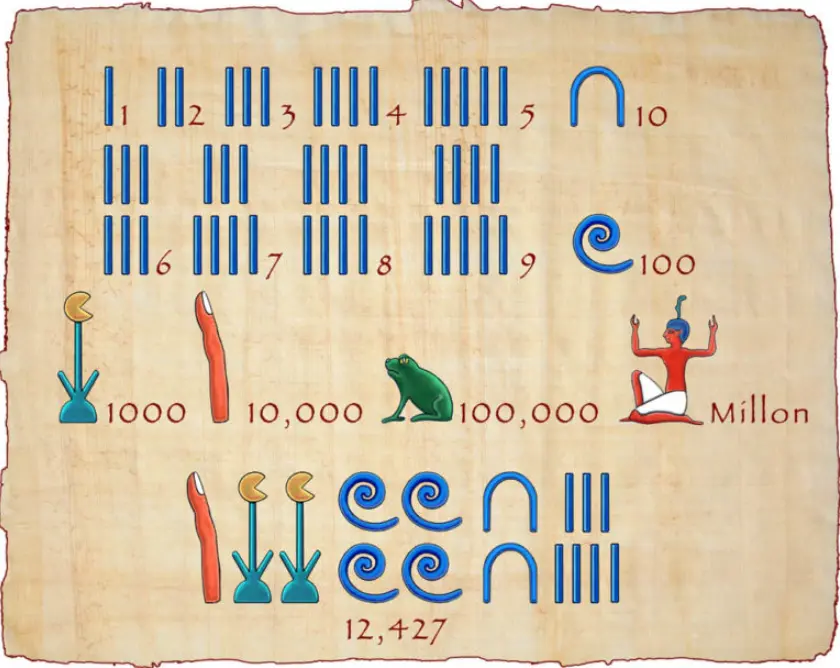
The Egyptians used a decimal system based on hieroglyphic numerals, with symbols for 1, 10, 100, 1,000, and higher powers of ten. Basic operations like addition and subtraction were straightforward, but multiplication and division relied on repeated doubling and halving techniques. Fractions were expressed as unit fractions (e.g., 1/2, 1/3), and they employed a “method of false position” for solving linear equations, which involved trial and error with adjustments.
Geometry played a crucial role, especially in surveying land after Nile floods and designing monumental structures like pyramids. They calculated areas of triangles, circles, and rectangles, and volumes of pyramids and cylinders. For instance, they approximated the area of a circle using the formula (8/9)d², where d is the diameter, and understood the concept of pi as roughly 3.16.
Applications extended to dividing land, managing resources, and even medical prescriptions. Egyptian mathematics influenced later civilizations, including the Greeks, through shared knowledge via trade and conquest, laying foundational ideas for algebra and geometry in the ancient world.
Table of Contents
- Part 1: OnlineExamMaker – Generate and Share Ancient Egyptian Mathematics Quiz with AI Automatically
- Part 2: 20 Ancient Egyptian Mathematics Quiz Questions & Answers
- Part 3: Save Time and Energy: Generate Quiz Questions with AI Technology
Part 1: OnlineExamMaker – Generate and Share Ancient Egyptian Mathematics Quiz with AI Automatically
OnlineExamMaker is a powerful AI-powered assessment platform to create auto-grading Ancient Egyptian Mathematics skills assessments. It’s designed for educators, trainers, businesses, and anyone looking to generate engaging quizzes without spending hours crafting questions manually. The AI Question Generator feature allows you to input a topic or specific details, and it generates a variety of question types automatically.
Top features for assessment organizers:
● Prevent cheating by randomizing questions or changing the order of questions, so learners don’t get the same set of questions each time.
● AI Exam Grader for efficiently grading quizzes and assignments, offering inline comments, automatic scoring, and “fudge points” for manual adjustments.
● Embed quizzes on websites, blogs, or share via email, social media (Facebook, Twitter), or direct links.
● Handles large-scale testing (thousands of exams/semester) without internet dependency, backed by cloud infrastructure.
Automatically generate questions using AI
Part 2: 20 Ancient Egyptian Mathematics Quiz Questions & Answers
or
1. What base was the Ancient Egyptian numeral system primarily based on?
A. Base 2
B. Base 10
C. Base 16
D. Base 60
Answer: B
Explanation: The Ancient Egyptians used a decimal system based on base 10, as evidenced by their hieroglyphic numerals representing powers of 10.
2. How did Ancient Egyptians typically represent fractions in their mathematics?
A. Using decimal points
B. As unit fractions with the numerator 1
C. As mixed numbers
D. As percentages
Answer: B
Explanation: They expressed most fractions as unit fractions, where the numerator is 1, such as 1/2 or 1/3, as seen in the Rhind Papyrus.
3. In Ancient Egyptian mathematics, what method was used for multiplication?
A. Long multiplication
B. Doubling and adding
C. Lattice method
D. Abacus calculation
Answer: B
Explanation: They employed a method of repeated doubling and adding to multiply numbers, which was efficient for their computational needs.
4. What symbol did Ancient Egyptians use to represent the number 1?
A. A vertical stroke
B. A circle
C. A hieroglyph of a heel bone
D. A lotus flower
Answer: A
Explanation: The numeral for 1 was a single vertical stroke, forming the basis of their hieroglyphic number system.
5. How did Ancient Egyptians calculate the area of a circle?
A. Using π as 3.14
B. Using the formula A = πr²
C. Approximating it as (8/9)d² where d is the diameter
D. Dividing the circle into equal triangles
Answer: C
Explanation: They approximated the area of a circle using the formula (8/9) times the square of the diameter, an early empirical method.
6. In the Rhind Papyrus, what fraction is equivalent to 2/3 when decomposed into unit fractions?
A. 1/2 + 1/6
B. 1/3 + 1/3
C. 1/4 + 1/4 + 1/4
D. 1/2 + 1/4
Answer: A
Explanation: The Rhind Papyrus shows that 2/3 can be expressed as the sum of unit fractions: 1/2 + 1/6.
7. What was the Ancient Egyptian unit for measuring length?
A. Meter
B. Cubit
C. Foot
D. Yard
Answer: B
Explanation: The cubit, approximately 52.5 cm, was their standard unit for length, used in architecture and surveying.
8. How did Ancient Egyptians divide two numbers?
A. Using long division
B. Repeated subtraction and doubling
C. Factoring into primes
D. Converting to fractions
Answer: B
Explanation: Division was performed by reversing the multiplication process, involving repeated subtraction and the doubling method.
9. What geometric shape did Ancient Egyptians calculate the volume for in relation to pyramids?
A. Sphere
B. Cylinder
C. Pyramid
D. Cone
Answer: C
Explanation: They developed methods to calculate the volume of a pyramid, often using approximations based on rectangular prisms.
10. In Ancient Egyptian mathematics, what is the sum of 10 and 20?
A. 20
B. 30
C. 40
D. 50
Answer: B
Explanation: Basic addition in their system was straightforward, with 10 + 20 equaling 30, as they used a positional numeral system.
11. How did Ancient Egyptians express the fraction 3/4?
A. As 1/2 + 1/4
B. As 1/3 + 1/3 + 1/4
C. As 1/4 + 1/4 + 1/4
D. As 1/2 alone
Answer: A
Explanation: They broke down 3/4 into unit fractions as 1/2 + 1/4, following their preference for sums of unit fractions.
12. What approximate value did Ancient Egyptians use for π?
A. 3
B. 3.1416
C. 22/7
D. (256/81)
Answer: D
Explanation: In their calculations, such as for the Great Pyramid, they effectively used a value close to 256/81, approximately 3.16, for π.
13. In Ancient Egyptian land measurement, how was the area of a rectangle calculated?
A. Length times width
B. Length plus width divided by 2
C. Length squared
D. Width squared
Answer: A
Explanation: They calculated the area of a rectangle by multiplying its length by its width, a basic geometric principle in their texts.
14. What was the purpose of the Rhind Papyrus in Ancient Egyptian mathematics?
A. To record astronomical data
B. To provide problems and solutions for teaching
C. To list kingly decrees
D. To map the Nile River
Answer: B
Explanation: The Rhind Papyrus is a mathematical text containing problems and solutions on arithmetic, geometry, and algebra for educational purposes.
15. How did Ancient Egyptians add fractions like 1/2 and 1/3?
A. Directly adding numerators and denominators
B. Finding a common denominator and decomposing
C. Multiplying the denominators
D. Using decimal equivalents
Answer: B
Explanation: They added fractions by finding equivalent unit fractions, such as 1/2 + 1/3 = 1/2 + 1/6 + 1/6, but typically decomposed further.
16. In pyramid construction, what formula did Ancient Egyptians use for the slope?
A. Rise over run
B. Base divided by height
C. Height squared
D. Perimeter divided by base
Answer: A
Explanation: They calculated slopes using ratios similar to rise over run, ensuring stability in pyramid designs.
17. What is the Ancient Egyptian equivalent of modern subtraction for 10 – 4?
A. 4
B. 6
C. 8
D. 10
Answer: B
Explanation: Subtraction was performed directly, with 10 – 4 equaling 6, using their numeral system for basic operations.
18. How did Ancient Egyptians handle square roots in their calculations?
A. Using the Babylonian method
B. Approximating through repeated addition
C. They did not use square roots
D. Via geometric means
Answer: D
Explanation: They approximated square roots through geometric methods, such as in area calculations, rather than algebraic formulas.
19. In Ancient Egyptian mathematics, what is the area of a triangle with base 10 and height 4?
A. 10
B. 14
C. 20
D. 40
Answer: C
Explanation: They calculated the area of a triangle as (base × height) / 2, so for base 10 and height 4, it is (10 × 4) / 2 = 20.
20. What mathematical tool did Ancient Egyptians use for surveying land along the Nile?
A. Compass and straightedge
B. Abacus
C. Measuring ropes and plumb lines
D. Slide rule
Answer: C
Explanation: They used measuring ropes for lengths and plumb lines for levels, essential for accurate land surveying after Nile floods.
or
Part 3: Save Time and Energy: Generate Quiz Questions with AI Technology
Automatically generate questions using AI