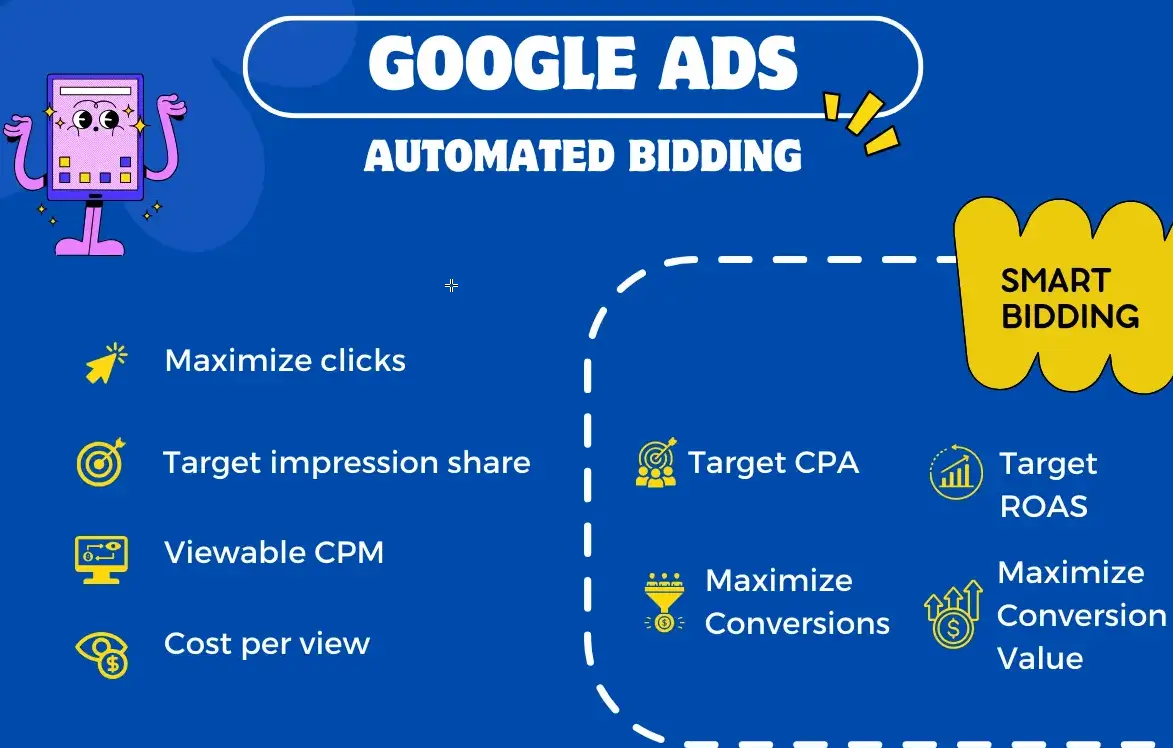
Google Ads Bidding Automation streamlines the process of managing bids for your advertising campaigns, leveraging machine learning to optimize performance in real-time. Unlike manual bidding, where advertisers set bids individually, automated bidding adjusts bids dynamically based on historical data, user behavior, and campaign goals to maximize results.
Key Features and Strategies
– Maximize Clicks: Automatically sets bids to get the most clicks within your budget, ideal for driving traffic to your site.
– Maximize Conversions: Focuses on achieving the highest number of conversions (e.g., sales or sign-ups) while staying within your spend limit.
– Target CPA (Cost Per Action): Aims to get as many conversions as possible at or below your specified average cost per action, making it perfect for performance-focused campaigns.
– Target ROAS (Return on Ad Spend): Optimizes bids to achieve a specific return on ad spend, helping maximize revenue from your ads.
– Enhanced CPC (Cost Per Click): Combines manual bidding with automation, adjusting your bids to increase the chances of conversion without fully relinquishing control.
– Maximize Conversion Value: Prioritizes bids to generate the highest total conversion value, useful for e-commerce businesses tracking revenue.
How It Works
Bidding automation uses Google’s advanced algorithms to analyze factors like device, location, time of day, and audience signals. By processing vast amounts of data, it predicts which auctions to bid on and at what price, allowing for more efficient ad spend and better outcomes.
Benefits
– Efficiency: Saves time by automating bid adjustments, freeing you to focus on creative and strategy.
– Improved Performance: Often leads to higher conversion rates and ROI through data-driven decisions.
– Flexibility: Easily integrates with other Google Ads tools, such as audience targeting and remarketing.
– Scalability: Handles complex campaigns across multiple platforms, adapting to market changes in real-time.
Best Practices for Implementation
– Start with a clear goal: Define your primary objective (e.g., conversions or clicks) before selecting a strategy.
– Use historical data: Ensure your account has sufficient conversion data for accurate automation.
– Monitor and refine: Regularly review performance reports and adjust budgets or strategies as needed.
– Test incrementally: Run A/B tests comparing automated and manual bidding to measure improvements.
By adopting Google Ads Bidding Automation, advertisers can achieve smarter, more effective campaigns that adapt to the ever-changing digital landscape.
Table of Contents
- Part 1: OnlineExamMaker AI Quiz Maker – Make A Free Quiz in Minutes
- Part 2: 20 Google Ads Bidding Automation Quiz Questions & Answers
- Part 3: AI Question Generator – Automatically Create Questions for Your Next Assessment
Part 1: OnlineExamMaker AI Quiz Maker – Make A Free Quiz in Minutes
What’s the best way to create a Google Ads Bidding Automation quiz online? OnlineExamMaker is the best AI quiz making software for you. No coding, and no design skills required. If you don’t have the time to create your online quiz from scratch, you are able to use OnlineExamMaker AI Question Generator to create question automatically, then add them into your online assessment. What is more, the platform leverages AI proctoring and AI grading features to streamline the process while ensuring exam integrity.
Key features of OnlineExamMaker:
● Create up to 10 question types, including multiple-choice, true/false, fill-in-the-blank, matching, short answer, and essay questions.
● Build and store questions in a centralized portal, tagged by categories and keywords for easy reuse and organization.
● Automatically scores multiple-choice, true/false, and even open-ended/audio responses using AI, reducing manual work.
● Create certificates with personalized company logo, certificate title, description, date, candidate’s name, marks and signature.
Automatically generate questions using AI
Part 2: 20 Google Ads Bidding Automation Quiz Questions & Answers
or
1. Question 1: What is the primary purpose of automated bidding in Google Ads?
A) To manually set bids for each keyword
B) To use machine learning to optimize bids in real-time
C) To limit ad spending regardless of performance
D) To focus only on display network campaigns
Answer: B
Explanation: Automated bidding leverages Google’s machine learning algorithms to adjust bids automatically based on various signals like user behavior and device type, aiming to meet specific performance goals more efficiently than manual bidding.
2. Question 2: Which automated bidding strategy is designed to get the most conversions within a target cost-per-action (CPA)?
A) Maximize Clicks
B) Target CPA
C) Enhanced CPC
D) Manual CPC
Answer: B
Explanation: Target CPA bidding strategy uses historical data and machine learning to set bids that aim to achieve an average CPA you specify, helping to optimize for conversions while controlling costs.
3. Question 3: In Google Ads, what does the Maximize Conversions bidding strategy prioritize?
A) Increasing impressions
B) Achieving the lowest possible CPC
C) Getting the most conversions within your budget
D) Targeting specific demographics only
Answer: C
Explanation: Maximize Conversions automatically sets bids to help you get as many conversions as possible while spending your entire budget, making it ideal for campaigns focused on volume over cost efficiency.
4. Question 4: How does Enhanced CPC (eCPC) differ from standard automated bidding strategies?
A) It only works for video ads
B) It automatically adjusts manual bids based on conversion likelihood
C) It ignores device targeting
D) It requires a fixed daily budget
Answer: B
Explanation: Enhanced CPC builds on manual bidding by using Google’s algorithms to increase or decrease your bids in real-time when a conversion is more likely, blending automation with user control.
5. Question 5: Which factor does Google Ads’ automated bidding consider to optimize bids?
A) Only the auction time of day
B) User intent, device, location, and time of day
C) Competitor ad copy exclusively
D) Historical weather data
Answer: B
Explanation: Automated bidding analyzes multiple signals, including user intent, device type, location, and time, to make bid adjustments that align with your campaign goals and improve performance.
6. Question 6: What is a key benefit of using Portfolio bid strategies in Google Ads?
A) It allows bidding on individual keywords only
B) It enables managing bids across multiple campaigns from a single strategy
C) It restricts ads to mobile devices
D) It eliminates the need for conversion tracking
Answer: B
Explanation: Portfolio bid strategies let you apply a single automated bidding approach to multiple campaigns or ad groups, simplifying management and optimizing performance at a broader level.
7. Question 7: Which automated bidding strategy is best suited for e-commerce sites aiming to maximize revenue?
A) Target Impression Share
B) Maximize Conversion Value
C) Manual CPV
D) Enhanced CPC
Answer: B
Explanation: Maximize Conversion Value bidding optimizes bids to get the most conversion value possible within your budget, making it ideal for e-commerce by prioritizing higher-value transactions.
8. Question 8: In automated bidding, what role does conversion tracking play?
A) It has no impact on bid adjustments
B) It provides data for algorithms to learn and optimize bids
C) It only tracks impressions
D) It limits ad scheduling
Answer: B
Explanation: Conversion tracking supplies Google Ads with data on user actions, allowing automated bidding algorithms to learn from past performance and make more accurate bid adjustments for better results.
9. Question 9: Why might you choose Target ROAS over other automated bidding strategies?
A) To minimize ad visibility
B) To achieve a specific return on ad spend for conversions
C) To focus solely on brand awareness
D) To avoid using any budget
Answer: B
Explanation: Target ROAS bidding sets bids to maximize conversion value while hitting a specified return on ad spend, helping advertisers maintain profitability by prioritizing high-ROI conversions.
10. Question 10: What is a potential drawback of relying solely on automated bidding?
A) It always guarantees the lowest CPC
B) It may require time for algorithms to learn and perform optimally
C) It eliminates the need for A/B testing
D) It only works for search campaigns
Answer: B
Explanation: Automated bidding needs historical data to refine its algorithms, so initial performance might be suboptimal, requiring advertisers to monitor and adjust settings during the learning phase.
11. Question 11: How does Google Ads’ Maximize Clicks bidding strategy function?
A) It sets bids to achieve the highest ad rank
B) It automatically adjusts bids to get as many clicks as possible within your budget
C) It focuses on video views only
D) It requires manual bid changes daily
Answer: B
Explanation: Maximize Clicks uses automation to increase bids where necessary to drive more traffic, making it suitable for campaigns prioritizing volume of visits over conversion quality.
12. Question 12: Which automated bidding option is most effective for campaigns with a limited budget?
A) Target CPA
B) Manual bidding
C) Maximize Conversions
D) Target Search Page Location
Answer: C
Explanation: Maximize Conversions ensures your budget is spent efficiently on conversions, making it effective for limited budgets by focusing on high-potential opportunities rather than spreading bids thinly.
13. Question 13: In Google Ads, what does “bid simulation” help with in automated bidding?
A) Predicting the impact of bid changes on performance
B) Manually editing ad creatives
C) Scheduling ads by hour
D) Excluding certain keywords
Answer: A
Explanation: Bid simulation tools in Google Ads allow you to forecast how different bid strategies might affect metrics like conversions and cost, aiding in informed decisions for automated bidding setups.
14. Question 14: What is the difference between standard bidding and Smart Bidding in Google Ads?
A) Standard bidding uses machine learning, while Smart Bidding does not
B) Smart Bidding is a subset of automated bidding that uses advanced signals for optimization
C) Standard bidding is only for mobile apps
D) There is no difference
Answer: B
Explanation: Smart Bidding encompasses advanced automated strategies like Target CPA and Maximize Conversions, which use machine learning and contextual signals for more precise bid adjustments compared to basic standard bidding.
15. Question 15: When should you use automated bidding for a new campaign with little data?
A) Immediately, as it works best from the start
B) After gathering some conversion data to improve accuracy
C) Only for display networks
D) Never, as it requires historical data
Answer: B
Explanation: Automated bidding performs better with existing data, so for new campaigns, it’s advisable to collect initial performance data first to help algorithms make effective bid optimizations.
16. Question 16: How can you adjust bids in an automated bidding strategy?
A) By manually overriding bids daily
B) Through bid adjustments for factors like device or location
C) By disabling conversion tracking
D) Through keyword-level editing only
Answer: B
Explanation: In automated bidding, you can apply bid adjustments to refine strategies based on audience segments, such as increasing bids for mobile devices, allowing for more targeted optimization.
17. Question 17: What key metric should you monitor when using automated bidding to evaluate success?
A) Only the number of impressions
B) Conversion rate and cost per conversion
C) Ad copy performance exclusively
D) Daily budget spend
Answer: B
Explanation: Monitoring conversion rate and cost per conversion helps assess whether automated bidding is meeting goals, as these metrics directly reflect the strategy’s effectiveness in driving valuable actions.
18. Question 18: Which automated bidding strategy is ideal for brand awareness campaigns?
A) Target CPA
B) Target Impression Share
C) Maximize Clicks
D) Manual CPC
Answer: B
Explanation: Target Impression Share bidding focuses on achieving a specific percentage of ad visibility, making it suitable for brand awareness by prioritizing impressions over direct conversions.
19. Question 19: How does automated bidding integrate with remarketing lists?
A) It ignores remarketing audiences
B) It uses audience data to adjust bids for higher-value users
C) It only applies to new customers
D) It disables dynamic ads
Answer: B
Explanation: Automated bidding incorporates remarketing data to increase bids for users who have previously interacted with your site, improving the chances of reconversion and ROI.
20. Question 20: What is a best practice for switching to automated bidding in Google Ads?
A) Do it without any preparation
B) Set clear goals, ensure conversion tracking is in place, and monitor performance initially
C) Focus only on high-traffic keywords
D) Disable all manual bids first
Answer: B
Explanation: Before switching, establish goals and verify tracking to allow automated bidding to learn effectively, and initial monitoring helps identify and address any performance issues quickly.
or
Part 3: AI Question Generator – Automatically Create Questions for Your Next Assessment
Automatically generate questions using AI