Oracle Data Mining is an integrated component of the Oracle Database that enables advanced analytical capabilities for discovering hidden patterns and insights in data. It leverages machine learning algorithms to perform tasks such as classification, regression, clustering, association rules, attribute importance, and anomaly detection directly within the database environment.
Key features include:
– In-Database Mining: Algorithms run inside the Oracle Database, eliminating the need to extract data, which enhances security and performance.
– SQL Integration: Users can access data mining functions via SQL, PL/SQL, or Oracle Data Miner, a graphical user interface for model building and deployment.
– Algorithms Supported: A range of algorithms like Decision Trees, Naive Bayes, Support Vector Machines, k-Means Clustering, and Apriori for association rules.
– Scalability: Designed to handle large datasets efficiently, leveraging parallel processing and Oracle’s Exadata technology.
– Model Management: Tools for building, evaluating, applying, and managing models, including automated model selection and tuning.
Benefits of Oracle Data Mining include improved decision-making through predictive analytics, cost savings from in-database processing, enhanced data security, and seamless integration with other Oracle tools like Oracle Business Intelligence and Oracle Machine Learning.
Applications span various industries, such as fraud detection in finance, customer segmentation in retail, predictive maintenance in manufacturing, and personalized recommendations in e-commerce. By embedding data mining into business processes, organizations can gain a competitive edge through data-driven insights.
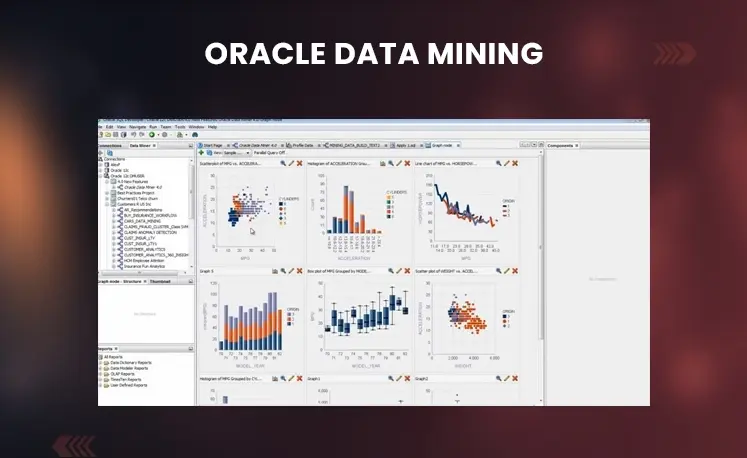
Table of Contents
- Part 1: OnlineExamMaker AI Quiz Generator – The Easiest Way to Make Quizzes Online
- Part 2: 20 Oracle Data Mining Quiz Questions & Answers
- Part 3: OnlineExamMaker AI Question Generator: Generate Questions for Any Topic
Part 1: OnlineExamMaker AI Quiz Generator – The Easiest Way to Make Quizzes Online
When it comes to ease of creating a Oracle Data Mining skills assessment, OnlineExamMaker is one of the best AI-powered quiz making software for your institutions or businesses. With its AI Question Generator, just upload a document or input keywords about your assessment topic, you can generate high-quality quiz questions on any topic, difficulty level, and format.
What you will like:
● AI Question Generator to help you save time in creating quiz questions automatically.
● Share your online exam with audiences on social platforms like Facebook, Twitter, Reddit and more.
● Display the feedback for correct or incorrect answers instantly after a question is answered.
● Create a lead generation form to collect an exam taker’s information, such as email, mobile phone, work title, company profile and so on.
Automatically generate questions using AI
Part 2: 20 Oracle Data Mining Quiz Questions & Answers
or
1. Question: What is the primary purpose of Oracle Data Mining?
A. To manage database transactions
B. To perform predictive analytics on data
C. To handle network security
D. To create user interfaces
Answer: B
Explanation: Oracle Data Mining uses machine learning algorithms to analyze data and make predictions, enabling businesses to discover patterns and insights.
2. Question: Which Oracle Data Mining algorithm is best suited for classification tasks?
A. k-Means
B. Naive Bayes
C. Apriori
D. Expectation Maximization
Answer: B
Explanation: Naive Bayes is a probabilistic classifier that works well for classification by applying Bayes’ theorem, making it ideal for predicting categories based on input features.
3. Question: In Oracle Data Mining, what does the term “model build” refer to?
A. Deleting old data
B. Training a machine learning model on data
C. Querying data from tables
D. Exporting results to external files
Answer: B
Explanation: Model build involves using algorithms to train on historical data, allowing the system to learn patterns for future predictions or analyses.
4. Question: Which SQL function is commonly used to apply a data mining model in Oracle?
A. PREDICTION
B. SUM
C. JOIN
D. GROUP BY
Answer: A
Explanation: The PREDICTION function in Oracle SQL applies a trained model to new data to generate predictions, integrating data mining directly into queries.
5. Question: What type of data mining task is clustering?
A. Supervised learning
B. Unsupervised learning
C. Regression analysis
D. Time series forecasting
Answer: B
Explanation: Clustering groups similar data points without predefined labels, making it an unsupervised learning technique in Oracle Data Mining.
6. Question: In Oracle Data Mining, what is an attribute?
A. A physical database file
B. A column in a dataset used for analysis
C. A user-defined function
D. A type of index
Answer: B
Explanation: Attributes are the features or columns in a dataset that are analyzed by mining algorithms to derive insights or build models.
7. Question: Which algorithm in Oracle Data Mining is used for association rule learning?
A. Decision Tree
B. Apriori
C. Support Vector Machine
D. Neural Network
Answer: B
Explanation: Apriori identifies frequent itemsets and generates association rules, such as market basket analysis, by finding relationships between variables.
8. Question: How does Oracle Data Mining handle missing data values?
A. By automatically deleting records
B. Through imputation or ignoring them based on settings
C. By converting them to zeros
D. By halting the mining process
Answer: B
Explanation: Oracle Data Mining uses techniques like imputation to estimate missing values, ensuring the mining process can continue without data loss.
9. Question: What is the role of the ODM (Oracle Data Miner) tool?
A. To perform basic data entry
B. To provide a graphical interface for building and evaluating models
C. To manage server hardware
D. To encrypt data
Answer: B
Explanation: ODM is a user-friendly tool that allows users to visually create, test, and deploy data mining models within the Oracle environment.
10. Question: In Oracle Data Mining, what is cross-validation?
A. A method to combine datasets
B. A technique to assess model accuracy by splitting data into subsets
C. A way to encrypt model outputs
D. A type of data transformation
Answer: B
Explanation: Cross-validation divides data into folds to train and test models multiple times, helping evaluate performance and reduce overfitting.
11. Question: Which Oracle Data Mining feature supports text mining?
A. Spatial analysis
B. Feature extraction from text data
C. Time-based querying
D. Image processing
Answer: B
Explanation: Oracle Data Mining includes capabilities for extracting features from text, such as tokenization and term weighting, to analyze unstructured data.
12. Question: What does the term “scoring” mean in Oracle Data Mining?
A. Assigning grades to users
B. Applying a model to new data to generate predictions
C. Measuring database performance
D. Creating data backups
Answer: B
Explanation: Scoring uses a trained model to evaluate new data and produce outputs like probabilities or classifications based on learned patterns.
13. Question: Which algorithm is typically used for anomaly detection in Oracle Data Mining?
A. Linear Regression
B. One-Class Support Vector Machine
C. K-Nearest Neighbors
D. Hierarchical Clustering
Answer: B
Explanation: One-Class SVM is designed to identify outliers by learning from normal data patterns, making it suitable for detecting anomalies.
14. Question: How are data mining models stored in Oracle Database?
A. As plain text files
B. In the data dictionary as mining model objects
C. In external cloud storage
D. As temporary tables
Answer: B
Explanation: Models are stored as objects in the Oracle data dictionary, allowing for easy management, versioning, and integration with SQL.
15. Question: What is the purpose of the SET command in Oracle Data Mining?
A. To define database schemas
B. To set parameters for mining algorithms
C. To insert data into tables
D. To run SQL queries
Answer: B
Explanation: The SET command configures settings for algorithms, such as specifying the number of clusters or tree depth, to customize model building.
16. Question: In Oracle Data Mining, what is feature selection?
A. Choosing the best database features
B. Identifying the most relevant attributes for a model
C. Selecting users for access
D. Exporting data features
Answer: B
Explanation: Feature selection reduces dimensionality by picking the most predictive attributes, improving model efficiency and accuracy.
17. Question: Which type of mining is used for predicting continuous values?
A. Classification
B. Regression
C. Clustering
D. Association
Answer: B
Explanation: Regression in Oracle Data Mining predicts numerical outcomes, such as sales figures, based on input variables.
18. Question: What does the DBMS_DATA_MINING package provide?
A. PL/SQL procedures for data mining operations
B. Java interfaces for databases
C. Reporting tools
D. Network configuration scripts
Answer: A
Explanation: DBMS_DATA_MINING is a PL/SQL package that offers APIs for creating, managing, and applying data mining models programmatically.
19. Question: How does Oracle Data Mining integrate with Oracle Autonomous Database?
A. Through manual data imports
B. Via built-in machine learning capabilities for automated model deployment
C. By requiring separate hardware
D. Only for on-premise setups
Answer: B
Explanation: Oracle Autonomous Database includes integrated data mining features, allowing for seamless, automated model building and scoring.
20. Question: What is the benefit of using ensemble methods in Oracle Data Mining?
A. They simplify data storage
B. They combine multiple models to improve accuracy and robustness
C. They reduce the need for data
D. They focus on single algorithms
Answer: B
Explanation: Ensemble methods, like boosting or bagging, aggregate predictions from several models to enhance overall performance and reduce errors.
or
Part 3: OnlineExamMaker AI Question Generator: Generate Questions for Any Topic
Automatically generate questions using AI