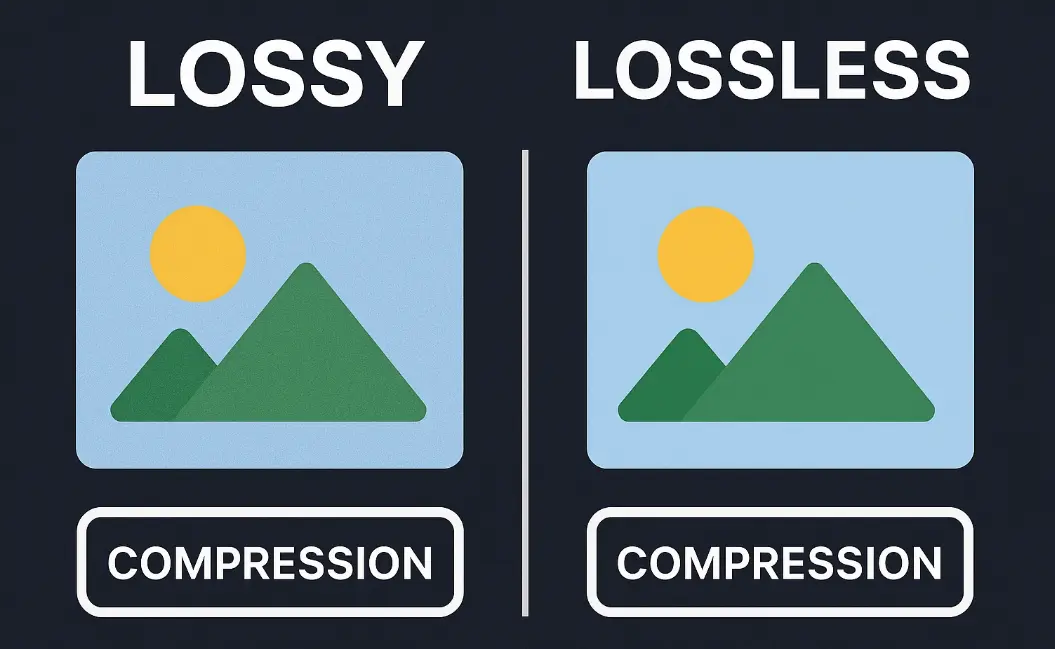
Lossless compression algorithms are data encoding techniques that reduce file sizes without losing any original information, allowing for exact reconstruction of the data. They exploit patterns, redundancies, and statistical properties in the data to achieve compression.
Key characteristics include:
– No data loss: The decompressed output is identical to the original input, making these algorithms ideal for text files, executables, and critical data like medical images.
– Efficiency through redundancy: They identify repetitive elements, such as repeated characters or sequences, and represent them more compactly.
Common examples:
– Huffman Coding: Assigns shorter binary codes to more frequent symbols and longer codes to less frequent ones, based on a frequency analysis.
– Run-Length Encoding (RLE): Replaces sequences of identical data with a single instance and a count, effective for data with long runs of the same value.
– Lempel-Ziv-Welch (LZW): A dictionary-based method that builds a table of strings during compression, replacing repeated sequences with shorter codes.
These algorithms are widely used in formats like ZIP, PNG, and GIF, ensuring data integrity while optimizing storage and transmission.
Table of Contents
- Part 1: Best AI Quiz Making Software for Creating A Lossless Compression Algorithms Quiz
- Part 2: 20 Lossless Compression Algorithms Quiz Questions & Answers
- Part 3: AI Question Generator – Automatically Create Questions for Your Next Assessment
Part 1: Best AI Quiz Making Software for Creating A Lossless Compression Algorithms Quiz
Nowadays more and more people create Lossless Compression Algorithms quizzes using AI technologies, OnlineExamMaker a powerful AI-based quiz making tool that can save you time and efforts. The software makes it simple to design and launch interactive quizzes, assessments, and surveys. With the Question Editor, you can create multiple-choice, open-ended, matching, sequencing and many other types of questions for your tests, exams and inventories. You are allowed to enhance quizzes with multimedia elements like images, audio, and video to make them more interactive and visually appealing.
Take a product tour of OnlineExamMaker:
● Create a question pool through the question bank and specify how many questions you want to be randomly selected among these questions.
● Build and store questions in a centralized portal, tagged by categories and keywords for easy reuse and organization.
● Simply copy a few lines of codes, and add them to a web page, you can present your online quiz in your website, blog, or landing page.
● Randomize questions or change the order of questions to ensure exam takers don’t get the same set of questions each time.
Automatically generate questions using AI
Part 2: 20 Lossless Compression Algorithms Quiz Questions & Answers
or
1. Question: Which of the following is a primary advantage of Huffman coding over other lossless compression methods?
A. It achieves better compression for data with uniform symbol frequencies.
B. It is optimal for sources with skewed symbol probabilities.
C. It requires no preprocessing of data.
D. It compresses data in linear time regardless of input size.
Answer: B
Explanation: Huffman coding builds a variable-length prefix code based on the frequency of symbols, making it optimal for data with skewed probabilities as it assigns shorter codes to more frequent symbols.
2. Question: In Run-Length Encoding (RLE), what happens to a sequence like “AAABBBCC”?
A. It becomes “A3B3C2”.
B. It becomes “ABC” with counts appended.
C. It remains unchanged.
D. It is encoded as binary values.
Answer: A
Explanation: RLE replaces sequences of repeated characters with the character followed by the number of repetitions, so “AAABBBCC” is encoded as “A3B3C2”.
3. Question: Which algorithm uses a sliding window to find and replace repeated strings in data?
A. Huffman coding.
B. LZ77.
C. Arithmetic coding.
D. Shannon-Fano coding.
Answer: B
Explanation: LZ77 is a dictionary-based algorithm that uses a sliding window to search for repeated substrings and replaces them with references to their previous occurrences.
4. Question: What is the key difference between LZW and LZ78 compression algorithms?
A. LZW uses a static dictionary, while LZ78 builds one dynamically.
B. LZW builds a dictionary incrementally during compression, unlike LZ78.
C. LZW is lossless, but LZ78 is lossy.
D. LZW requires more memory than LZ78.
Answer: B
Explanation: LZW starts with a predefined dictionary and adds new entries as it processes data, whereas LZ78 also builds a dictionary but has slight variations in how strings are handled.
5. Question: Arithmetic coding represents data as:
A. A fixed-length code for each symbol.
B. A single number between 0 and 1.
C. A tree structure like Huffman.
D. Binary strings without probabilities.
Answer: B
Explanation: Arithmetic coding encodes the entire message as a single fractional number in the range [0, 1), based on the cumulative probabilities of symbols.
6. Question: Which lossless algorithm is commonly used in GIF image files?
A. DEFLATE.
B. LZW.
C. Huffman coding alone.
D. Run-Length Encoding.
Answer: B
Explanation: LZW is the primary compression algorithm used in GIF files, allowing for effective compression of images with repetitive patterns.
7. Question: In Shannon-Fano coding, how are symbols assigned codes?
A. By building a Huffman tree.
B. By dividing symbols into subsets based on probability and assigning codes recursively.
C. By using a fixed binary length.
D. By ignoring symbol frequencies.
Answer: B
Explanation: Shannon-Fano coding partitions the set of symbols into two subsets of approximately equal probability and assigns codes by recursively applying this process.
8. Question: What does the Burrows-Wheeler Transform (BWT) primarily do?
A. Directly compresses data using codes.
B. Rearranges data to group similar characters, aiding further compression.
C. Encodes data with run-length methods.
D. Builds a dictionary for string matching.
Answer: B
Explanation: BWT transforms a string into a format where similar characters are clustered, making it easier for subsequent stages like Move-To-Front to compress the data effectively.
9. Question: Which of the following is NOT a lossless compression algorithm?
A. JPEG 2000.
B. DEFLATE.
C. Lempel-Ziv.
D. Arithmetic coding.
Answer: A
Explanation: JPEG 2000 is primarily a lossy compression algorithm, though it has a lossless mode; the others are inherently lossless.
10. Question: In DEFLATE compression, what combination of techniques is used?
A. Huffman coding and LZ77.
B. Run-Length Encoding and Arithmetic coding.
C. LZW and Shannon-Fano.
D. BWT and dictionary building.
Answer: A
Explanation: DEFLATE combines LZ77 for string matching and Huffman coding for entropy encoding, as seen in formats like ZIP and PNG.
11. Question: Why is Arithmetic coding more efficient than Huffman coding for some data?
A. It handles symbols with probabilities not powers of 1/2.
B. It uses less memory.
C. It is faster in encoding.
D. It does not require a code table.
Answer: A
Explanation: Arithmetic coding can represent probabilities more precisely, even if they are not dyadic fractions, leading to better compression for certain data distributions.
12. Question: What is a potential drawback of Run-Length Encoding?
A. It expands data with no repetitions.
B. It is always slower than other methods.
C. It requires complex dictionaries.
D. It cannot handle binary data.
Answer: A
Explanation: RLE can increase the size of data that lacks repeated sequences, as it adds overhead for counting non-repeating elements.
13. Question: In Lempel-Ziv-Welch (LZW) algorithm, the dictionary is:
A. Predefined and static.
B. Built during both compression and decompression.
C. Only used for decompression.
D. Reset after each block.
Answer: B
Explanation: LZW dynamically builds a dictionary of strings as it processes the data, which is shared between the compressor and decompressor.
14. Question: Which algorithm is best suited for compressing text with many repeated words?
A. Huffman coding.
B. Dictionary-based methods like LZ78.
C. Arithmetic coding.
D. Run-Length Encoding for single characters.
Answer: B
Explanation: Dictionary-based algorithms like LZ78 excel at compressing data with repeated strings or phrases by storing and referencing them.
15. Question: How does the Move-To-Front (MTF) transform assist in compression?
A. By sorting data alphabetically.
B. By rearranging symbols so frequent ones get smaller codes.
C. By encoding the entire string at once.
D. By applying Huffman coding directly.
Answer: B
Explanation: MTF transforms the data by moving frequently occurring symbols to the front of a list, making subsequent encoding more efficient.
16. Question: What is the output of Huffman coding for symbols A (frequency 5) and B (frequency 1)?
A. A: 0, B: 1.
B. A: 1, B: 0.
C. Both get equal lengths.
D. A: 00, B: 1.
Answer: A
Explanation: In Huffman coding, the more frequent symbol (A with frequency 5) gets a shorter code (e.g., 0), while the less frequent one (B with frequency 1) gets a longer code (e.g., 1).
17. Question: Which lossless algorithm is patented and was a key part of the original Unisys compression?
A. LZ77.
B. LZW.
C. DEFLATE.
D. Arithmetic coding.
Answer: B
Explanation: LZW was patented by Welch and others, and it was notably used in formats like GIF, leading to licensing issues.
18. Question: In Arithmetic coding, the interval is subdivided based on:
A. The order of symbols.
B. The cumulative probabilities of symbols.
C. Fixed binary divisions.
D. Dictionary entries.
Answer: B
Explanation: Arithmetic coding narrows the interval based on the cumulative probability distribution of the symbols in the data.
19. Question: What makes LZ78 different from LZ77 in terms of window usage?
A. LZ78 does not use a sliding window.
B. LZ78 uses a fixed window size.
C. LZ78 builds a dictionary of phrases explicitly.
D. LZ78 is not a compression algorithm.
Answer: C
Explanation: LZ78 creates a dictionary by explicitly adding phrases as it encounters them, unlike LZ77 which relies on a sliding window for matches.
20. Question: Which technique is often used after Burrows-Wheeler Transform to enhance compression?
A. Huffman coding.
B. Move-To-Front followed by Run-Length Encoding.
C. LZW dictionary building.
D. Direct arithmetic encoding.
Answer: B
Explanation: After BWT, Move-To-Front is applied to make frequent symbols have smaller indices, and then Run-Length Encoding can compress the resulting data effectively.
or
Part 3: AI Question Generator – Automatically Create Questions for Your Next Assessment
Automatically generate questions using AI