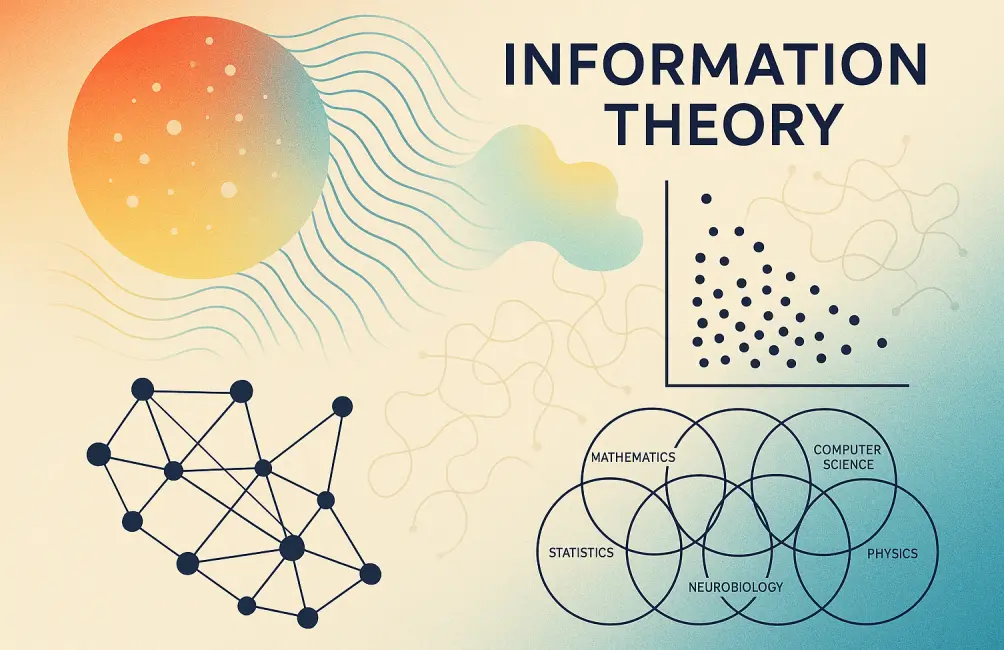
Information Theory is a mathematical framework for understanding the quantification, storage, and communication of information. It was pioneered by Claude Shannon in the 1940s and forms the foundation of modern digital communication, data compression, and cryptography.
At its core, Information Theory measures uncertainty and efficiency in information processing. Key concepts include:
– Entropy: A measure of the average uncertainty in a random variable. For a discrete random variable X with possible outcomes x_i and probabilities p(x_i), entropy H(X) is calculated as H(X) = -Σ p(x_i) log₂ p(x_i). It represents the minimum number of bits needed to encode the information on average.
– Information Sources: These are probabilistic models that generate messages. Shannon’s source coding theorem states that messages from a source with entropy H can be compressed to H bits per symbol without loss, but not below.
– Channels and Capacity: Communication channels, like noisy telephone lines, have a maximum rate at which information can be reliably transmitted, known as channel capacity. Shannon’s channel coding theorem shows that it is possible to transmit at rates up to this capacity with arbitrarily low error by using appropriate coding.
– Mutual Information: Measures the amount of information one random variable contains about another. For variables X and Y, it is I(X; Y) = H(X) + H(Y) – H(X, Y), indicating shared uncertainty.
Applications of Information Theory are vast:
– In data compression, algorithms like Huffman coding and Lempel-Ziv achieve efficient storage by exploiting redundancy.
– In telecommunications, it underpins error-correcting codes, such as turbo codes and LDPC codes, to combat noise.
– It extends to cryptography, where concepts like entropy help evaluate the security of encryption systems.
– Beyond engineering, it influences fields like biology (e.g., genetic information), physics (e.g., black hole entropy), and machine learning (e.g., feature selection).
Information Theory revolutionized how we think about data, emphasizing that not all information is equally valuable and that efficient representation is key to managing the information age.
Table of Contents
- Part 1: Create A Information Theory Quiz in Minutes Using AI with OnlineExamMaker
- Part 2: 20 Information Theory Quiz Questions & Answers
- Part 3: OnlineExamMaker AI Question Generator: Generate Questions for Any Topic
Part 1: Create A Information Theory Quiz in Minutes Using AI with OnlineExamMaker
Are you looking for an online assessment to test the Information Theory skills of your learners? OnlineExamMaker uses artificial intelligence to help quiz organizers to create, manage, and analyze exams or tests automatically. Apart from AI features, OnlineExamMaker advanced security features such as full-screen lockdown browser, online webcam proctoring, and face ID recognition.
Recommended features for you:
● Includes a safe exam browser (lockdown mode), webcam and screen recording, live monitoring, and chat oversight to prevent cheating.
● Enhances assessments with interactive experience by embedding video, audio, image into quizzes and multimedia feedback.
● Once the exam ends, the exam scores, question reports, ranking and other analytics data can be exported to your device in Excel file format.
● Offers question analysis to evaluate question performance and reliability, helping instructors optimize their training plan.
Automatically generate questions using AI
Part 2: 20 Information Theory Quiz Questions & Answers
or
Question 1:
What is the entropy of a discrete random variable X with possible outcomes x1, x2, …, xn and probabilities p(x1), p(x2), …, p(xn)?
A. H(X) = -∑ p(xi) log2 p(xi)
B. H(X) = ∑ p(xi) log2 p(xi)
C. H(X) = -∑ p(xi) / log2 p(xi)
D. H(X) = ∑ log2 p(xi)
Answer: A
Explanation: Entropy measures the average uncertainty in a random variable, and the formula H(X) = -∑ p(xi) log2 p(xi) quantifies this as the expected value of the information content.
Question 2:
Which of the following is a property of entropy for a discrete random variable?
A. Entropy is always negative.
B. Entropy is maximized when all outcomes are equally likely.
C. Entropy decreases with more possible outcomes.
D. Entropy is zero for a deterministic variable.
Answer: D
Explanation: A deterministic variable has only one possible outcome with probability 1, so its entropy is zero, indicating no uncertainty.
Question 3:
For two discrete random variables X and Y, what is joint entropy H(X,Y)?
A. H(X,Y) = H(X) + H(Y)
B. H(X,Y) = H(X) – H(Y|X)
C. H(X,Y) = -∑∑ p(x,y) log2 p(x,y)
D. H(X,Y) = H(Y) – H(X|Y)
Answer: C
Explanation: Joint entropy is the total uncertainty in both variables and is calculated as H(X,Y) = -∑∑ p(x,y) log2 p(x,y) over all possible pairs.
Question 4:
What does conditional entropy H(Y|X) represent?
A. The uncertainty in X given Y is known.
B. The uncertainty in Y given X is known.
C. The total entropy of both X and Y.
D. The mutual information between X and Y.
Answer: B
Explanation: Conditional entropy H(Y|X) measures the average uncertainty remaining in Y after X is known, calculated as H(Y|X) = ∑ p(x) H(Y|X=x).
Question 5:
Mutual information I(X;Y) is defined as:
A. I(X;Y) = H(X) + H(Y)
B. I(X;Y) = H(X) – H(X|Y)
C. I(X;Y) = H(Y) – H(Y|X)
D. Both B and C
Answer: D
Explanation: Mutual information quantifies the shared information between X and Y, and it can be expressed as either I(X;Y) = H(X) – H(X|Y) or I(X;Y) = H(Y) – H(Y|X).
Question 6:
In Huffman coding, how is the code designed?
A. By assigning shorter codes to more frequent symbols.
B. By assigning equal-length codes to all symbols.
C. By maximizing the code length for common symbols.
D. By using a fixed binary tree for all inputs.
Answer: A
Explanation: Huffman coding is a lossless data compression method that builds a variable-length prefix code based on symbol frequencies, ensuring shorter codes for more frequent symbols to minimize expected length.
Question 7:
What is the channel capacity C for a discrete memoryless channel?
A. C = maximum mutual information over all input distributions.
B. C = the entropy of the input.
C. C = the entropy of the output.
D. C = the difference between input and output entropy.
Answer: A
Explanation: Channel capacity is the maximum rate at which information can be transmitted reliably, defined as C = max I(X;Y), where the maximum is taken over all possible input distributions.
Question 8:
For a binary symmetric channel with crossover probability p, what is the capacity?
A. C = 1 – H(p)
B. C = H(p)
C. C = 1 + H(p)
D. C = p log2(1/p)
Answer: A
Explanation: The capacity of a binary symmetric channel is C = 1 – H(p), where H(p) is the binary entropy function, representing the maximum achievable rate for reliable communication.
Question 9:
What is the purpose of error-correcting codes in information theory?
A. To detect and correct errors in transmitted data.
B. To compress data without loss.
C. To increase the entropy of the source.
D. To minimize mutual information.
Answer: A
Explanation: Error-correcting codes add redundancy to the data to allow detection and correction of errors introduced by noise in the channel.
Question 10:
According to the source coding theorem, for a source with entropy H(X), the average codeword length must be at least:
A. H(X) bits per symbol.
B. 2H(X) bits per symbol.
C. H(X)/2 bits per symbol.
D. 1/H(X) bits per symbol.
Answer: A
Explanation: The source coding theorem states that for lossless compression, the average codeword length is at least H(X), the entropy of the source, achieving the minimum possible length.
Question 11:
The channel coding theorem states that reliable communication is possible if the transmission rate is:
A. Less than or equal to the channel capacity.
B. Greater than the channel capacity.
C. Equal to the source entropy.
D. Independent of the channel capacity.
Answer: A
Explanation: The theorem guarantees that for rates R ≤ C, there exist codes that allow error-free transmission as the block length approaches infinity.
Question 12:
In rate-distortion theory, what does the distortion-rate function represent?
A. The minimum rate required to achieve a given distortion level.
B. The maximum distortion for a given rate.
C. The entropy of the distorted signal.
D. The mutual information of the original signal.
Answer: A
Explanation: The rate-distortion function gives the lowest rate at which a source can be encoded while ensuring the distortion does not exceed a specified level.
Question 13:
For a memoryless source, the information rate is:
A. The entropy multiplied by the symbol rate.
B. The mutual information divided by the symbol rate.
C. The channel capacity minus entropy.
D. The average codeword length.
Answer: A
Explanation: The information rate is calculated as the entropy H(X) times the number of symbols per unit time, representing the average information per unit time.
Question 14:
What is the entropy of a binary source with probabilities 0.5 and 0.5 for two outcomes?
A. 1 bit
B. 0 bits
C. 0.5 bits
D. 2 bits
Answer: A
Explanation: For a fair coin flip (p=0.5), the entropy is H = -2*(0.5 log2 0.5) = 1 bit, indicating maximum uncertainty.
Question 15:
If a random variable X has outcomes with probabilities [0.1, 0.2, 0.7], what is its entropy?
A. Approximately 1.41 bits
B. 1 bit
C. 0.5 bits
D. 2 bits
Answer: A
Explanation: H(X) = -[0.1 log2 0.1 + 0.2 log2 0.2 + 0.7 log2 0.7] ≈ 1.41 bits, calculated by summing the weighted information content.
Question 16:
For two random variables X and Y, if X and Y are independent, what is I(X;Y)?
A. 0
B. H(X) + H(Y)
C. H(X,Y)
D. H(X) * H(Y)
Answer: A
Explanation: Mutual information I(X;Y) = 0 when X and Y are independent, as knowing one provides no information about the other.
Question 17:
The capacity of a noiseless binary channel is:
A. 1 bit per channel use
B. 0 bits per channel use
C. Dependent on the input distribution
D. Equal to the binary entropy
Answer: A
Explanation: In a noiseless channel, every bit transmitted is received perfectly, so the capacity is 1 bit per use for binary inputs.
Question 18:
What is the Hamming distance between two binary strings of equal length?
A. The number of positions at which the symbols differ.
B. The total length of the strings.
C. The entropy of the strings.
D. The mutual information between them.
Answer: A
Explanation: Hamming distance measures the difference between two strings by counting the positions where they differ, used in error detection and correction.
Question 19:
Shannon’s limit refers to:
A. The maximum error-free data rate over a channel.
B. The minimum entropy of a source.
C. The average codeword length.
D. The distortion in rate-distortion theory.
Answer: A
Explanation: Shannon’s limit, or channel capacity, is the theoretical maximum rate for reliable communication over a noisy channel.
Question 20:
In information theory, data processing inequality states that:
A. I(X;Z) ≤ I(X;Y) for a Markov chain X → Y → Z.
B. I(X;Z) ≥ I(X;Y) for any processing.
C. Entropy always increases with processing.
D. Mutual information is always zero in a chain.
Answer: A
Explanation: The data processing inequality implies that processing data cannot increase the mutual information about the original variable, so I(X;Z) ≤ I(X;Y).
or
Part 3: OnlineExamMaker AI Question Generator: Generate Questions for Any Topic
Automatically generate questions using AI