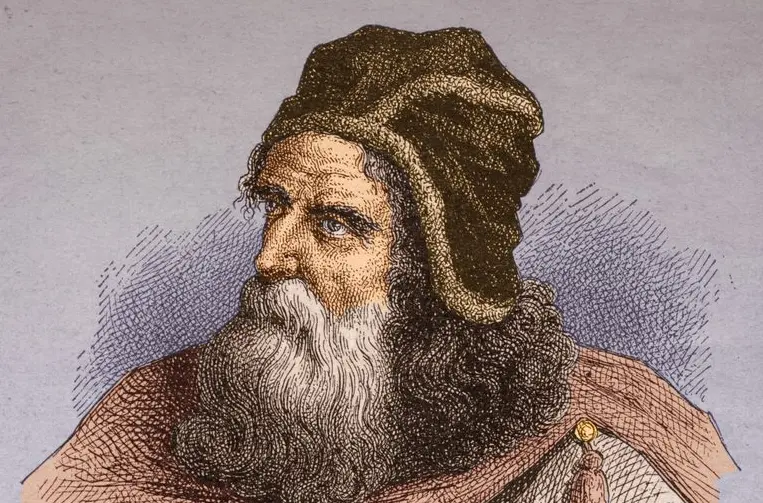
Archimedes (c. 287–212 BC) was an ancient Greek mathematician, physicist, engineer, and inventor from Syracuse, Sicily. Often regarded as one of the greatest minds of antiquity, he made groundbreaking contributions to mathematics, including the calculation of pi and the development of methods for determining the areas and volumes of geometric shapes like spheres and cylinders.
His principle of buoyancy, known as Archimedes’ principle, states that the upward force on an object submerged in a fluid equals the weight of the fluid displaced, leading to practical applications such as measuring the purity of gold. Among his inventions were the Archimedes’ screw, a device for lifting water, and innovative war machines used to defend Syracuse during the Roman siege.
Archimedes also worked on levers and pulleys, famously claiming, “Give me a place to stand, and I shall move the Earth.” His treatises, such as “On the Sphere and Cylinder” and “On Floating Bodies,” influenced later scientific thought. He died in 212 BC during the sack of Syracuse, reportedly killed by a Roman soldier while focused on a mathematical diagram. His legacy endures in fields like calculus, physics, and engineering.
Table of Contents
- Part 1: OnlineExamMaker AI Quiz Generator – Save Time and Efforts
- Part 2: 20 Archimedes Quiz Questions & Answers
- Part 3: Save Time and Energy: Generate Quiz Questions with AI Technology
Part 1: OnlineExamMaker AI Quiz Generator – Save Time and Efforts
Still spend a lot of time in editing questions for your next Archimedes assessment? OnlineExamMaker is an AI quiz maker that leverages artificial intelligence to help users create quizzes, tests, and assessments quickly and efficiently. You can start by inputting a topic or specific details into the OnlineExamMaker AI Question Generator, and the AI will generate a set of questions almost instantly. It also offers the option to include answer explanations, which can be short or detailed, helping learners understand their mistakes.
What you may like:
● Automatic grading and insightful reports. Real-time results and interactive feedback for quiz-takers.
● The exams are automatically graded with the results instantly, so that teachers can save time and effort in grading.
● LockDown Browser to restrict browser activity during quizzes to prevent students searching answers on search engines or other software.
● OnlineExamMaker API offers private access for developers to extract your exam data back into your system automatically.
Automatically generate questions using AI
Part 2: 20 Archimedes Quiz Questions & Answers
or
Question 1: What is Archimedes’ principle?
A) The force of gravity on an object
B) The buoyant force on an object is equal to the weight of the fluid displaced by the object
C) The speed of light in a vacuum
D) The formula for calculating the circumference of a circle
Answer: B
Explanation: Archimedes’ principle states that the upward buoyant force exerted on a submerged object is equal to the weight of the fluid it displaces, which he discovered while determining the purity of a crown.
Question 2: In which city was Archimedes born?
A) Athens
B) Alexandria
C) Syracuse
D) Rome
Answer: C
Explanation: Archimedes was born in Syracuse, a city in Sicily, around 287 BC, where he spent much of his life working on scientific and mathematical problems.
Question 3: What famous exclamation did Archimedes shout upon discovering buoyancy?
A) Eureka!
B) Voilà!
C) Huzzah!
D) Bravo!
Answer: A
Explanation: Archimedes shouted “Eureka!” meaning “I have found it,” when he realized the principle of buoyancy while bathing, leading to his method for verifying the purity of King Hiero’s crown.
Question 4: What is the primary use of the Archimedes screw?
A) Lifting heavy objects
B) Measuring time
C) Pumping water
D) Calculating pi
Answer: C
Explanation: The Archimedes screw is a device invented by Archimedes to raise water from a lower to a higher level, commonly used in irrigation and drainage systems.
Question 5: Which mathematical constant did Archimedes approximate using the method of exhaustion?
A) e (Euler’s number)
B) Pi (π)
C) The golden ratio
D) Square root of 2
Answer: B
Explanation: Archimedes approximated the value of pi by calculating the perimeters of polygons inscribed in and circumscribed around a circle, determining pi to be between 3.1408 and 3.1429.
Question 6: How did Archimedes die?
A) From old age
B) Killed during the Roman siege of Syracuse
C) In a shipwreck
D) By poisoning
Answer: B
Explanation: Archimedes was killed by a Roman soldier in 212 BC during the siege of Syracuse, as he was reportedly focused on a mathematical diagram and refused to leave it.
Question 7: What did Archimedes say about levers in his famous quote?
A) “Give me a firm spot and I will move the world.”
B) “Give me a place to stand and I will move the Earth.”
C) “Levers are the key to all machines.”
D) “A lever multiplies force infinitely.”
Answer: B
Explanation: Archimedes demonstrated the principle of the lever, stating, “Give me a place to stand and I will move the Earth,” illustrating how a lever can amplify force to move heavy objects.
Question 8: Which of the following did Archimedes use to determine the volume of irregular objects?
A) Water displacement
B) String measurement
C) Weighing on a balance
D) Shadow projection
Answer: A
Explanation: Archimedes used water displacement to measure the volume of irregular objects, as seen in his experiment with King Hiero’s crown, by submerging the object in water and measuring the overflow.
Question 9: What is the name of Archimedes’ treatise on floating bodies?
A) On the Sphere and Cylinder
B) On Floating Bodies
C) The Method
D) Measurement of a Circle
Answer: B
Explanation: In “On Floating Bodies,” Archimedes explored the equilibrium of floating objects and the conditions under which they sink or float, building on his principles of buoyancy.
Question 10: Which ancient king commissioned Archimedes to verify the purity of a gold crown?
A) Alexander the Great
B) Ptolemy I
C) King Hiero II
D) Julius Caesar
Answer: C
Explanation: King Hiero II of Syracuse asked Archimedes to determine if his crown was pure gold or adulterated with silver, leading to the discovery of Archimedes’ principle.
Question 11: What shape did Archimedes calculate the surface area and volume for in his work “On the Sphere and Cylinder”?
A) Cube
B) Sphere
C) Pyramid
D) Cone
Answer: B
Explanation: In “On the Sphere and Cylinder,” Archimedes derived formulas for the surface area and volume of a sphere, showing that the sphere’s volume is two-thirds that of the circumscribed cylinder.
Question 12: Which of the following is NOT an invention attributed to Archimedes?
A) The Archimedes screw
B) The telescope
C) The compound pulley
D) The claw of Archimedes
Answer: B
Explanation: The telescope was invented much later by Hans Lippershey in the 17th century, whereas Archimedes invented the screw, pulley systems, and defensive weapons like the claw.
Question 13: How did Archimedes contribute to the understanding of pi?
A) By inventing the wheel
B) By calculating it using polygons
C) By discovering zero
D) By creating the abacus
Answer: B
Explanation: Archimedes calculated pi by inscribing and circumscribing polygons around a circle, providing one of the first accurate estimates of pi as a value between 223/71 and 22/7.
Question 14: What defensive weapon did Archimedes allegedly use against the Roman fleet?
A) Catapults
B) Burning mirrors
C) Poison arrows
D) Underwater mines
Answer: B
Explanation: Archimedes is said to have used large mirrors to focus sunlight and burn enemy ships during the siege of Syracuse, though this is more legendary than historically confirmed.
Question 15: In which field did Archimedes make significant contributions beyond mathematics?
A) Astronomy
B) Hydrostatics
C) Biology
D) Metallurgy
Answer: B
Explanation: Archimedes advanced hydrostatics through his studies of fluids, buoyancy, and equilibrium, as detailed in his works on floating bodies and the principles of levers.
Question 16: What method did Archimedes use to find areas and volumes of curved shapes?
A) Algebra
B) Method of exhaustion
C) Direct measurement
D) Trigonometry
Answer: B
Explanation: The method of exhaustion, an early form of integral calculus, allowed Archimedes to approximate the areas and volumes of shapes like circles and spheres by summing infinite series.
Question 17: Approximately how many books or treatises did Archimedes write?
A) 5
B) 10
C) 15
D) Over 20
Answer: A
Explanation: Archimedes wrote about 5 major surviving treatises, including “On the Sphere and Cylinder” and “On Floating Bodies,” though some works are lost or fragmentary.
Question 18: Which of Archimedes’ inventions is still used in modern machinery?
A) The astrolabe
B) The screw pump
C) The steam engine
D) The clock
Answer: B
Explanation: The Archimedes screw, or screw pump, is still used today for moving water in irrigation, wastewater treatment, and other applications.
Question 19: What did Archimedes discover about the relationship between a sphere and its circumscribed cylinder?
A) They have the same volume
B) The sphere’s volume is two-thirds that of the cylinder
C) The cylinder’s volume is half that of the sphere
D) They are equal in surface area
Answer: B
Explanation: Archimedes proved that the volume of a sphere is two-thirds the volume of the smallest cylinder that completely encloses it, a key result in his geometric studies.
Question 20: Why is Archimedes considered the father of mathematical physics?
A) For his work in algebra
B) For applying mathematics to physical problems like buoyancy and levers
C) For inventing the calendar
D) For his contributions to literature
Answer: B
Explanation: Archimedes is regarded as the father of mathematical physics because he used rigorous mathematical methods to solve physical problems, such as the laws of levers and principles of equilibrium.
or
Part 3: Save Time and Energy: Generate Quiz Questions with AI Technology
Automatically generate questions using AI