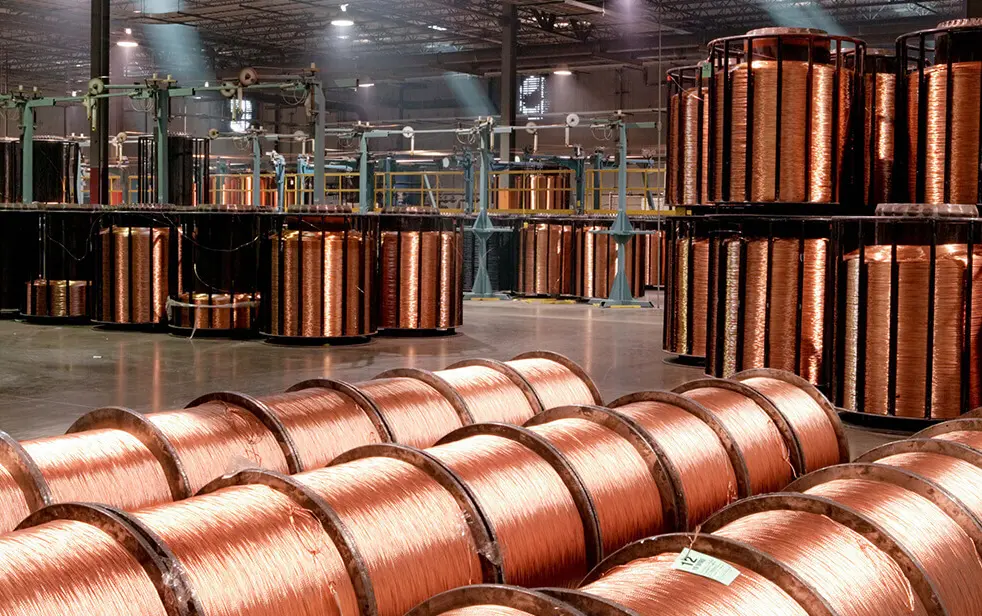
The copper industry plays a pivotal role in global manufacturing and technology, centered around the extraction, processing, and distribution of copper, a highly conductive and ductile metal.
Copper is primarily mined from large open-pit or underground operations in key regions like Chile, Peru, and the Democratic Republic of Congo, where it is extracted from ore deposits through methods such as blasting, crushing, and froth flotation. The refined metal is then produced via smelting and electrorefining, yielding high-purity copper cathodes for various applications.
This industry supports diverse sectors, including electrical wiring, where copper’s superior conductivity powers everything from household appliances to high-voltage transmission lines; plumbing and construction, due to its corrosion resistance and malleability; and electronics, where it’s essential for circuit boards and smartphones. Additionally, copper is crucial in renewable energy systems, such as solar panels and electric vehicles, driving demand amid the global shift to sustainable technologies.
Economically, the copper market influences commodity prices, with major players like Codelco, Freeport-McMoRan, and BHP driving production. However, challenges such as environmental regulations, fluctuating ore grades, and the push for recycling highlight the industry’s evolution toward more sustainable practices, including water-efficient mining and circular economy initiatives.
Overall, the copper industry remains a cornerstone of modern infrastructure, blending historical significance with innovative applications to meet growing global needs.
Table of Contents
- Part 1: OnlineExamMaker AI Quiz Generator – The Easiest Way to Make Quizzes Online
- Part 2: 20 Copper Industry Quiz Questions & Answers
- Part 3: Try OnlineExamMaker AI Question Generator to Create Quiz Questions
Part 1: OnlineExamMaker AI Quiz Generator – The Easiest Way to Make Quizzes Online
Are you looking for an online assessment to test the Copper Industry skills of your learners? OnlineExamMaker uses artificial intelligence to help quiz organizers to create, manage, and analyze exams or tests automatically. Apart from AI features, OnlineExamMaker advanced security features such as full-screen lockdown browser, online webcam proctoring, and face ID recognition.
Take a product tour of OnlineExamMaker:
● Includes a safe exam browser (lockdown mode), webcam and screen recording, live monitoring, and chat oversight to prevent cheating.
● AI Exam Grader for efficiently grading quizzes and assignments, offering inline comments, automatic scoring, and “fudge points” for manual adjustments.
● Embed quizzes on websites, blogs, or share via email, social media (Facebook, Twitter), or direct links.
● Handles large-scale testing (thousands of exams/semester) without internet dependency, backed by cloud infrastructure.
Automatically generate questions using AI
Part 2: 20 Copper Industry Quiz Questions & Answers
or
Question 1:
What is the primary ore from which copper is most commonly extracted?
A) Hematite
B) Chalcopyrite
C) Bauxite
D) Galena
Correct Answer: B
Explanation: Chalcopyrite is the most abundant copper-bearing mineral and serves as the primary ore for copper extraction due to its high copper content and widespread availability.
Question 2:
Which country is the largest producer of copper in the world?
A) United States
B) Australia
C) Chile
D) China
Correct Answer: C
Explanation: Chile leads global copper production, accounting for a significant portion of the world’s supply, primarily from large mines like Escondida, due to its rich mineral deposits.
Question 3:
What is the main use of copper in electrical applications?
A) Insulation
B) Conductivity
C) Magnetism
D) Corrosion resistance
Correct Answer: B
Explanation: Copper is widely used in electrical wiring and components because of its excellent electrical conductivity, which allows for efficient transmission of electricity with minimal loss.
Question 4:
In copper mining, what process is used to separate copper from its ore?
A) Smelting
B) Filtration
C) Distillation
D) Evaporation
Correct Answer: A
Explanation: Smelting involves heating the ore to extract copper by melting it and separating it from impurities, making it a crucial step in refining copper from raw ore.
Question 5:
What environmental issue is commonly associated with copper mining?
A) Deforestation
B) Acid mine drainage
C) Soil alkalinity
D) Ocean acidification
Correct Answer: B
Explanation: Acid mine drainage occurs when sulfide minerals in copper ore are exposed to air and water, producing sulfuric acid that can contaminate waterways and harm ecosystems.
Question 6:
Which alloy is primarily made from copper and is known for its strength and corrosion resistance?
A) Steel
B) Brass
C) Aluminum
D) Titanium
Correct Answer: B
Explanation: Brass is an alloy of copper and zinc, valued for its durability, malleability, and resistance to corrosion, making it ideal for plumbing and musical instruments.
Question 7:
What is the approximate purity level of copper after electrolytic refining?
A) 50%
B) 75%
C) 99.9%
D) 90%
Correct Answer: C
Explanation: Electrolytic refining achieves over 99.9% purity by using electricity to deposit pure copper onto cathodes, removing impurities like gold and silver.
Question 8:
Which factor has the most significant impact on copper prices in the global market?
A) Agricultural output
B) Supply and demand dynamics
C) Textile production
D) Oil reserves
Correct Answer: B
Explanation: Copper prices fluctuate based on global supply and demand, influenced by industrial growth, mining output, and economic conditions, making it a key commodity indicator.
Question 9:
What is the role of sulfuric acid in copper extraction?
A) It acts as a coolant
B) It is used for leaching copper from ore
C) It provides structural support
D) It prevents oxidation
Correct Answer: B
Explanation: Sulfuric acid is used in heap leaching to dissolve copper from low-grade ores, allowing for efficient extraction in a cost-effective manner.
Question 10:
In which century did large-scale copper mining begin in the United States?
A) 17th
B) 18th
C) 19th
D) 20th
Correct Answer: C
Explanation: Large-scale copper mining in the U.S. expanded in the 19th century, particularly in states like Michigan and Arizona, driven by the Industrial Revolution’s demand.
Question 11:
What property makes copper suitable for use in plumbing?
A) High density
B) Malleability and ductility
C) Low melting point
D) Reactivity
Correct Answer: B
Explanation: Copper’s malleability and ductility allow it to be easily shaped into pipes and fittings, while its resistance to corrosion ensures longevity in plumbing systems.
Question 12:
Which organization sets standards for copper products worldwide?
A) ISO
B) WHO
C) NASA
D) UNESCO
Correct Answer: A
Explanation: The International Organization for Standardization (ISO) develops standards for copper and its alloys, ensuring quality and consistency in global trade and manufacturing.
Question 13:
What is the byproduct of copper smelting that can be recycled?
A) Slag
B) Water vapor
C) Carbon dioxide
D) Nitrogen gas
Correct Answer: A
Explanation: Slag, a waste product from copper smelting, can be recycled for use in construction materials like cement, reducing environmental waste.
Question 14:
Which metal is often recovered as a byproduct during copper mining?
A) Iron
B) Gold
C) Lead
D) Tin
Correct Answer: B
Explanation: Gold is frequently recovered as a valuable byproduct in copper mining operations, especially from ores that contain both metals, enhancing profitability.
Question 15:
What is the estimated global copper reserve as of recent years?
A) 500 million metric tons
B) 1 billion metric tons
C) 2.1 billion metric tons
D) 3 billion metric tons
Correct Answer: C
Explanation: Global copper reserves are estimated at around 2.1 billion metric tons, based on geological surveys, which supports long-term production but requires sustainable mining practices.
Question 16:
In copper production, what does the term “blister copper” refer to?
A) Fully refined copper
B) Impure copper with 98-99% purity
C) Copper ore before processing
D) Waste from mining
Correct Answer: B
Explanation: Blister copper is the intermediate product from smelting with about 98-99% purity, characterized by its blistered surface due to escaping gases, before final refining.
Question 17:
Which region is known for the largest copper deposits in Africa?
A) Sahara Desert
B) Congo Basin
C) Nile Valley
D) Kalahari Desert
Correct Answer: B
Explanation: The Congo Basin, particularly in the Democratic Republic of Congo, hosts significant copper deposits, making it a major mining region in Africa.
Question 18:
What innovation has improved copper recycling rates?
A) Hydraulic mining
B) Electronic sorting technology
C) Open-pit blasting
D) Chemical dissolution
Correct Answer: B
Explanation: Electronic sorting technology uses sensors to identify and separate copper from scrap, increasing recycling efficiency and reducing the need for virgin materials.
Question 19:
How does copper contribute to renewable energy technologies?
A) In solar panel frames
B) As a conductor in wind turbines
C) In battery production
D) All of the above
Correct Answer: D
Explanation: Copper is essential in renewable energy as a conductor in wind turbines, wiring in solar panels, and components in batteries, supporting the global shift to sustainable energy.
Question 20:
What is the primary challenge facing the copper industry today?
A) Overproduction
B) Declining demand
C) Resource depletion and environmental regulations
D) Excessive government subsidies
Correct Answer: C
Explanation: The copper industry faces challenges from finite resources and stricter environmental regulations, necessitating sustainable practices to balance production and ecological impact.
or
Part 3: Try OnlineExamMaker AI Question Generator to Create Quiz Questions
Automatically generate questions using AI