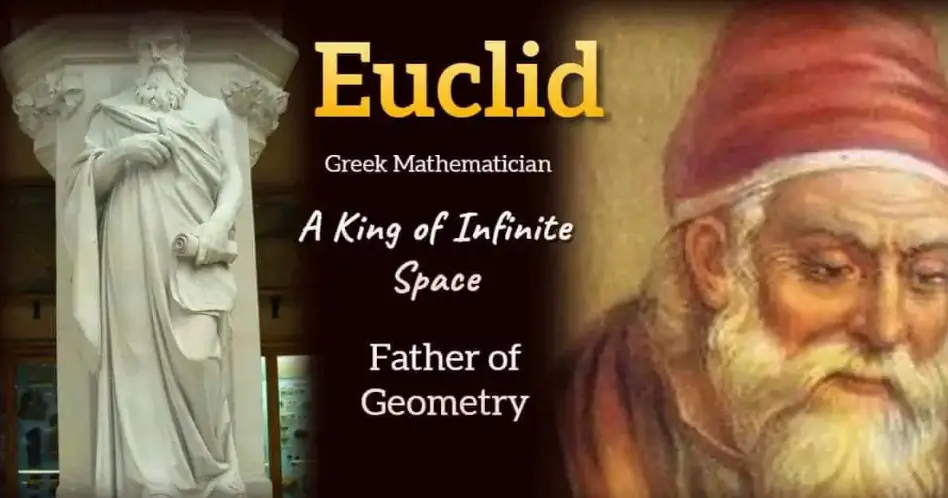
Euclid of Alexandria (c. 325–c. 270 BC) was an ancient Greek mathematician, often called the “Father of Geometry.” He is best known for his monumental work, *Elements*, a 13-volume treatise that systematized the knowledge of geometry, number theory, and other mathematical principles using axioms, theorems, and logical proofs.
In *Elements*, Euclid established the foundations of Euclidean geometry, including definitions of points, lines, and planes, and introduced the five postulates that underpin much of classical mathematics. His rigorous deductive method influenced scientific inquiry for centuries.
Beyond *Elements*, Euclid authored works on optics, conic sections, and data (a text on geometric propositions). His ideas shaped the development of algebra, calculus, and modern mathematics, remaining influential in education and philosophy.
Table of Contents
- Part 1: OnlineExamMaker AI Quiz Generator – Save Time and Efforts
- Part 2: 20 Euclid Quiz Questions & Answers
- Part 3: Save Time and Energy: Generate Quiz Questions with AI Technology
Part 1: OnlineExamMaker AI Quiz Generator – Save Time and Efforts
Still spend a lot of time in editing questions for your next Euclid assessment? OnlineExamMaker is an AI quiz maker that leverages artificial intelligence to help users create quizzes, tests, and assessments quickly and efficiently. You can start by inputting a topic or specific details into the OnlineExamMaker AI Question Generator, and the AI will generate a set of questions almost instantly. It also offers the option to include answer explanations, which can be short or detailed, helping learners understand their mistakes.
What you may like:
● Automatic grading and insightful reports. Real-time results and interactive feedback for quiz-takers.
● The exams are automatically graded with the results instantly, so that teachers can save time and effort in grading.
● LockDown Browser to restrict browser activity during quizzes to prevent students searching answers on search engines or other software.
● OnlineExamMaker API offers private access for developers to extract your exam data back into your system automatically.
Automatically generate questions using AI
Part 2: 20 Euclid Quiz Questions & Answers
or
1. Question: What is the sum of the interior angles of a triangle in Euclidean geometry?
Options: A) 90 degrees
B) 180 degrees
C) 270 degrees
D) 360 degrees
Answer: B) 180 degrees
Explanation: In Euclidean geometry, the sum of the interior angles of any triangle is always 180 degrees, as proven by drawing a line parallel to one side.
2. Question: If two lines are perpendicular, what is the measure of the angle formed between them?
Options: A) 30 degrees
B) 45 degrees
C) 90 degrees
D) 180 degrees
Answer: C) 90 degrees
Explanation: Perpendicular lines intersect to form right angles, which measure 90 degrees in Euclidean geometry.
3. Question: What theorem states that the angles opposite equal sides in an isosceles triangle are equal?
Options: A) Pythagorean theorem
B) Angle sum theorem
C) Base angles theorem
D) Exterior angle theorem
Answer: C) Base angles theorem
Explanation: The base angles theorem in Euclidean geometry states that in an isosceles triangle, the angles opposite the equal sides are equal.
4. Question: In Euclidean geometry, how many points determine a unique plane?
Options: A) 1
B) 2
C) 3
D) 4
Answer: C) 3
Explanation: Three non-collinear points are required to define a unique plane in Euclidean geometry.
5. Question: What is the measure of an angle formed by two adjacent angles that are supplementary?
Options: A) 90 degrees
B) 180 degrees
C) Less than 90 degrees
D) Greater than 180 degrees
Answer: B) 180 degrees
Explanation: Supplementary angles add up to 180 degrees, so the straight line formed by them measures 180 degrees.
6. Question: Which of the following is a property of a square in Euclidean geometry?
Options: A) All angles are obtuse
B) All sides are equal and all angles are 90 degrees
C) Opposite sides are parallel but not equal
D) Diagonals are perpendicular but not equal
Answer: B) All sides are equal and all angles are 90 degrees
Explanation: A square has four equal sides and four right angles of 90 degrees, as per Euclidean definitions of quadrilaterals.
7. Question: What is the Euclidean distance formula between two points (x1, y1) and (x2, y2)?
Options: A) √[(x2 – x1) + (y2 – y1)]
B) √[(x2 – x1)^2 + (y2 – y1)^2]
C) (x2 – x1) + (y2 – y1)
D) (x2 + x1) – (y2 + y1)
Answer: B) √[(x2 – x1)^2 + (y2 – y1)^2]
Explanation: The Euclidean distance formula calculates the straight-line distance as the square root of the sum of the squares of the differences in coordinates.
8. Question: In a circle, what is the name of the line segment from the center to a point on the circumference?
Options: A) Chord
B) Radius
C) Diameter
D) Tangent
Answer: B) Radius
Explanation: A radius is a line segment from the center of the circle to any point on its circumference in Euclidean geometry.
9. Question: What type of triangle has one angle greater than 90 degrees?
Options: A) Acute triangle
B) Right triangle
C) Obtuse triangle
D) Equilateral triangle
Answer: C) Obtuse triangle
Explanation: An obtuse triangle has one angle measuring greater than 90 degrees, according to Euclidean angle classifications.
10. Question: If two triangles are congruent by SAS (Side-Angle-Side), what must be true?
Options: A) Two sides and a non-included angle are equal
B) Two angles and the included side are equal
C) Two sides and the included angle are equal
D) All three sides are equal
Answer: C) Two sides and the included angle are equal
Explanation: SAS congruence in Euclidean geometry requires two sides and the angle between them to be equal for triangles to be congruent.
11. Question: What is the midpoint formula for a line segment with endpoints (x1, y1) and (x2, y2)?
Options: A) ((x1 + x2)/2, (y1 + y2)/2)
B) ((x1 – x2)/2, (y1 – y2)/2)
C) (x1 + y1, x2 + y2)
D) (x2 – x1, y2 – y1)
Answer: A) ((x1 + x2)/2, (y1 + y2)/2)
Explanation: The midpoint of a line segment in Euclidean geometry is the average of the x-coordinates and y-coordinates of the endpoints.
12. Question: In Euclidean geometry, parallel lines cut by a transversal form corresponding angles that are:
Options: A) Equal
B) Supplementary
C) Complementary
D) Vertical
Answer: A) Equal
Explanation: Corresponding angles formed by a transversal intersecting parallel lines are equal in measure.
13. Question: What is the area of a rectangle with length 5 units and width 3 units?
Options: A) 8 square units
B) 15 square units
C) 25 square units
D) 30 square units
Answer: B) 15 square units
Explanation: The area of a rectangle is calculated as length times width, so 5 × 3 = 15 square units.
14. Question: Which postulate states that through any two points, there is exactly one straight line?
Options: A) Incidence postulate
B) Parallel postulate
C) Ruler postulate
D) Line postulate
Answer: A) Incidence postulate
Explanation: The incidence postulate in Euclidean geometry asserts that exactly one straight line passes through any two distinct points.
15. Question: In a right-angled triangle, the side opposite the right angle is called the:
Options: A) Hypotenuse
B) Adjacent side
C) Opposite side
D) Median
Answer: A) Hypotenuse
Explanation: The hypotenuse is the longest side in a right-angled triangle, directly opposite the right angle.
16. Question: What is the circumference of a circle with radius 7 units? (Use π ≈ 3.14)
Options: A) 21.98 units
B) 43.96 units
C) 153.86 units
D) 307.72 units
Answer: B) 43.96 units
Explanation: The circumference is calculated as 2πr, so 2 × 3.14 × 7 = 43.96 units.
17. Question: Two angles are complementary if their measures add up to:
Options: A) 90 degrees
B) 180 degrees
C) 270 degrees
D) 360 degrees
Answer: A) 90 degrees
Explanation: Complementary angles in Euclidean geometry sum to 90 degrees.
18. Question: What is the slope of a line parallel to the x-axis in Euclidean geometry?
Options: A) 0
B) 1
C) Undefined
D) Infinite
Answer: A) 0
Explanation: A line parallel to the x-axis has a constant y-value, resulting in a slope of 0.
19. Question: In Euclidean geometry, the exterior angle of a triangle is equal to the sum of:
Options: A) The two opposite interior angles
B) All three interior angles
C) The two adjacent interior angles
D) None of the above
Answer: A) The two opposite interior angles
Explanation: The exterior angle theorem states that an exterior angle equals the sum of the two non-adjacent interior angles.
20. Question: What is the volume of a cube with side length 4 units?
Options: A) 16 cubic units
B) 32 cubic units
C) 64 cubic units
D) 128 cubic units
Answer: C) 64 cubic units
Explanation: The volume of a cube is side length cubed, so 4 × 4 × 4 = 64 cubic units.
or
Part 3: Save Time and Energy: Generate Quiz Questions with AI Technology
Automatically generate questions using AI