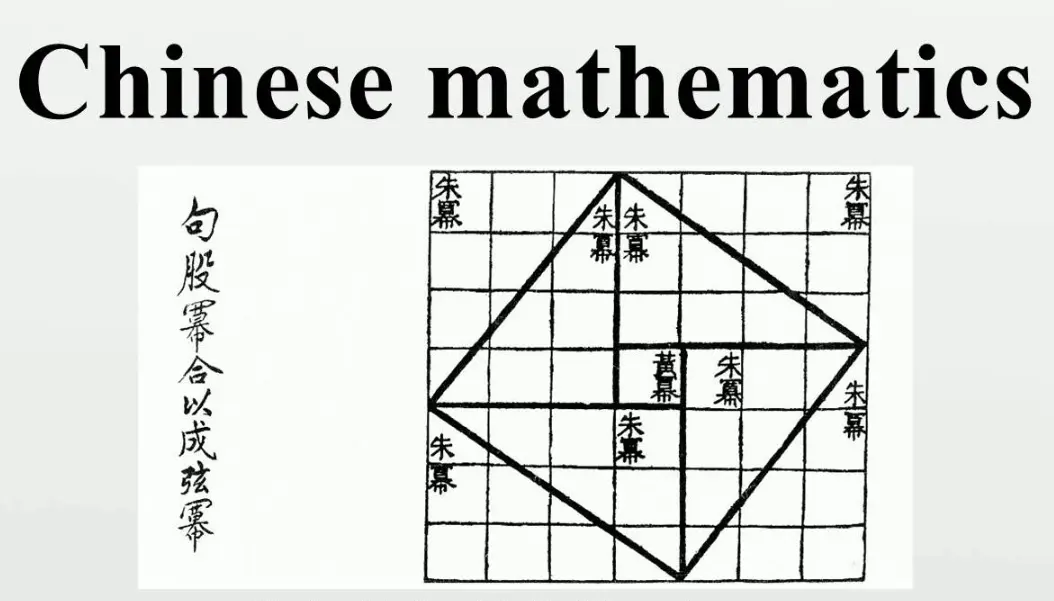
Chinese mathematics has a long and distinguished history, with significant achievements dating back to ancient times. As early as around 2000 BCE, the development of mathematics in China was closely linked to astronomy and calendrical science. The Zhoubi Suanjing and The Nine Chapters on the Mathematical Art are among the earliest classical works; the former discusses the Pythagorean theorem, while the latter systematically presents methods for solving equations and calculating areas and volumes.
During the Han Dynasty, the mathematician Zhang Heng invented the armillary sphere. In the Song and Yuan periods, Zu Chongzhi calculated the value of π accurately to seven decimal places. Qin Jiushao introduced the “Tian Yuan Shu” (method of the celestial unknown), which resembles modern algebra. In the Ming and Qing dynasties, mathematics continued to develop further, exemplified by works such as Mei Wending’s General Treatise on Ancient and Modern Mathematics.
Modern Chinese mathematics experienced rapid progress in the 20th century. Mathematicians such as Hua Luogeng and Chen Jingrun made important contributions to fields including number theory and analysis. Notably, Chen Jingrun achieved a major breakthrough related to the proof of Goldbach’s conjecture. Today, China holds a prominent position in the international mathematical community, achieving repeated success in the International Mathematical Olympiad and actively advancing applied mathematical research in areas such as artificial intelligence and big data.
Table of Contents
- Part 1: OnlineExamMaker – Generate and Share Chinese Mathematics Quiz with AI Automatically
- Part 2: 20 Chinese Mathematics Quiz Questions & Answers
- Part 3: Save Time and Energy: Generate Quiz Questions with AI Technology
Part 1: OnlineExamMaker – Generate and Share Chinese Mathematics Quiz with AI Automatically
The quickest way to assess the Chinese Mathematics knowledge of candidates is using an AI assessment platform like OnlineExamMaker. With OnlineExamMaker AI Question Generator, you are able to input content—like text, documents, or topics—and then automatically generate questions in various formats (multiple-choice, true/false, short answer). Its AI Exam Grader can automatically grade the exam and generate insightful reports after your candidate submit the assessment.
What you will like:
● Create a question pool through the question bank and specify how many questions you want to be randomly selected among these questions.
● Allow the quiz taker to answer by uploading video or a Word document, adding an image, and recording an audio file.
● Display the feedback for correct or incorrect answers instantly after a question is answered.
● Create a lead generation form to collect an exam taker’s information, such as email, mobile phone, work title, company profile and so on.
Automatically generate questions using AI
Part 2: 20 Chinese Mathematics Quiz Questions & Answers
or
1. Question: What is one of the earliest classical texts of Chinese mathematics?
A. The Elements
B. The Nine Chapters on the Mathematical Art
C. Principia Mathematica
D. Ars Magna
Answer: B
Explanation: *The Nine Chapters on the Mathematical Art* is one of the most influential ancient Chinese mathematical texts, covering arithmetic, geometry, and equation-solving methods.
2. Question: What mathematical concept is discussed in *The Zhoubi Suanjing*?
A. Calculus
B. Probability theory
C. The Pythagorean theorem
D. Matrix algebra
Answer: C
Explanation: *The Zhoubi Suanjing* includes early discussions of the Pythagorean theorem, linking mathematics with astronomy.
3. Question: Which ancient Chinese mathematical work focused on practical problem-solving?
A. The Nine Chapters on the Mathematical Art
B. Euclid’s Elements
C. Almagest
D. Liber Abaci
Answer: A
Explanation: *The Nine Chapters* emphasizes real-world applications such as land measurement, taxation, and engineering.
4. Question: Who accurately calculated the value of π to seven decimal places in ancient China?
A. Liu Hui
B. Zhang Heng
C. Zu Chongzhi
D. Qin Jiushao
Answer: C
Explanation: Zu Chongzhi calculated π as between 3.1415926 and 3.1415927, an achievement unmatched for centuries.
5. Question: What mathematical device did Zhang Heng invent during the Han Dynasty?
A. Abacus
B. Armillary sphere
C. Compass
D. Sundial
Answer: B
Explanation: Zhang Heng invented the armillary sphere, which was used to model celestial movements and required advanced mathematical understanding.
6. Question: What is the “Tian Yuan Shu” proposed by Qin Jiushao primarily related to?
A. Geometry
B. Trigonometry
C. Algebraic equations
D. Statistics
Answer: C
Explanation: The “Tian Yuan Shu” is an early algebraic method for representing and solving polynomial equations.
7. Question: Which dynasty saw major advancements in Chinese mathematics and astronomy?
A. Tang
B. Han
C. Song and Yuan
D. Qing
Answer: C
Explanation: The Song and Yuan dynasties were a golden age for mathematical and astronomical innovation in China.
8. Question: Which mathematician is associated with improvements to polygon approximation methods for π?
A. Chen Jingrun
B. Hua Luogeng
C. Liu Hui
D. Mei Wending
Answer: C
Explanation: Liu Hui refined polygon methods to approximate π with high accuracy.
9. Question: What role did mathematics play in ancient Chinese society?
A. Pure philosophical study
B. Military strategy only
C. Practical administration and engineering
D. Religious rituals
Answer: C
Explanation: Mathematics was used for land measurement, taxation, construction, and calendar-making.
10. Question: Which book by Mei Wending contributed to mathematical development in the Ming–Qing period?
A. Mathematical Principles
B. General Treatise on Ancient and Modern Mathematics
C. Nine Chapters Commentary
D. Mathematical Methods
Answer: B
Explanation: Mei Wending’s work integrated traditional Chinese mathematics with new methods and historical analysis.
11. Question: Which field did Hua Luogeng make significant contributions to?
A. Topology
B. Number theory
C. Mathematical logic
D. Game theory
Answer: B
Explanation: Hua Luogeng was a leading figure in number theory and modern mathematical research in China.
12. Question: What is Chen Jingrun best known for in mathematics?
A. Solving Fermat’s Last Theorem
B. Proving the Riemann Hypothesis
C. His work related to Goldbach’s conjecture
D. Inventing calculus
Answer: C
Explanation: Chen Jingrun made a major breakthrough by proving a strong form of Goldbach’s conjecture.
13. Question: How did ancient Chinese mathematics differ from ancient Greek mathematics?
A. Focused more on abstract proofs
B. Emphasized practical problem-solving
C. Rejected geometry
D. Ignored numerical methods
Answer: B
Explanation: Chinese mathematics prioritized practical applications over formal deductive proofs.
14. Question: What tool was widely used in traditional Chinese calculations?
A. Slide rule
B. Abacus
C. Calculator
D. Logarithmic tables
Answer: B
Explanation: The abacus was a central calculating tool in Chinese mathematics for centuries.
15. Question: Which mathematical area is strongly linked to Chinese calendar-making?
A. Probability
B. Set theory
C. Astronomy and arithmetic
D. Linear algebra
Answer: C
Explanation: Accurate calendars required precise astronomical observation and numerical calculation.
16. Question: What international competition has showcased China’s modern mathematical strength?
A. Fields Medal
B. International Mathematical Olympiad
C. Nobel Prize
D. Turing Award
Answer: B
Explanation: Chinese students have achieved outstanding results in the International Mathematical Olympiad.
17. Question: What was the main purpose of mathematical education in ancient China?
A. Philosophical debate
B. Entertainment
C. Government service and administration
D. Religious training
Answer: C
Explanation: Mathematics was essential for civil service tasks such as engineering, taxation, and planning.
18. Question: Which period marked the rise of modern mathematics in China?
A. Tang Dynasty
B. Song Dynasty
C. 20th century
D. 18th century
Answer: C
Explanation: Modern mathematical research in China developed rapidly during the 20th century.
19. Question: How does Chinese mathematics contribute to modern technology today?
A. Only through education
B. Mainly through philosophy
C. Through applied mathematics in AI and big data
D. By preserving ancient texts
Answer: C
Explanation: Applied mathematics supports modern fields such as artificial intelligence and data science in China.
20. Question: What best describes the overall tradition of Chinese mathematics?
A. Abstract and theoretical
B. Experimental and random
C. Practical, systematic, and application-oriented
D. Isolated from society
Answer: C
Explanation: Chinese mathematics has historically focused on systematic methods and real-world applications.
or
Part 3: Save Time and Energy: Generate Quiz Questions with AI Technology
Automatically generate questions using AI