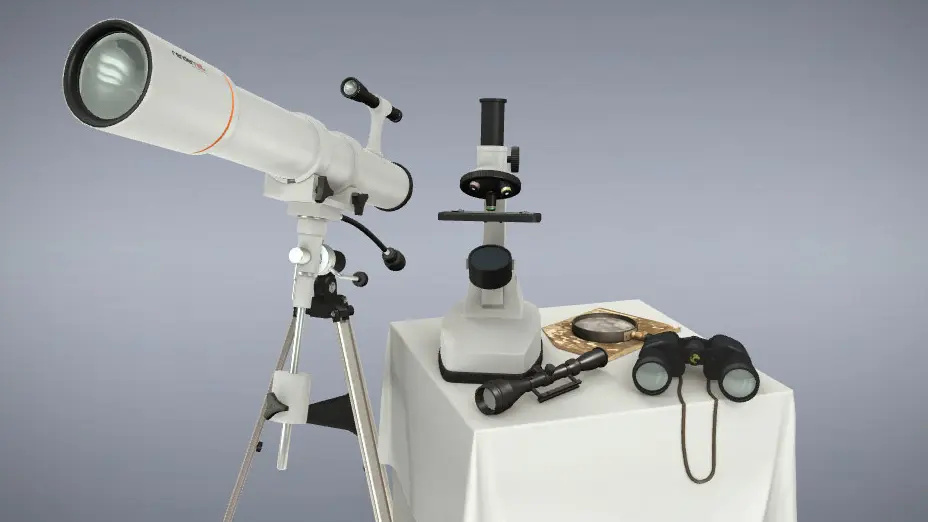
Optical instruments are devices designed to manipulate light for observation, measurement, and analysis, utilizing principles such as reflection, refraction, and diffraction. They include microscopes, which magnify minute objects for detailed examination in fields like biology and materials science; telescopes, which gather and focus light from distant celestial bodies to explore the universe; and cameras, which capture images by controlling light exposure. Other examples encompass binoculars, spectrometers, and lasers, each serving specific purposes in medicine, astronomy, photography, and industry. These tools enhance human vision, enable precise measurements, and drive technological advancements by converting light into usable information.
Table of Contents
- Part 1: Create An Amazing Optical Instruments Quiz Using AI Instantly in OnlineExamMaker
- Part 2: 20 Optical Instruments Quiz Questions & Answers
- Part 3: Save Time and Energy: Generate Quiz Questions with AI Technology
Part 1: Create An Amazing Optical Instruments Quiz Using AI Instantly in OnlineExamMaker
The quickest way to assess the Optical Instruments knowledge of candidates is using an AI assessment platform like OnlineExamMaker. With OnlineExamMaker AI Question Generator, you are able to input content—like text, documents, or topics—and then automatically generate questions in various formats (multiple-choice, true/false, short answer). Its AI Exam Grader can automatically grade the exam and generate insightful reports after your candidate submit the assessment.
Overview of its key assessment-related features:
● Create up to 10 question types, including multiple-choice, true/false, fill-in-the-blank, matching, short answer, and essay questions.
● Automatically generates detailed reports—individual scores, question report, and group performance.
● Instantly scores objective questions and subjective answers use rubric-based scoring for consistency.
● API and SSO help trainers integrate OnlineExamMaker with Google Classroom, Microsoft Teams, CRM and more.
Automatically generate questions using AI
Part 2: 20 Optical Instruments Quiz Questions & Answers
or
Question 1:
What is the primary function of a convex lens in optical instruments?
A) To diverge light rays
B) To converge light rays
C) To reflect light rays
D) To absorb light rays
Answer: B
Explanation: A convex lens converges parallel light rays to a focal point, which is essential for forming real images in instruments like cameras and magnifiers.
Question 2:
In a compound microscope, which lens provides the initial magnification?
A) Eyepiece lens
B) Objective lens
C) Condenser lens
D) Projector lens
Answer: B
Explanation: The objective lens is closest to the specimen and produces a magnified real image, which is then further enlarged by the eyepiece.
Question 3:
What type of telescope uses a concave mirror as its primary optical element?
A) Refracting telescope
B) Reflecting telescope
C) Galilean telescope
D) Chromatic telescope
Answer: B
Explanation: Reflecting telescopes, like Newtonian ones, use a concave mirror to collect and focus light, reducing chromatic aberration compared to refracting telescopes.
Question 4:
Which optical instrument is used to measure the refractive index of a material?
A) Spectrometer
B) Microscope
C) Periscope
D) Binoculars
Answer: A
Explanation: A spectrometer analyzes the spectrum of light to determine properties like the refractive index by measuring how light bends through the material.
Question 5:
What is the role of the aperture in a camera?
A) To focus the image
B) To control the amount of light entering
C) To magnify the subject
D) To store the image
Answer: B
Explanation: The aperture adjusts the size of the lens opening, controlling light exposure and depth of field in photography.
Question 6:
In fiber optics, what principle allows light to travel through the fiber?
A) Reflection
B) Refraction
C) Total internal reflection
D) Diffraction
Answer: C
Explanation: Total internal reflection occurs when light hits the fiber’s boundary at an angle greater than the critical angle, allowing it to propagate along the fiber with minimal loss.
Question 7:
Which lens is used in a simple magnifying glass?
A) Concave lens
B) Convex lens
C) Plano-convex lens
D) Double-concave lens
Answer: B
Explanation: A convex lens bends light rays to converge, creating a virtual, enlarged image when an object is placed within its focal length.
Question 8:
What corrects myopia in eyeglasses?
A) Convex lenses
B) Concave lenses
C) Cylindrical lenses
D) Bifocal lenses
Answer: B
Explanation: Concave lenses diverge light rays, helping to focus the image on the retina for nearsighted individuals by counteracting the eye’s excessive convergence.
Question 9:
In a prism spectrometer, what does the prism do?
A) Amplify light
B) Disperse light into its spectrum
C) Reflect light directly
D) Absorb ultraviolet light
Answer: B
Explanation: A prism refracts light at different angles based on wavelength, separating it into a spectrum for analysis of light sources.
Question 10:
What is the function of the eyepiece in a telescope?
A) To gather light from distant objects
B) To magnify the image formed by the objective
C) To stabilize the telescope
D) To filter out colors
Answer: B
Explanation: The eyepiece acts as a magnifying lens, enlarging the real image produced by the objective lens for the observer.
Question 11:
Which optical instrument uses a combination of lenses and mirrors to view objects around corners?
A) Microscope
B) Periscope
C) Telescope
D) Spectrometer
Answer: B
Explanation: A periscope uses mirrors or prisms at 45-degree angles to reflect light, allowing users to see over obstacles or around corners.
Question 12:
What type of mirror is used in a reflecting telescope’s primary mirror?
A) Plane mirror
B) Convex mirror
C) Concave mirror
D) Parabolic mirror
Answer: D
Explanation: A parabolic mirror is used to focus incoming parallel rays to a single point, minimizing spherical aberration in telescopes.
Question 13:
In photography, what does the shutter speed control?
A) The color of the image
B) The duration of light exposure
C) The lens focus
D) The image size
Answer: B
Explanation: Shutter speed determines how long the camera’s sensor is exposed to light, affecting motion blur and overall brightness.
Question 14:
What is the purpose of a Nicol prism in polarimeters?
A) To produce polarized light
B) To magnify small objects
C) To reflect infrared light
D) To disperse white light
Answer: A
Explanation: A Nicol prism polarizes light by allowing only one vibration direction to pass, which is used to measure the rotation of polarized light in solutions.
Question 15:
Which optical instrument is essential for viewing microorganisms?
A) Telescope
B) Microscope
C) Binoculars
D) Camera
Answer: B
Explanation: A microscope uses lenses to magnify tiny objects, allowing detailed observation of microorganisms that are invisible to the naked eye.
Question 16:
What causes chromatic aberration in lenses?
A) Uneven reflection
B) Different wavelengths refracting at different angles
C) Light absorption
D) Lens scratching
Answer: B
Explanation: Chromatic aberration occurs because shorter wavelengths (like blue light) bend more than longer ones (like red light) in a lens, causing color fringing.
Question 17:
In a camera obscura, how is an image formed?
A) By digital sensors
B) By light passing through a small hole and projecting an inverted image
C) By mirrors only
D) By laser beams
Answer: B
Explanation: A camera obscura uses a pinhole to allow light to enter and form an inverted real image on a surface inside the darkened box.
Question 18:
What is the key advantage of a zoom lens over a fixed focal length lens?
A) It is lighter
B) It allows variable magnification without changing lenses
C) It produces only black and white images
D) It requires less light
Answer: B
Explanation: A zoom lens changes its focal length, enabling different magnifications while keeping the camera focused, which is useful in varying shooting conditions.
Question 19:
Which part of the human eye acts like the aperture in a camera?
A) Retina
B) Iris
C) Lens
D) Cornea
Answer: B
Explanation: The iris controls the size of the pupil, regulating the amount of light entering the eye, similar to a camera’s aperture.
Question 20:
What principle explains how a diffraction grating separates light?
A) Reflection
B) Interference and diffraction of light waves
C) Total internal reflection
D) Refraction only
Answer: B
Explanation: A diffraction grating uses the wave nature of light, where interference from closely spaced slits creates a spectrum by diffracting light at different angles for each wavelength.
or
Part 3: Save Time and Energy: Generate Quiz Questions with AI Technology
Automatically generate questions using AI