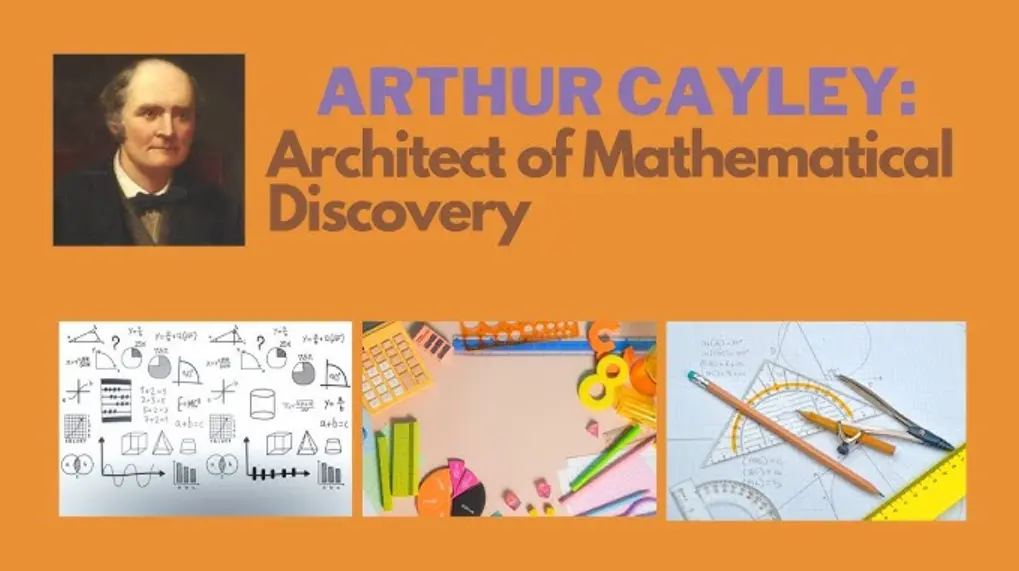
Arthur Cayley (1821–1895) was a pioneering British mathematician whose work laid the foundations for modern algebra and geometry. Born in Richmond, London, he studied at Trinity College, Cambridge, where he excelled in mathematics, graduating as Senior Wrangler in 1842. Initially pursuing a career in law, Cayley qualified as a barrister in 1849 but returned to mathematics full-time in 1863, becoming the Sadlerian Professor of Pure Mathematics at Cambridge.
Cayley’s contributions were vast and influential. He is credited with formalizing the concept of matrices in 1858, introducing matrix algebra as a tool for solving linear equations and transformations. His development of the Cayley-Hamilton theorem and Cayley’s formula for the number of spanning trees in a graph remain fundamental in linear algebra and graph theory. He also co-founded the theory of algebraic invariants with James Joseph Sylvester, exploring how certain properties remain unchanged under linear transformations.
In group theory, Cayley introduced the idea of abstract groups and Cayley’s theorem, which states that every group is isomorphic to a subgroup of a symmetric group. Over his career, he published more than 900 papers, covering topics from elliptic functions and differential equations to quaternions and non-Euclidean geometry. His interdisciplinary approach bridged pure and applied mathematics, influencing fields like physics and engineering. Cayley’s legacy endures in the Cayley graph, Cayley numbers, and his role in advancing mathematical abstraction.
Table of Contents
- Part 1: Create A Arthur Cayley Quiz in Minutes Using AI with OnlineExamMaker
- Part 2: 20 Arthur Cayley Quiz Questions & Answers
- Part 3: Save Time and Energy: Generate Quiz Questions with AI Technology
Part 1: Create A Arthur Cayley Quiz in Minutes Using AI with OnlineExamMaker
When it comes to ease of creating a Arthur Cayley skills assessment, OnlineExamMaker is one of the best AI-powered quiz making software for your institutions or businesses. With its AI Question Generator, just upload a document or input keywords about your assessment topic, you can generate high-quality quiz questions on any topic, difficulty level, and format.
Overview of its key assessment-related features:
● AI Question Generator to help you save time in creating quiz questions automatically.
● Share your online exam with audiences on social platforms like Facebook, Twitter, Reddit and more.
● Instantly scores objective questions and subjective answers use rubric-based scoring for consistency.
● Simply copy and insert a few lines of embed codes to display your online exams on your website or WordPress blog.
Automatically generate questions using AI
Part 2: 20 Arthur Cayley Quiz Questions & Answers
or
1. Question: What field of mathematics is Arthur Cayley most associated with?
Options: A) Number theory
B) Matrix algebra
C) Topology
D) Probability
Answer: B
Explanation: Cayley is renowned for his foundational work in matrix algebra, including the development of the Cayley-Hamilton theorem and matrix determinants.
2. Question: Which theorem is named after Arthur Cayley?
Options: A) Pythagorean theorem
B) Cayley-Hamilton theorem
C) Fermat’s last theorem
D) Euler’s theorem
Answer: B
Explanation: The Cayley-Hamilton theorem states that every square matrix satisfies its own characteristic equation, a key result in linear algebra.
3. Question: In what year was Arthur Cayley born?
Options: A) 1821
B) 1800
C) 1850
D) 1776
Answer: A
Explanation: Arthur Cayley was born on August 16, 1821, in Richmond, England.
4. Question: What is Cayley’s formula used for?
Options: A) Calculating the volume of a sphere
B) Counting the number of spanning trees in a graph
C) Solving quadratic equations
D) Finding the roots of polynomials
Answer: B
Explanation: Cayley’s formula provides the number of distinct spanning trees in a complete graph with n vertices, expressed as n^(n-2).
5. Question: Which university did Arthur Cayley attend?
Options: A) Cambridge University
B) Oxford University
C) Harvard University
D) University of Paris
Answer: A
Explanation: Cayley studied at Trinity College, Cambridge, where he later became a professor.
6. Question: Arthur Cayley is credited with co-founding which branch of mathematics?
Options: A) Invariant theory
B) Set theory
C) Abstract algebra
D) Combinatorics
Answer: A
Explanation: Cayley, along with James Joseph Sylvester, helped establish invariant theory, which deals with properties unchanged under transformations.
7. Question: What was Arthur Cayley’s profession besides being a mathematician?
Options: A) Lawyer
B) Physician
C) Engineer
D) Astronomer
Answer: A
Explanation: Before focusing on mathematics, Cayley practiced as a lawyer for several years in London.
8. Question: In group theory, what is a Cayley table used for?
Options: A) Representing group operations
B) Calculating determinants
C) Solving differential equations
D) Plotting graphs
Answer: A
Explanation: A Cayley table is a matrix that displays the results of a binary operation for every pair of elements in a group.
9. Question: How many papers did Arthur Cayley publish during his career?
Options: A) Over 900
B) Around 500
C) Exactly 100
D) Less than 50
Answer: A
Explanation: Cayley published more than 900 papers, making him one of the most prolific mathematicians in history.
10. Question: What is the Cayley graph in mathematics?
Options: A) A representation of group actions
B) A type of polynomial equation
C) A method for integration
D) A geometric shape in topology
Answer: A
Explanation: A Cayley graph visualizes the structure of a group by representing its elements as vertices and generators as edges.
11. Question: Arthur Cayley served as the president of which mathematical society?
Options: A) Royal Society
B) London Mathematical Society
C) American Mathematical Society
D) French Academy of Sciences
Answer: B
Explanation: Cayley was the president of the London Mathematical Society from 1868 to 1870.
12. Question: Which of the following did Cayley contribute to in linear algebra?
Options: A) The concept of eigenvalues
B) The binomial theorem
C) Fourier series
D) Vector spaces
Answer: A
Explanation: Cayley’s work on matrices included early developments in eigenvalues and eigenvectors.
13. Question: What is the significance of Cayley’s work on elliptic functions?
Options: A) It advanced the study of complex analysis
B) It simplified arithmetic operations
C) It related to quantum mechanics
D) It focused on statistical distributions
Answer: A
Explanation: Cayley’s research on elliptic functions contributed to the broader field of complex analysis and algebraic geometry.
14. Question: In what year did Arthur Cayley die?
Options: A) 1895
B) 1900
C) 1880
D) 1920
Answer: A
Explanation: Arthur Cayley died on January 26, 1895, in Cambridge, England.
15. Question: Which mathematician collaborated closely with Cayley?
Options: A) Isaac Newton
B) James Joseph Sylvester
C) Carl Friedrich Gauss
D) Leonhard Euler
Answer: B
Explanation: Cayley and Sylvester worked together on invariant theory and other algebraic concepts.
16. Question: What does the Cayley determinant represent?
Options: A) The determinant of a matrix
B) A specific formula for graph theory
C) An integral in calculus
D) A sequence in number theory
Answer: A
Explanation: The Cayley determinant is a method for computing the determinant of a matrix, building on his matrix algebra contributions.
17. Question: Arthur Cayley’s work influenced the development of which modern field?
Options: A) Computer science
B) Quantum physics
C) Botany
D) Linguistics
Answer: A
Explanation: His advancements in algebra and graph theory laid groundwork for algorithms and data structures in computer science.
18. Question: What is a key feature of Cayley’s hyperdeterminant?
Options: A) It generalizes determinants to higher dimensions
B) It solves linear systems
C) It calculates probabilities
D) It measures angles in geometry
Answer: A
Explanation: The hyperdeterminant, introduced by Cayley, extends the concept of determinants to tensors and multidimensional arrays.
19. Question: Which award or honor did Arthur Cayley receive?
Options: A) The Copley Medal
B) The Fields Medal
C) The Nobel Prize
D) The Turing Award
Answer: A
Explanation: Cayley was awarded the Copley Medal by the Royal Society in 1859 for his mathematical contributions.
20. Question: How did Cayley’s formula impact graph theory?
Options: A) It counts tree structures in graphs
B) It classifies geometric shapes
C) It optimizes network flows
D) It analyzes wave functions
Answer: A
Explanation: Cayley’s formula is fundamental in graph theory for enumerating spanning trees, influencing network design and combinatorics.
or
Part 3: Save Time and Energy: Generate Quiz Questions with AI Technology
Automatically generate questions using AI