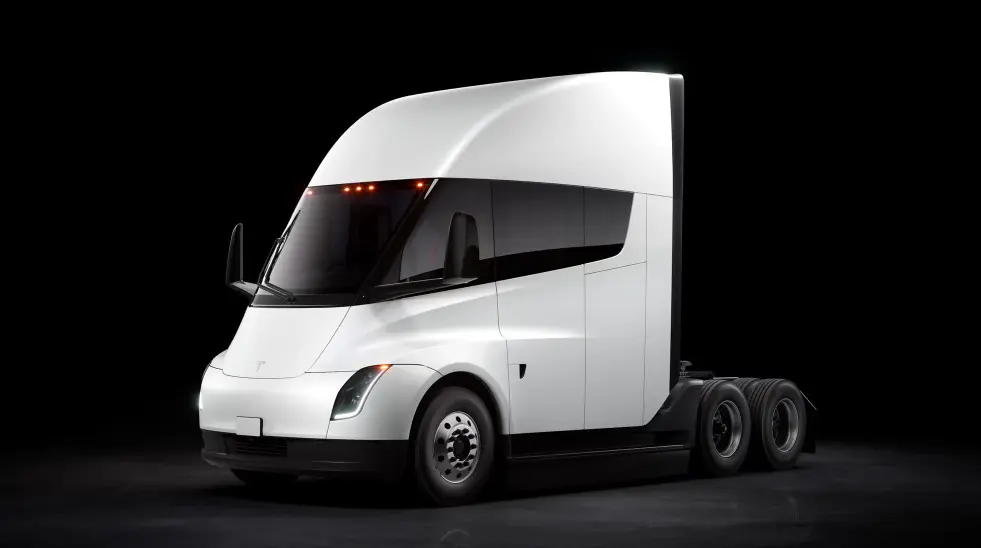
The Tesla Semi is an all-electric Class 8 semi-truck designed for long-haul freight transport, emphasizing efficiency, sustainability, and performance. Introduced by Tesla in 2017, it aims to revolutionize the trucking industry by replacing diesel vehicles with zero-emission alternatives.
Key specifications include:
– Range: Up to 500 miles (800 km) on a single charge with the standard battery, and up to 800 miles (1,300 km) with the extended version.
– Performance: Accelerates from 0 to 60 mph (0-97 km/h) in as little as 20 seconds when fully loaded, with a top speed of 65 mph (105 km/h) for the base model and 80 mph (129 km/h) for highway use.
– Battery and Charging: Utilizes Tesla’s 4680 cell batteries, supporting Megachargers that can add up to 1,000 miles (1,600 km) of range per hour, allowing for quick turnaround times.
– Payload and Aerodynamics: Offers a gross vehicle weight rating of up to 82,000 pounds (37,000 kg), with a sleek, aerodynamic design that reduces drag and improves energy efficiency.
Benefits include:
– Environmental Impact: Produces zero tailpipe emissions, helping to reduce greenhouse gases and air pollution in the logistics sector.
– Cost Savings: Lower operating costs due to cheaper electricity compared to diesel fuel, reduced maintenance from fewer moving parts, and regenerative braking for energy recapture.
– Safety and Autonomy: Features advanced driver-assistance systems, including autopilot for highway driving, collision avoidance, and enhanced visibility through a centralized driver’s display.
Production began in late 2022 at Tesla’s Nevada Gigafactory, with initial deliveries to partners like PepsiCo and Walmart. The Semi is positioned as a scalable solution for fleet operators, supporting the global shift toward sustainable transportation. Tesla plans further enhancements, including full autonomy, to optimize routes and minimize downtime.
Table of Contents
- Part 1: OnlineExamMaker AI Quiz Maker – Make A Free Quiz in Minutes
- Part 2: 20 Tesla Semi Quiz Questions & Answers
- Part 3: OnlineExamMaker AI Question Generator: Generate Questions for Any Topic
Part 1: OnlineExamMaker AI Quiz Maker – Make A Free Quiz in Minutes
Still spend a lot of time in editing questions for your next Tesla Semi assessment? OnlineExamMaker is an AI quiz maker that leverages artificial intelligence to help users create quizzes, tests, and assessments quickly and efficiently. You can start by inputting a topic or specific details into the OnlineExamMaker AI Question Generator, and the AI will generate a set of questions almost instantly. It also offers the option to include answer explanations, which can be short or detailed, helping learners understand their mistakes.
What you may like:
● Automatic grading and insightful reports. Real-time results and interactive feedback for quiz-takers.
● The exams are automatically graded with the results instantly, so that teachers can save time and effort in grading.
● LockDown Browser to restrict browser activity during quizzes to prevent students searching answers on search engines or other software.
● Create certificates with personalized company logo, certificate title, description, date, candidate’s name, marks and signature.
Automatically generate questions using AI
Part 2: 20 Tesla Semi Quiz Questions & Answers
or
1. Question: What is the approximate maximum range of the Tesla Semi on a single charge?
A. 200 miles
B. 300 miles
C. 500 miles
D. 700 miles
Answer: C
Explanation: The Tesla Semi is engineered to achieve up to 500 miles of range on a single charge, allowing it to handle long-haul routes efficiently.
2. Question: What is the top speed of the Tesla Semi when fully loaded?
A. 55 mph
B. 65 mph
C. 75 mph
D. 85 mph
Answer: B
Explanation: The Tesla Semi has a top speed of 65 mph when fully loaded, which helps maintain highway speeds while prioritizing energy efficiency.
3. Question: How long does it take for the Tesla Semi to accelerate from 0 to 60 mph with a full load?
A. 10 seconds
B. 15 seconds
C. 20 seconds
D. 25 seconds
Answer: C
Explanation: The Tesla Semi can accelerate from 0 to 60 mph in about 20 seconds when fully loaded, demonstrating strong performance for an electric truck.
4. Question: What is the maximum payload capacity of the Tesla Semi?
A. 60,000 pounds
B. 72,000 pounds
C. 82,000 pounds
D. 90,000 pounds
Answer: C
Explanation: The Tesla Semi is designed to carry up to 82,000 pounds, making it competitive with traditional diesel trucks in terms of cargo capacity.
5. Question: Which type of battery cells does the Tesla Semi primarily use?
A. 18650 cells
B. 2170 cells
C. 4680 cells
D. 21700 cells
Answer: C
Explanation: The Tesla Semi utilizes 4680 battery cells, which offer higher energy density and support Tesla’s advancements in electric vehicle technology.
6. Question: How does the Tesla Semi reduce environmental impact compared to diesel trucks?
A. By emitting less noise
B. By producing zero tailpipe emissions
C. By using less fuel
D. All of the above
Answer: D
Explanation: The Tesla Semi reduces environmental impact through zero tailpipe emissions, lower noise levels, and overall energy efficiency compared to diesel trucks.
7. Question: What is the primary advantage of the Tesla Semi’s electric motors?
A. Higher maintenance costs
B. Instant torque delivery
C. Slower acceleration
D. Increased fuel consumption
Answer: B
Explanation: Electric motors in the Tesla Semi provide instant torque, resulting in better acceleration and responsiveness without the need for a traditional gearbox.
8. Question: When did Tesla begin production of the Tesla Semi?
A. 2017
B. 2020
C. 2022
D. 2025
Answer: C
Explanation: Tesla started production of the Tesla Semi in 2022, with initial deliveries to select customers like PepsiCo.
9. Question: Which company was one of the first to receive Tesla Semi trucks?
A. Amazon
B. Walmart
C. PepsiCo
D. FedEx
Answer: C
Explanation: PepsiCo was one of the first companies to receive Tesla Semi trucks, using them for their logistics operations.
10. Question: What aerodynamic feature helps improve the Tesla Semi’s efficiency?
A. Traditional cab design
B. Sleek, teardrop-shaped cab
C. Added spoilers
D. Larger wheels
Answer: B
Explanation: The Tesla Semi’s sleek, teardrop-shaped cab reduces drag and enhances aerodynamics, contributing to its extended range.
11. Question: How does the Tesla Semi handle regenerative braking?
A. It does not use regenerative braking
B. It converts kinetic energy to battery power
C. It increases energy consumption
D. It only works at high speeds
Answer: B
Explanation: Regenerative braking in the Tesla Semi captures kinetic energy during deceleration and converts it back into stored battery power, improving overall efficiency.
12. Question: What is the estimated energy efficiency of the Tesla Semi compared to diesel trucks?
A. 10% more efficient
B. 20% less efficient
C. Up to 50% more efficient
D. Equal efficiency
Answer: C
Explanation: The Tesla Semi is up to 50% more energy-efficient than diesel trucks, leading to significant cost savings over time.
13. Question: Which safety feature is integrated into the Tesla Semi?
A. Basic collision avoidance
B. Advanced Autopilot for trucks
C. Manual emergency brakes only
D. No safety enhancements
Answer: B
Explanation: The Tesla Semi includes advanced Autopilot features, such as automatic emergency braking and lane-keeping, to enhance driver safety.
14. Question: What is the approximate charging time for a full charge of the Tesla Semi?
A. 1 hour
B. 30 minutes
C. 2 hours
D. 5 hours
Answer: A
Explanation: Using Tesla’s Megachargers, the Tesla Semi can achieve a full charge in about 1 hour, minimizing downtime for fleets.
15. Question: How does the Tesla Semi’s weight compare to traditional diesel trucks?
A. Significantly heavier
B. Lighter due to battery placement
C. Exactly the same
D. Variable based on load
Answer: B
Explanation: The Tesla Semi is designed to be lighter than equivalent diesel trucks when accounting for battery weight distribution, improving payload efficiency.
16. Question: What role does the Tesla Semi play in reducing operating costs?
A. Higher fuel expenses
B. Lower maintenance and energy costs
C. Increased insurance rates
D. Frequent part replacements
Answer: B
Explanation: The Tesla Semi lowers operating costs through reduced maintenance needs and cheaper electricity compared to diesel fuel.
17. Question: Which factor contributes to the Tesla Semi’s quiet operation?
A. Loud electric motors
B. Electric powertrain with no engine noise
C. Exhaust system design
D. Tire modifications
Answer: B
Explanation: The electric powertrain of the Tesla Semi produces minimal noise, making it quieter than traditional internal combustion engine trucks.
18. Question: What is the primary motor configuration in the Tesla Semi?
A. Single motor
B. Dual motors
C. Quad motors
D. No motors
Answer: C
Explanation: The Tesla Semi uses a quad-motor setup, providing all-wheel drive and enhanced traction for various road conditions.
19. Question: How does the Tesla Semi support autonomous driving?
A. It does not support autonomy
B. Basic level with hardware for future updates
C. Full autonomy from the start
D. Only manual mode
Answer: B
Explanation: The Tesla Semi includes hardware for autonomous driving capabilities, allowing for over-the-air updates to enable features like platooning in the future.
20. Question: What is a key benefit of the Tesla Semi for logistics companies?
A. Increased emissions
B. Reduced downtime with fast charging
C. Higher operational complexity
D. Limited route options
Answer: B
Explanation: The Tesla Semi’s fast charging reduces downtime, enabling logistics companies to maintain efficient schedules and improve productivity.
or
Part 3: OnlineExamMaker AI Question Generator: Generate Questions for Any Topic
Automatically generate questions using AI