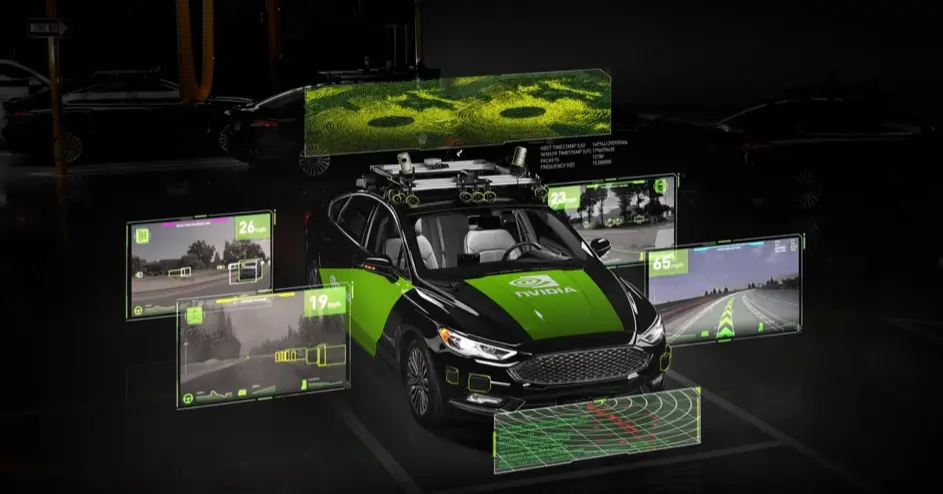
Nvidia DRIVE is a comprehensive platform engineered for autonomous vehicles and advanced driver-assistance systems (ADAS), leveraging AI, machine learning, and high-performance computing to enable safe, intelligent mobility.
Key Features:
– Hardware: Includes the DRIVE AGX family of systems-on-chips (SoCs) and GPUs, such as the Orin processor, which deliver real-time processing for sensor fusion, computer vision, and deep learning tasks.
– Software: Encompasses the DRIVE OS, Hyperion simulation environment, and a full software stack for perception, mapping, localization, planning, and control, allowing developers to build and deploy AI-driven applications.
– Ecosystem Integration: Supports a wide range of sensors (cameras, radar, lidar) and cloud-based tools for over-the-air updates, data analytics, and fleet management.
Applications:
– Powers self-driving cars, trucks, and shuttles for enhanced safety and efficiency.
– Enables ADAS features like automatic emergency braking, lane-keeping assist, and adaptive cruise control.
– Extends to robotics, drones, and smart infrastructure for broader AI applications in transportation.
Benefits:
– Accelerates development with scalable computing power, reducing time-to-market for autonomous solutions.
– Enhances safety through advanced neural networks that process complex environments in real time.
– Promotes innovation with open APIs and partnerships, fostering a collaborative ecosystem for future mobility.
Nvidia DRIVE represents a pivotal advancement in automotive technology, driving the transition to fully autonomous worlds.
Table of Contents
- Part 1: OnlineExamMaker – Generate and Share Nvidia DRIVE Platform Quiz with AI Automatically
- Part 2: 20 Nvidia DRIVE Platform Quiz Questions & Answers
- Part 3: OnlineExamMaker AI Question Generator: Generate Questions for Any Topic
Part 1: OnlineExamMaker – Generate and Share Nvidia DRIVE Platform Quiz with AI Automatically
OnlineExamMaker is a powerful AI-powered assessment platform to create auto-grading Nvidia DRIVE Platform skills assessments. It’s designed for educators, trainers, businesses, and anyone looking to generate engaging quizzes without spending hours crafting questions manually. The AI Question Generator feature allows you to input a topic or specific details, and it generates a variety of question types automatically.
Top features for assessment organizers:
● Prevent cheating by randomizing questions or changing the order of questions, so learners don’t get the same set of questions each time.
● AI Exam Grader for efficiently grading quizzes and assignments, offering inline comments, automatic scoring, and “fudge points” for manual adjustments.
● Embed quizzes on websites, blogs, or share via email, social media (Facebook, Twitter), or direct links.
● Handles large-scale testing (thousands of exams/semester) without internet dependency, backed by cloud infrastructure.
Automatically generate questions using AI
Part 2: 20 Nvidia DRIVE Platform Quiz Questions & Answers
or
1. Question: What is the primary purpose of the Nvidia DRIVE platform?
A. Enhancing gaming performance
B. Enabling autonomous driving and AI in vehicles
C. Developing mobile applications
D. Creating cloud computing solutions
Answer: B
Explanation: Nvidia DRIVE is specifically engineered for automotive applications, focusing on AI, deep learning, and autonomous driving technologies to power self-driving cars and advanced driver-assistance systems.
2. Question: Which hardware component is central to the Nvidia DRIVE platform?
A. CPU
B. GPU
C. RAM
D. Hard drive
Answer: B
Explanation: The GPU is at the core of Nvidia DRIVE, providing the parallel processing power needed for real-time AI computations in autonomous vehicles.
3. Question: What does Nvidia DRIVE Hypervisor enable?
A. Basic operating system functions
B. Running multiple operating systems securely on the same hardware
C. Wireless connectivity
D. Battery management
Answer: B
Explanation: The DRIVE Hypervisor allows for the safe and efficient partitioning of hardware resources, enabling multiple OS environments to operate simultaneously, which is crucial for safety in automotive systems.
4. Question: Which Nvidia technology is integrated into DRIVE for sensor fusion?
A. CUDA
B. TensorRT
C. DeepStream
D. All of the above
Answer: D
Explanation: CUDA, TensorRT, and DeepStream are all integrated into DRIVE to handle sensor data processing, AI inference, and streaming, enhancing capabilities for perception in autonomous driving.
5. Question: What is the role of Nvidia DRIVE OS in the platform?
A. Managing user interfaces
B. Providing a secure, real-time operating system for vehicles
C. Handling network security
D. Optimizing battery life
Answer: B
Explanation: DRIVE OS is a Linux-based operating system tailored for automotive use, ensuring real-time performance, security, and reliability in safety-critical applications.
6. Question: How does Nvidia DRIVE support over-the-air (OTA) updates?
A. Through manual software installation
B. Via secure, wireless firmware updates
C. By replacing hardware components
D. Using physical USB connections
Answer: B
Explanation: DRIVE enables OTA updates to allow vehicles to receive software enhancements remotely, improving safety and functionality without physical intervention.
7. Question: What type of AI model is commonly used with Nvidia DRIVE for object detection?
A. Recurrent Neural Networks (RNN)
B. Convolutional Neural Networks (CNN)
C. Decision Trees
D. Support Vector Machines
Answer: B
Explanation: CNNs are optimized for image and video processing in DRIVE, making them ideal for tasks like object detection in autonomous driving scenarios.
8. Question: Which certification is Nvidia DRIVE designed to meet for automotive safety?
A. ISO 9001
B. ISO 26262
C. IEEE 802.11
D. PCI DSS
Answer: B
Explanation: ISO 26262 is the functional safety standard for road vehicles, and DRIVE is built to comply with it to ensure reliable operation in safety-critical environments.
9. Question: What is the main benefit of Nvidia DRIVE’s simulation tools?
A. Reducing physical testing costs
B. Increasing game graphics quality
C. Enhancing social media features
D. Managing office productivity
Answer: A
Explanation: Simulation tools in DRIVE allow developers to test autonomous driving scenarios virtually, cutting down on the need for expensive real-world prototypes and tests.
10. Question: How does Nvidia DRIVE handle data from multiple sensors in a vehicle?
A. By ignoring redundant data
B. Through sensor fusion algorithms
C. By shutting down unnecessary sensors
D. Using simple averaging
Answer: B
Explanation: Sensor fusion in DRIVE combines data from cameras, radar, lidar, and other sources to create a comprehensive environmental understanding, improving accuracy and decision-making.
11. Question: What is Nvidia DRIVE AGX?
A. A software development kit
B. A family of AI computing platforms for vehicles
C. A mobile app for drivers
D. A cloud storage service
Answer: B
Explanation: DRIVE AGX is a series of high-performance computing platforms that integrate AI accelerators and processors for advanced automotive applications.
12. Question: Which feature of Nvidia DRIVE enhances vehicle-to-everything (V2X) communication?
A. Bluetooth connectivity
B. 5G and edge computing integration
C. Wired Ethernet only
D. Infrared sensors
Answer: B
Explanation: DRIVE supports 5G and edge computing to enable real-time V2X communication, allowing vehicles to interact with other vehicles, infrastructure, and networks for safer driving.
13. Question: What programming language is primarily used for developing applications on Nvidia DRIVE?
A. Java
B. C++ with CUDA extensions
C. Python only
D. Assembly language
Answer: B
Explanation: C++ is commonly used in DRIVE development, especially with CUDA extensions, to leverage GPU acceleration for high-performance computing tasks.
14. Question: How does Nvidia DRIVE contribute to energy efficiency in electric vehicles?
A. By increasing engine power
B. Optimizing AI algorithms for lower power consumption
C. Adding more batteries
D. Boosting audio systems
Answer: B
Explanation: DRIVE’s AI optimizations allow for efficient processing, reducing the energy required for computations and extending the range of electric vehicles.
15. Question: What is the purpose of Nvidia DRIVE’s end-to-end deep learning?
A. To simplify data entry
B. To train models that handle the full driving pipeline from perception to control
C. To create animations
D. To manage email systems
Answer: B
Explanation: End-to-end deep learning in DRIVE enables a seamless AI workflow, from sensor input to vehicle control, accelerating the development of fully autonomous systems.
16. Question: Which Nvidia tool is used for deploying AI models on DRIVE?
A. TensorFlow
B. TensorRT
C. Excel
D. Photoshop
Answer: B
Explanation: TensorRT optimizes and deploys deep learning models on DRIVE hardware, ensuring fast inference speeds for real-time applications in vehicles.
17. Question: What role does Nvidia DRIVE play in advanced driver-assistance systems (ADAS)?
A. Providing entertainment features
B. Enabling features like adaptive cruise control and lane keeping
C. Handling vehicle cleaning
D. Optimizing fuel types
Answer: B
Explanation: DRIVE powers ADAS by processing sensor data to support safety features, helping prevent accidents through AI-driven assistance.
18. Question: How does Nvidia DRIVE ensure data privacy in connected vehicles?
A. By sharing all data publicly
B. Through encryption and secure boot mechanisms
C. By disabling internet access
D. Using open-source code without restrictions
Answer: B
Explanation: DRIVE incorporates encryption, secure boot, and other security protocols to protect sensitive vehicle data from unauthorized access.
19. Question: What is the significance of Nvidia DRIVE in robotics beyond automotive?
A. It is limited to cars only
B. It supports AI for robots in warehouses and delivery
C. It focuses on household appliances
D. It is used for weather forecasting
Answer: B
Explanation: While primarily automotive, DRIVE’s AI capabilities extend to robotics applications, such as autonomous delivery robots and industrial automation.
20. Question: Which aspect of Nvidia DRIVE helps in reducing development time for autonomous vehicles?
A. Manual coding requirements
B. Pre-built SDKs and reference designs
C. Requiring custom hardware builds
D. Limiting software updates
Answer: B
Explanation: DRIVE provides ready-to-use SDKs, tools, and reference designs that accelerate the development process, allowing engineers to focus on innovation rather than building from scratch.
or
Part 3: OnlineExamMaker AI Question Generator: Generate Questions for Any Topic
Automatically generate questions using AI