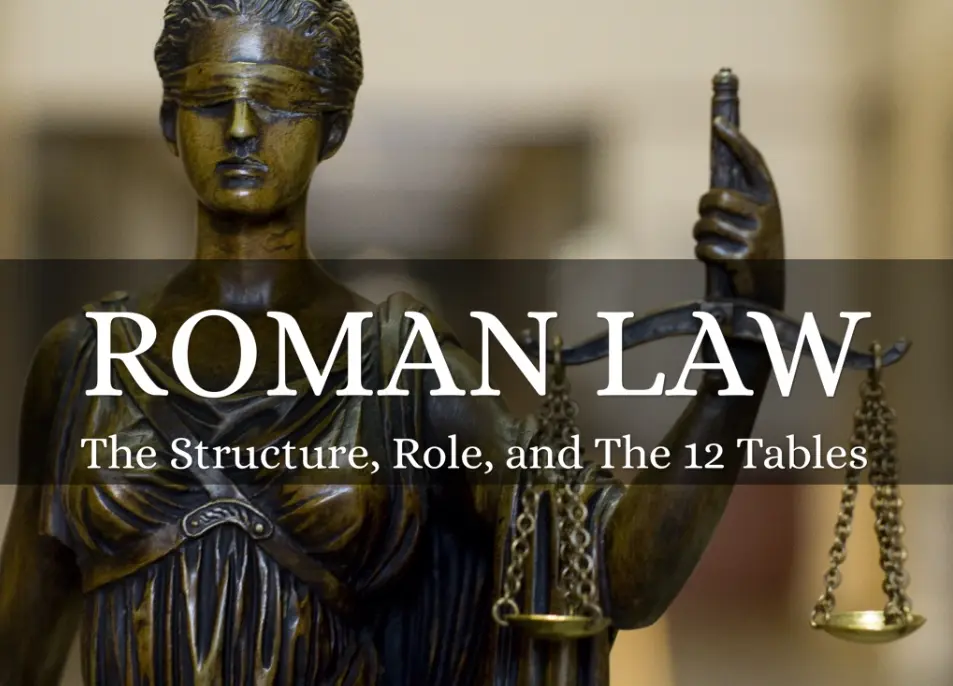
Roman Law, one of the most influential legal systems in history, originated in ancient Rome and evolved over centuries to form the foundation of modern civil law. Its roots trace back to the Twelve Tables in 450 BC, which codified early customs and principles for Roman citizens.
Historical Development:
– Republican Era (509–27 BC): Law was primarily based on customs, religious practices, and the Twelve Tables. The role of magistrates and the Senate was crucial, with the development of legal procedures through praetors’ edicts.
– Imperial Era (27 BC–476 AD): Emperors like Augustus and Justinian centralized legal authority. Key compilations included the Codex Theodosianus (5th century AD) and Justinian’s Corpus Juris Civilis (6th century AD), which systematized statutes, legal opinions, and imperial decrees.
– Post-Roman Influence: After the fall of the Western Roman Empire, Roman Law persisted in the Byzantine Empire and was revived in Europe during the Middle Ages, influencing canon law and scholastic studies.
Key Components:
– Private Law: Governed individual rights and relationships, including contract law (e.g., sale, lease, partnership), property law (ownership, possession), family law (marriage, inheritance, guardianship), and obligations.
– Public Law: Dealt with the state and its citizens, encompassing constitutional law (powers of magistrates), administrative law (governance), and criminal law (offenses like treason, theft, and assault, with penalties ranging from fines to death).
– Principles and Concepts: Emphasized equity (aequitas), where judges could adapt strict law for fairness; the idea of persona (legal personality); and the distinction between ius civile (citizen law) and ius gentium (law of nations, applicable to foreigners).
Sources of Law:
– Legislation from assemblies and emperors.
– Jurisprudential opinions from legal experts (e.g., Cicero, Ulpian).
– Customary practices and edicts from officials.
Legacy and Influence:
Roman Law shaped legal systems across Europe, forming the basis for civil codes in countries like France (Napoleonic Code), Germany, and Italy. It influenced international law, human rights concepts, and modern legal education, emphasizing reason, precedent, and systematic codification. Today, its principles underpin the legal frameworks of over 150 countries worldwide.
Table of Contents
- Part 1: Create A Roman Law Quiz in Minutes Using AI with OnlineExamMaker
- Part 2: 20 Roman Law Quiz Questions & Answers
- Part 3: Try OnlineExamMaker AI Question Generator to Create Quiz Questions
Part 1: Create A Roman Law Quiz in Minutes Using AI with OnlineExamMaker
Are you looking for an online assessment to test the Roman Law skills of your learners? OnlineExamMaker uses artificial intelligence to help quiz organizers to create, manage, and analyze exams or tests automatically. Apart from AI features, OnlineExamMaker advanced security features such as full-screen lockdown browser, online webcam proctoring, and face ID recognition.
Recommended features for you:
● Includes a safe exam browser (lockdown mode), webcam and screen recording, live monitoring, and chat oversight to prevent cheating.
● Enhances assessments with interactive experience by embedding video, audio, image into quizzes and multimedia feedback.
● Once the exam ends, the exam scores, question reports, ranking and other analytics data can be exported to your device in Excel file format.
● Offers question analysis to evaluate question performance and reliability, helping instructors optimize their training plan.
Automatically generate questions using AI
Part 2: 20 Roman Law Quiz Questions & Answers
or
1. What was the primary source of early Roman law?
A. The Code of Hammurabi
B. The Twelve Tables
C. The Justinian Code
D. The Corpus Juris Civilis
Answer: B
Explanation: The Twelve Tables were the foundation of Roman law, inscribed in the 5th century BC and served as the basis for legal principles in Rome.
2. In Roman law, what does “paterfamilias” refer to?
A. The eldest son in a family
B. The male head of a household with absolute authority
C. A public official in charge of markets
D. A judge in civil courts
Answer: B
Explanation: Paterfamilias denoted the father or eldest male in a family who held legal authority over family members and property under Roman patriarchal system.
3. Which Roman emperor is credited with compiling the Corpus Juris Civilis?
A. Augustus
B. Julius Caesar
C. Justinian I
D. Constantine
Answer: C
Explanation: Justinian I ordered the compilation of the Corpus Juris Civilis in the 6th century AD, which systematized Roman law and influenced legal systems worldwide.
4. What was the purpose of the Lex Aquilia?
A. To regulate marriage laws
B. To define rules for property damage and delictual liability
C. To establish criminal punishments
D. To govern international trade
Answer: B
Explanation: The Lex Aquilia, enacted around 286 BC, dealt with damages to property and established principles of liability for wrongful acts in Roman law.
5. In Roman law, what distinguished “res mancipi” from “res nec mancipi”?
A. Res mancipi were items requiring formal transfer, while res nec mancipi did not
B. Res mancipi were only for slaves, and res nec mancipi for land
C. Res mancipi were criminal offenses, and res nec mancipi were civil
D. Res mancipi were public goods, and res nec mancipi were private
Answer: A
Explanation: Res mancipi referred to certain valuable items like land and slaves that required a formal ceremony for transfer, unlike res nec mancipi which could be transferred informally.
6. What role did the praetor play in Roman law?
A. Enforcing criminal sentences
B. Interpreting and adapting laws through edicts
C. Collecting taxes
D. Leading military campaigns
Answer: B
Explanation: The praetor, as a magistrate, issued edicts that interpreted and expanded upon existing laws, helping to develop equity in Roman legal practice.
7. Which of the following was not a part of the Roman legal system?
A. Ius civile
B. Ius gentium
C. Ius naturale
D. Ius commune
Answer: D
Explanation: Ius commune is a medieval concept, while ius civile (citizen law), ius gentium (law of nations), and ius naturale (natural law) were key elements of Roman law.
8. What was the significance of the formula in Roman civil procedure?
A. It was a magical incantation used in trials
B. It outlined the issues and remedies in a lawsuit
C. It was a tax form for property owners
D. It defined military strategies
Answer: B
Explanation: In Roman civil procedure, the formula was a written instruction from the praetor to the judge, specifying the legal question and possible outcomes.
9. Under Roman law, how was a contract formed through “stipulation”?
A. By written agreement only
B. Through a verbal question and response
C. By exchanging goods without words
D. Through a public auction
Answer: B
Explanation: Stipulation involved a formal verbal exchange, such as one party asking a question and the other responding, to create a binding oral contract.
10. What did the Edict of Diocletian primarily address?
A. Price controls and economic stability
B. Religious freedoms
C. Military reforms
D. Land distribution
Answer: A
Explanation: The Edict of Diocletian in 301 AD aimed to control inflation by fixing prices and wages, reflecting Roman law’s response to economic crises.
11. In Roman law, what is “culpa” defined as?
A. Intentional wrongdoing
B. Negligence or fault
C. A type of inheritance
D. A marital contract
Answer: B
Explanation: Culpa referred to negligence or fault in causing harm, a key concept in determining liability in delicts under Roman law.
12. Which legal principle from Roman law influenced modern contract law?
A. Pacta sunt servanda
B. Habeas corpus
C. Stare decisis
D. Miranda rights
Answer: A
Explanation: Pacta sunt servanda, meaning “agreements must be kept,” established the enforceability of contracts in Roman law and is a cornerstone of modern legal systems.
13. What was the function of the censor in ancient Rome?
A. To oversee moral conduct and public registers
B. To lead the Senate
C. To prosecute criminals
D. To manage foreign affairs
Answer: A
Explanation: Censors maintained the register of citizens, assessed property, and upheld public morality, which tied into legal and social order in Rome.
14. How did Roman law classify slaves?
A. As full citizens with rights
B. As property without personal rights
C. As temporary workers with contracts
D. As equals in marriage laws
Answer: B
Explanation: Under Roman law, slaves were considered property and had no legal rights, though they could be manumitted to gain freedom.
15. What is the meaning of “actio” in Roman law?
A. A criminal accusation
B. A legal action or lawsuit
C. A form of taxation
D. A religious ritual
Answer: B
Explanation: Actio referred to a formal legal proceeding or right to sue, essential for enforcing rights in Roman civil law.
16. Which Roman legal concept is similar to modern adverse possession?
A. Usucapion
B. Emptio venditio
C. Interdictum
D. Mandatum
Answer: A
Explanation: Usucapion allowed for the acquisition of property through long-term possession, a precursor to adverse possession in contemporary law.
17. In Roman law, what was the “senatus consultum”?
A. A decree from the emperor
B. An advisory opinion from the Senate
C. A public holiday declaration
D. A military order
Answer: B
Explanation: Senatus consultum was a resolution or advice from the Roman Senate that often carried legal weight, influencing legislation.
18. What distinguished “delict” from “contract” in Roman law?
A. Delict involved voluntary agreements, while contract did not
B. Delict dealt with wrongful acts and harm, while contract concerned agreements
C. Delict was only for family law, and contract for business
D. Delict required witnesses, while contract did not
Answer: B
Explanation: Delict focused on civil wrongs and remedies for harm, whereas contract law governed enforceable promises and obligations.
19. Who were the “iudices” in Roman legal proceedings?
A. Professional lawyers
B. Private individuals acting as judges in civil cases
C. Emperors’ advisors
D. Public prosecutors
Answer: B
Explanation: Iudices were ordinary citizens appointed to decide civil disputes based on the praetor’s formula, not professional judges.
20. How did Roman law influence the development of canon law?
A. By providing a model for ecclesiastical courts
B. Through its emphasis on oral traditions
C. By rejecting all religious influences
D. By focusing solely on criminal matters
Answer: A
Explanation: Roman law’s structured legal principles, such as those in the Corpus Juris Civilis, served as a foundation for the organization of canon law in the Christian church.
or
Part 3: Try OnlineExamMaker AI Question Generator to Create Quiz Questions
Automatically generate questions using AI