Programming languages are formal languages used to communicate instructions to a computer, enabling the creation of software, applications, and systems. They serve as a bridge between human logic and machine execution, allowing developers to solve problems, automate tasks, and build technology.
Key Elements of Programming Languages:
– Syntax: The set of rules defining how code is written, including keywords, operators, and structure. For example, in Python, a simple statement is `print(“Hello, World!”)`.
– Semantics: The meaning behind the code, determining what actions are performed when executed.
– Data Types: Basic building blocks like integers, strings, booleans, and more complex structures such as arrays or objects.
– Control Structures: Mechanisms for controlling program flow, including loops (e.g., for, while), conditionals (e.g., if-else), and functions.
Types of Programming Languages:
– Procedural Languages: Focus on procedures or routines, such as C and Pascal. They emphasize step-by-step instructions.
– Object-Oriented Languages: Organize code around objects and classes, promoting reusability and modularity. Examples include Java, C++, and Python.
– Functional Languages: Treat computation as the evaluation of mathematical functions, avoiding changing-state and mutable data. Haskell and Lisp are prominent examples.
– Scripting Languages: Designed for automating tasks and rapid development, often interpreted rather than compiled. JavaScript and Python are widely used.
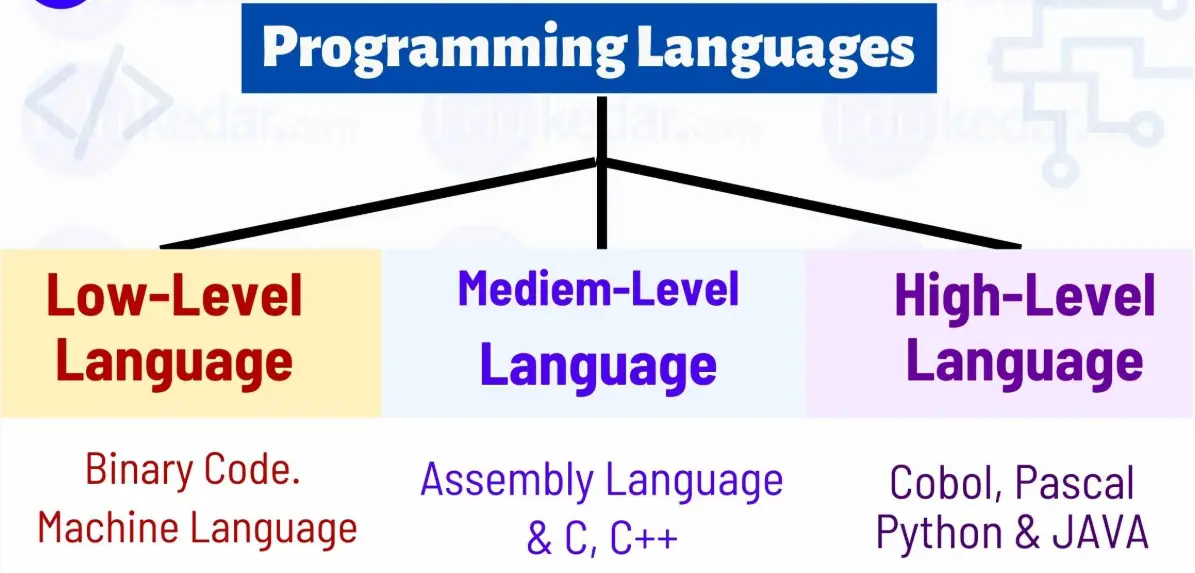
– Low-Level Languages: Close to machine code, like Assembly, offering fine-grained control but requiring more effort.
– High-Level Languages: Abstract away hardware details for easier coding, such as Python, Java, and Ruby.
History and Evolution:
Programming languages evolved from machine code in the 1940s to assembly languages in the 1950s, and then to high-level languages like FORTRAN (1957) for scientific computing and COBOL (1959) for business. The 1970s introduced C, revolutionizing system programming, while the 1980s and 1990s brought object-oriented paradigms with C++ and Java. Modern languages like Python (1991) emphasize simplicity and versatility, with ongoing trends in web development (e.g., JavaScript) and data science (e.g., R).
Importance and Applications:
Programming languages are essential for innovation across industries. They power:
– Software Development: Building applications, operating systems, and mobile apps.
– Web Development: Creating websites and services using HTML, CSS, JavaScript, and frameworks like React.
– Data Science and AI: Languages like Python and R for analysis, machine learning, and neural networks.
– Embedded Systems: C and C++ for hardware like IoT devices.
– Cybersecurity: Scripting languages for automation and ethical hacking.
Choosing a language depends on factors like project requirements, performance needs, and developer expertise. As technology advances, languages continue to adapt, incorporating features for concurrency, security, and scalability.
Table of Contents
- Part 1: OnlineExamMaker AI Quiz Generator – The Easiest Way to Make Quizzes Online
- Part 2: 20 Programming Language Quiz Questions & Answers
- Part 3: OnlineExamMaker AI Question Generator: Generate Questions for Any Topic
Part 1: OnlineExamMaker AI Quiz Generator – The Easiest Way to Make Quizzes Online
Are you looking for an online assessment to test the Programming Language skills of your learners? OnlineExamMaker uses artificial intelligence to help quiz organizers to create, manage, and analyze exams or tests automatically. Apart from AI features, OnlineExamMaker advanced security features such as full-screen lockdown browser, online webcam proctoring, and face ID recognition.
Take a product tour of OnlineExamMaker:
● Includes a safe exam browser (lockdown mode), webcam and screen recording, live monitoring, and chat oversight to prevent cheating.
● AI Exam Grader for efficiently grading quizzes and assignments, offering inline comments, automatic scoring, and “fudge points” for manual adjustments.
● Embed quizzes on websites, blogs, or share via email, social media (Facebook, Twitter), or direct links.
● Handles large-scale testing (thousands of exams/semester) without internet dependency, backed by cloud infrastructure.
Automatically generate questions using AI
Part 2: 20 Programming Language Quiz Questions & Answers
or
1. Question: What is the primary purpose of the Python programming language?
Options:
A. Web development
B. General-purpose programming
C. Embedded systems
D. Hardware programming
Answer: B
Explanation: Python is designed as a general-purpose language, used for a wide range of applications including scripting, web development, data analysis, and automation due to its simplicity and readability.
2. Question: In Java, what does the keyword ‘public’ signify?
Options:
A. The method or class is accessible only within the same package
B. The method or class is accessible from anywhere
C. The method or class is private to the class
D. The method or class is protected within subclasses
Answer: B
Explanation: In Java, ‘public’ is an access modifier that allows the method, class, or variable to be accessed from any other class, promoting reusability and encapsulation.
3. Question: What is a key feature of C++ that distinguishes it from C?
Options:
A. Support for object-oriented programming
B. Faster compilation
C. Simpler syntax
D. Automatic memory management
Answer: A
Explanation: C++ extends C by adding object-oriented features like classes, inheritance, and polymorphism, making it suitable for complex software development.
4. Question: Which programming language is most commonly associated with front-end web development?
Options:
A. Python
B. Java
C. JavaScript
D. C#
Answer: C
Explanation: JavaScript is the standard language for creating interactive elements on web pages, as it runs in web browsers and handles client-side scripting.
5. Question: What is Ruby often used for in software development?
Options:
A. Mobile app development
B. Web application frameworks like Ruby on Rails
C. System programming
D. Data visualization
Answer: B
Explanation: Ruby is popular for web development, especially with frameworks like Ruby on Rails, which simplifies building database-driven web applications.
6. Question: In JavaScript, what does the ‘let’ keyword do?
Options:
A. Declares a constant variable
B. Declares a block-scoped variable
C. Declares a global variable
D. Imports modules
Answer: B
Explanation: ‘let’ in JavaScript declares a variable with block scope, allowing it to be reassigned but not redeclared in the same scope, improving code modularity.
7. Question: Which language is primarily used for server-side scripting and is known for its efficiency in handling large-scale applications?
Options:
A. PHP
B. Swift
C. Go
D. Rust
Answer: A
Explanation: PHP is designed for web development and excels in server-side scripting, integrating seamlessly with HTML and databases for dynamic websites.
8. Question: What is the main advantage of using Swift for iOS development?
Options:
A. Backward compatibility with C
B. Safety features and performance
C. Cross-platform capabilities
D. Simplicity for beginners
Answer: B
Explanation: Swift offers modern syntax, safety features like optionals, and high performance, making it ideal for developing secure and efficient iOS applications.
9. Question: In C#, what is the purpose of the ‘namespace’ keyword?
Options:
A. To define a class
B. To organize code and avoid naming conflicts
C. To handle exceptions
D. To create loops
Answer: B
Explanation: Namespaces in C# are used to encapsulate code elements, preventing name collisions and improving code organization in large projects.
10. Question: What does SQL stand for, and what is it used for?
Options:
A. Structured Query Language, for database management
B. Simple Query Language, for web scripting
C. Secure Query Language, for encryption
D. Standard Query Language, for file systems
Answer: A
Explanation: SQL is a standard language for managing and manipulating relational databases, allowing users to query, update, and manage data efficiently.
11. Question: Which programming language is interpreted and often used for scripting and automation?
Options:
A. C++
B. Perl
C. Assembly
D. Fortran
Answer: B
Explanation: Perl is an interpreted language known for its text processing capabilities, making it popular for system administration and rapid prototyping.
12. Question: In Go (Golang), what is a goroutine?
Options:
A. A type of variable
B. A lightweight thread for concurrent execution
C. A memory allocation function
D. A loop structure
Answer: B
Explanation: Goroutines in Go are functions that run concurrently, enabling efficient multitasking and simplifying the handling of asynchronous operations.
13. Question: What is a primary feature of the Rust programming language?
Options:
A. Memory safety without a garbage collector
B. Dynamic typing
C. Slow execution speed
D. Limited to web development
Answer: A
Explanation: Rust emphasizes memory safety, concurrency, and performance, using its ownership model to prevent common errors like data races.
14. Question: Which language is commonly used for data analysis and machine learning due to its extensive libraries?
Options:
A. Java
B. R
C. C
D. Pascal
Answer: B
Explanation: R is designed for statistical computing and graphics, with packages like ggplot2 and dplyr that make it ideal for data analysis and visualization.
15. Question: In Kotlin, what is the key benefit over Java for Android development?
Options:
A. Null safety features
B. Slower runtime
C. Less concise code
D. Limited IDE support
Answer: A
Explanation: Kotlin provides null safety, reducing the risk of null pointer exceptions, and offers more concise syntax compared to Java.
16. Question: What is the main use of the Scala programming language?
Options:
A. Game development
B. Big data processing with Apache Spark
C. Embedded systems
D. Front-end web design
Answer: B
Explanation: Scala is a scalable language that runs on the JVM and is widely used for big data applications, particularly with frameworks like Apache Spark.
17. Question: In PHP, how is a string typically defined?
Options:
A. Using single quotes or double quotes
B. Only with double quotes
C. Using brackets {}
D. With the ‘str’ keyword
Answer: A
Explanation: In PHP, strings can be defined with single quotes for literal strings or double quotes for interpolated strings, allowing variable embedding.
18. Question: Which language is known for its functional programming features and is used in the Haskell community?
Options:
A. JavaScript
B. Haskell
C. Python
D. Ruby
Answer: B
Explanation: Haskell is a purely functional language that emphasizes immutability, lazy evaluation, and mathematical functions, ideal for concurrent programming.
19. Question: What does the ‘async’ keyword do in JavaScript?
Options:
A. Declares a synchronous function
B. Defines an asynchronous function for handling promises
C. Creates a loop
D. Imports external libraries
Answer: B
Explanation: ‘async’ in JavaScript allows functions to use ‘await’ for asynchronous operations, making code cleaner for tasks like API calls.
20. Question: In Python, what is the use of the ‘lambda’ keyword?
Options:
A. To create anonymous functions
B. To define classes
C. To handle exceptions
D. To import modules
Answer: A
Explanation: Lambda in Python is used for creating small, anonymous functions inline, often for short-term use in functions like map() or filter().
or
Part 3: OnlineExamMaker AI Question Generator: Generate Questions for Any Topic
Automatically generate questions using AI