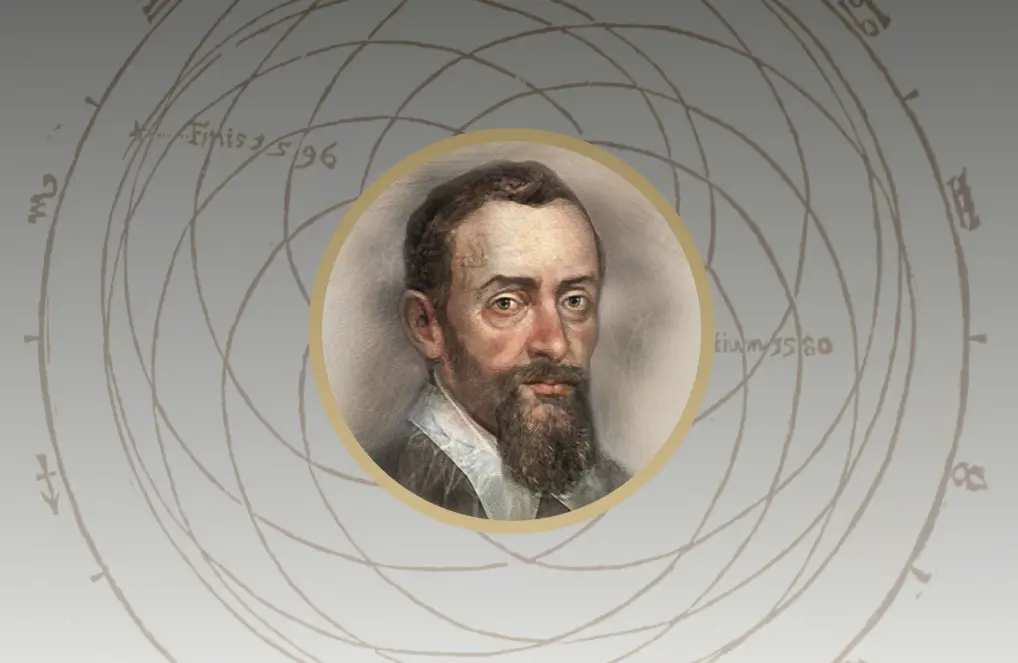
Johannes Kepler (1571–1630) was a pioneering German astronomer, mathematician, and astrologer whose work revolutionized our understanding of the cosmos. Born in Weil der Stadt, he studied at the University of Tübingen and initially pursued theology before focusing on astronomy. Kepler served as an assistant to Tycho Brahe, using Brahe’s precise observational data to develop his three laws of planetary motion, published between 1609 and 1619. These laws—stating that planets orbit the sun in elliptical paths, that a line from the sun to a planet sweeps equal areas in equal times, and that the square of a planet’s orbital period is proportional to the cube of its average distance from the sun—overturned the ancient Ptolemaic system and supported the Copernican heliocentric model.
Kepler’s major works include *Mysterium Cosmographicum* (1596), which proposed a geometric basis for the solar system, and *Astronomia Nova* (1609), where he detailed his first two laws. He also contributed to optics, defending the idea that vision occurs through light entering the eye, and explored the harmony of the spheres in *Harmonices Mundi* (1619). Despite facing personal hardships, such as poverty and the Thirty Years’ War, Kepler’s empirical approach bridged mathematics and astronomy, paving the way for Isaac Newton’s laws of motion and universal gravitation. His legacy endures as a cornerstone of modern physics and astronomy.
Table of Contents
- Part 1: OnlineExamMaker AI Quiz Generator – Save Time and Efforts
- Part 2: 20 Johannes Kepler Quiz Questions & Answers
- Part 3: Save Time and Energy: Generate Quiz Questions with AI Technology
Part 1: OnlineExamMaker AI Quiz Generator – Save Time and Efforts
Still spend a lot of time in editing questions for your next Johannes Kepler assessment? OnlineExamMaker is an AI quiz maker that leverages artificial intelligence to help users create quizzes, tests, and assessments quickly and efficiently. You can start by inputting a topic or specific details into the OnlineExamMaker AI Question Generator, and the AI will generate a set of questions almost instantly. It also offers the option to include answer explanations, which can be short or detailed, helping learners understand their mistakes.
What you may like:
● Automatic grading and insightful reports. Real-time results and interactive feedback for quiz-takers.
● The exams are automatically graded with the results instantly, so that teachers can save time and effort in grading.
● LockDown Browser to restrict browser activity during quizzes to prevent students searching answers on search engines or other software.
● OnlineExamMaker API offers private access for developers to extract your exam data back into your system automatically.
Automatically generate questions using AI
Part 2: 20 Johannes Kepler Quiz Questions & Answers
or
1. What is Johannes Kepler’s first law of planetary motion?
A. Planets orbit the sun in elliptical paths with the sun at one focus.
B. The square of the orbital period is proportional to the cube of the semi-major axis.
C. A line from the sun to a planet sweeps out equal areas in equal times.
D. Planets move at constant speed in their orbits.
Answer: A
Explanation: Kepler’s first law states that the orbit of a planet is an ellipse with the sun at one of the two foci, describing the shape of planetary paths.
2. Who provided Johannes Kepler with the astronomical data that helped him formulate his laws?
A. Galileo Galilei
B. Tycho Brahe
C. Nicolaus Copernicus
D. Isaac Newton
Answer: B
Explanation: Tycho Brahe’s precise observations of planetary positions allowed Kepler to analyze and derive his laws of planetary motion.
3. In which year was Johannes Kepler born?
A. 1546
B. 1571
C. 1642
D. 1473
Answer: B
Explanation: Kepler was born on December 27, 1571, in Weil der Stadt, Germany, marking the start of his influential life in science.
4. What is Kepler’s second law of planetary motion?
A. Planets orbit the sun in elliptical paths.
B. A line segment joining a planet and the sun sweeps out equal areas in equal times.
C. The square of a planet’s orbital period is proportional to the cube of its orbit’s semi-major axis.
D. Planets have circular orbits centered on the sun.
Answer: B
Explanation: This law describes how a planet’s speed varies in its orbit, moving faster when closer to the sun to cover equal areas over equal times.
5. Which of Kepler’s works introduced his first two laws of planetary motion?
A. Harmonices Mundi
B. Astronomia Nova
C. Epitome Astronomiae Copernicanae
D. Dioptrice
Answer: B
Explanation: In “Astronomia Nova” (1609), Kepler presented his first two laws, based on his analysis of Mars’ orbit.
6. What is the mathematical relationship described by Kepler’s third law?
A. T² ∝ r
B. T ∝ r²
C. T² ∝ r³
D. T³ ∝ r²
Answer: C
Explanation: Kepler’s third law states that the square of a planet’s orbital period (T) is proportional to the cube of the semi-major axis of its orbit (r), linking period and distance.
7. Kepler served as the Imperial Mathematician to which emperor?
A. Holy Roman Emperor Rudolf II
B. King James I of England
C. Louis XIV of France
D. Ferdinand II
Answer: A
Explanation: Kepler was appointed as the Imperial Mathematician to Rudolf II in 1601, where he continued his astronomical work.
8. Besides astronomy, in which field did Kepler make significant contributions?
A. Chemistry
B. Optics
C. Biology
D. Geology
Answer: B
Explanation: Kepler advanced the field of optics through his work on lenses and the nature of vision, as detailed in his book “Dioptrice.”
9. What was the primary model Kepler replaced with his elliptical orbits?
A. Geocentric model
B. Circular orbits around the sun
C. Flat Earth theory
D. Heliocentric model with epicycles
Answer: B
Explanation: Kepler disproved the idea of perfect circular orbits, showing instead that planets follow elliptical paths, improving on Copernicus’ model.
10. In what year did Johannes Kepler die?
A. 1609
B. 1630
C. 1642
D. 1571
Answer: B
Explanation: Kepler died on November 15, 1630, in Regensburg, Germany, after a life dedicated to scientific inquiry.
11. Which of the following best describes Kepler’s role in the Scientific Revolution?
A. He invented the telescope.
B. He formulated laws that bridged astronomy and physics.
C. He proved the Earth is flat.
D. He rejected mathematics in science.
Answer: B
Explanation: Kepler’s laws provided a mathematical foundation for understanding planetary motion, influencing later scientists like Newton.
12. How many laws of planetary motion did Kepler formulate?
A. Two
B. Three
C. Four
D. Five
Answer: B
Explanation: Kepler is credited with three laws, which together revolutionized the understanding of celestial mechanics.
13. What shape did Kepler determine for planetary orbits?
A. Circles
B. Ellipses
C. Spirals
D. Straight lines
Answer: B
Explanation: Through his calculations, Kepler concluded that planetary orbits are ellipses, not perfect circles as previously thought.
14. Kepler’s third law applies to which celestial bodies?
A. Only the Moon and Earth
B. All planets orbiting the sun
C. Stars in a galaxy
D. Comets and asteroids only
Answer: B
Explanation: The law relates the orbital periods and distances of planets from the sun, making it applicable to solar system planets.
15. Which book by Kepler explored the harmony of the world and introduced his third law?
A. Astronomia Nova
B. Harmonices Mundi
C. Somnium
D. De Stella Nova
Answer: B
Explanation: In “Harmonices Mundi” (1619), Kepler presented his third law and connected music, geometry, and astronomy.
16. What was Kepler’s profession besides being an astronomer?
A. Physician
B. Astrologer and mathematician
C. Architect
D. Philosopher
Answer: B
Explanation: Kepler worked as an astrologer and mathematician, casting horoscopes and applying math to various scientific problems.
17. How did Kepler’s laws influence Isaac Newton’s work?
A. Newton rejected them entirely.
B. They provided the basis for Newton’s law of universal gravitation.
C. Newton used them only for optics.
D. They had no impact on physics.
Answer: B
Explanation: Kepler’s laws helped Newton derive his laws of motion and gravity, explaining why planets follow those paths.
18. What nationality was Johannes Kepler?
A. Italian
B. English
C. German
D. Dutch
Answer: C
Explanation: Kepler was born and worked primarily in what is now Germany, contributing to the German scientific tradition.
19. Kepler used data from which planet to develop his first law?
A. Earth
B. Mars
C. Jupiter
D. Venus
Answer: B
Explanation: Kepler analyzed Tycho Brahe’s data on Mars’ orbit, which had irregularities that led to his discovery of elliptical paths.
20. What is the significance of Kepler’s laws in modern astronomy?
A. They are outdated and unused.
B. They form the foundation for understanding orbits in space exploration.
C. They apply only to historical observations.
D. They were replaced by Einstein’s theories.
Answer: B
Explanation: Kepler’s laws are essential for calculating spacecraft trajectories and predicting planetary motions in contemporary astronomy.
or
Part 3: Save Time and Energy: Generate Quiz Questions with AI Technology
Automatically generate questions using AI