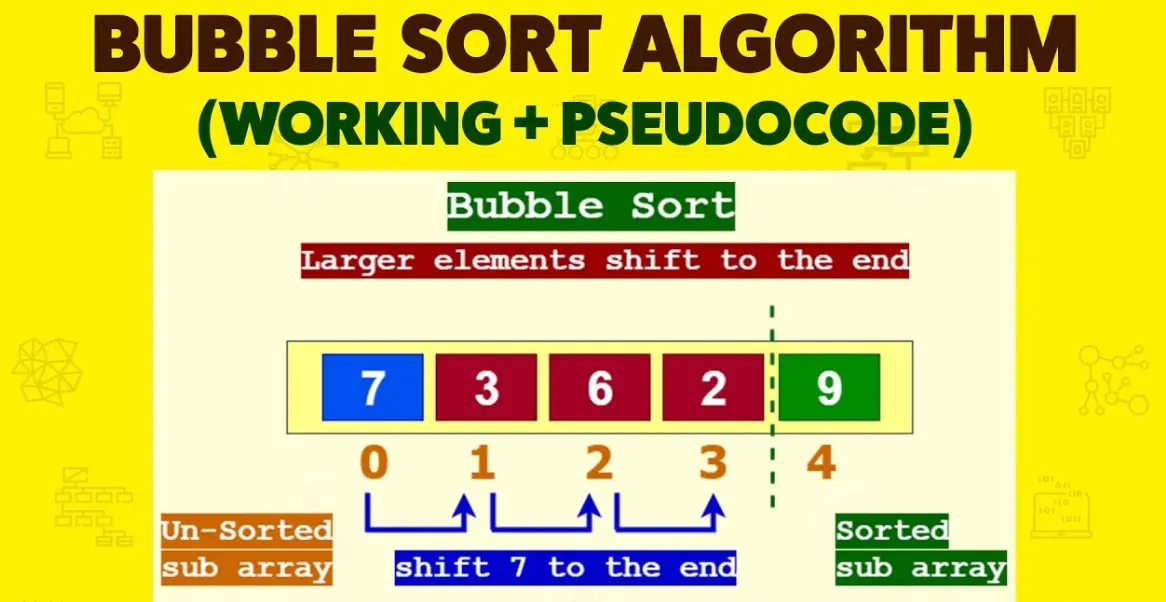
Bubble Sort is a straightforward sorting algorithm that works by repeatedly stepping through the list, comparing adjacent elements, and swapping them if they are in the wrong order. This process is repeated for each pass through the list until no more swaps are needed, indicating the list is sorted. It operates with a time complexity of O(n^2), making it simple to implement but inefficient for large datasets. Despite its drawbacks, Bubble Sort is useful for educational purposes and small-scale sorting tasks.
Table of Contents
- Part 1: Create A Bubble Sort Quiz in Minutes Using AI with OnlineExamMaker
- Part 2: 20 Bubble Sort Quiz Questions & Answers
- Part 3: AI Question Generator – Automatically Create Questions for Your Next Assessment
Part 1: Create A Bubble Sort Quiz in Minutes Using AI with OnlineExamMaker
Are you looking for an online assessment to test the Bubble Sort skills of your learners? OnlineExamMaker uses artificial intelligence to help quiz organizers to create, manage, and analyze exams or tests automatically. Apart from AI features, OnlineExamMaker advanced security features such as full-screen lockdown browser, online webcam proctoring, and face ID recognition.
Recommended features for you:
● Includes a safe exam browser (lockdown mode), webcam and screen recording, live monitoring, and chat oversight to prevent cheating.
● Enhances assessments with interactive experience by embedding video, audio, image into quizzes and multimedia feedback.
● Once the exam ends, the exam scores, question reports, ranking and other analytics data can be exported to your device in Excel file format.
● Offers question analysis to evaluate question performance and reliability, helping instructors optimize their training plan.
Automatically generate questions using AI
Part 2: 20 Bubble Sort Quiz Questions & Answers
or
1. Question: What is the primary operation in Bubble Sort?
A. Dividing the array into halves
B. Comparing and swapping adjacent elements
C. Using a pivot to partition the array
D. Merging sorted subarrays
Correct Answer: B
Explanation: Bubble Sort works by repeatedly comparing adjacent elements and swapping them if they are in the wrong order, which gradually moves larger elements to the end.
2. Question: In Bubble Sort, how many passes are needed to sort an array of n elements in the worst case?
A. n/2 passes
B. n-1 passes
C. 1 pass
D. n passes
Correct Answer: B
Explanation: In the worst case, where the array is sorted in reverse order, Bubble Sort requires n-1 passes to ensure all elements are in their correct positions.
3. Question: What is the time complexity of Bubble Sort in the best case?
A. O(1)
B. O(n)
C. O(n log n)
D. O(n^2)
Correct Answer: B
Explanation: If the array is already sorted, Bubble Sort can detect this in a single pass, resulting in O(n) time complexity when an optimization flag is used.
4. Question: Which of the following is a disadvantage of Bubble Sort?
A. It is very efficient for large datasets
B. It has a simple implementation
C. It requires O(1) extra space
D. It is inefficient for large lists due to its O(n^2) complexity
Correct Answer: D
Explanation: Bubble Sort’s quadratic time complexity makes it inefficient for large datasets, as it performs poorly compared to more advanced algorithms like Quick Sort.
5. Question: In Bubble Sort, after the first pass, what is the position of the largest element?
A. At the beginning of the array
B. In the middle of the array
C. At the end of the array
D. It depends on the array size
Correct Answer: C
Explanation: During the first pass, the largest element is bubbled to the end of the array through successive comparisons and swaps.
6. Question: How does Bubble Sort handle duplicates in an array?
A. It removes them automatically
B. It sorts them in ascending order only
C. It treats them like any other elements and sorts based on comparisons
D. It requires a separate function for duplicates
Correct Answer: C
Explanation: Bubble Sort compares and swaps elements regardless of duplicates, so they are placed in the correct order based on the sorting criteria.
7. Question: What is the space complexity of Bubble Sort?
A. O(n)
B. O(1)
C. O(n log n)
D. O(n^2)
Correct Answer: B
Explanation: Bubble Sort uses a constant amount of extra space, as it only requires a few variables for swapping, making its space complexity O(1).
8. Question: In an optimized version of Bubble Sort, what condition stops the algorithm early?
A. If the array is empty
B. If no swaps occur in a pass
C. If the array has even elements
D. If the array is half-sorted
Correct Answer: B
Explanation: An optimization checks if any swaps were made in a pass; if none occur, the array is already sorted, and the algorithm terminates early.
9. Question: For an array of 5 elements, how many comparisons does Bubble Sort make in the worst case?
A. 5
B. 10
C. 15
D. 20
Correct Answer: B
Explanation: In the worst case, Bubble Sort performs (n*(n-1))/2 comparisons, which for n=5 is (5*4)/2 = 10 comparisons.
10. Question: Which sorting algorithm is Bubble Sort most similar to in terms of its basic mechanism?
A. Merge Sort
B. Insertion Sort
C. Quick Sort
D. Selection Sort
Correct Answer: D
Explanation: Both Bubble Sort and Selection Sort involve repeated passes through the array, though Bubble Sort swaps adjacent elements while Selection Sort swaps with the minimum element.
11. Question: What happens if you run Bubble Sort on a sorted array without optimizations?
A. It finishes in one pass
B. It performs all n-1 passes
C. It crashes the program
D. It reverses the array
Correct Answer: B
Explanation: Without optimizations, Bubble Sort will always complete all passes, even if the array is already sorted, leading to unnecessary comparisons.
12. Question: In Bubble Sort, the inner loop typically runs from:
A. The start to the end of the array
B. The end to the start of the array
C. The start to n-i-1 in the i-th pass
D. Random indices
Correct Answer: C
Explanation: In the i-th pass, the inner loop compares elements from the start up to n-i-1, as the last i elements are already sorted.
13. Question: Why is Bubble Sort called “Bubble Sort”?
A. Because it uses bubbles to sort
B. Because smaller elements “bubble” to the top
C. Because it creates bubble-like patterns
D. Because it was invented by a scientist named Bubble
Correct Answer: B
Explanation: The name comes from the way smaller elements gradually move to the beginning of the array, similar to how bubbles rise in a liquid.
14. Question: Can Bubble Sort be used for descending order sorting?
A. No, only ascending
B. Yes, by reversing the comparison logic
C. Yes, but it requires a different algorithm
D. No, it always sorts ascending
Correct Answer: B
Explanation: Bubble Sort can sort in descending order by simply changing the comparison operator, such as swapping when the first element is greater than or equal to the second.
15. Question: What is the average time complexity of Bubble Sort?
A. O(1)
B. O(n)
C. O(n log n)
D. O(n^2)
Correct Answer: D
Explanation: On average, Bubble Sort has a time complexity of O(n^2) due to the nested loops, regardless of the initial order of elements.
16. Question: In Bubble Sort, how are elements swapped?
A. Using a temporary array
B. Directly in place with a temporary variable
C. By shifting the entire array
D. It doesn’t require swapping
Correct Answer: B
Explanation: Elements are swapped in place using a temporary variable to hold one value while exchanging positions.
17. Question: For an array [3, 2, 1], how many swaps occur in the first pass of Bubble Sort?
A. 0
B. 1
C. 2
D. 3
Correct Answer: C
Explanation: In the first pass, 3 and 2 are swapped, then 3 and 1 are swapped, resulting in two swaps, and the array becomes [2, 1, 3].
18. Question: Is Bubble Sort stable?
A. Yes
B. No
C. Only for even-sized arrays
D. Only for odd-sized arrays
Correct Answer: A
Explanation: Bubble Sort is stable because it only swaps adjacent elements that are in the wrong order, preserving the relative order of equal elements.
19. Question: What modification can make Bubble Sort more efficient?
A. Adding recursion
B. Using a flag to check for swaps
C. Converting it to parallel processing
D. Increasing the array size
Correct Answer: B
Explanation: Using a flag to track if any swaps were made in a pass allows the algorithm to stop early if the array is sorted, reducing unnecessary iterations.
20. Question: Bubble Sort is generally suitable for:
A. Large datasets in real-time applications
B. Educational purposes or nearly sorted arrays
C. External sorting of files
D. High-performance computing
Correct Answer: B
Explanation: Due to its simplicity and effectiveness on small or nearly sorted arrays, Bubble Sort is often used for teaching sorting concepts rather than in production environments.
or
Part 3: AI Question Generator – Automatically Create Questions for Your Next Assessment
Automatically generate questions using AI