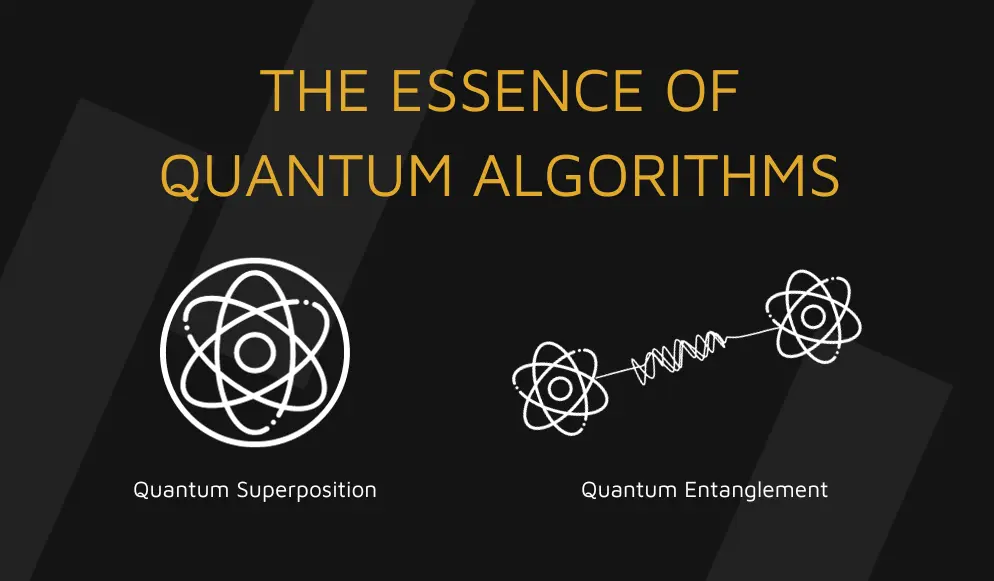
Quantum algorithms are computational procedures designed to run on quantum computers, leveraging principles of quantum mechanics such as superposition, entanglement, and interference to solve complex problems more efficiently than classical algorithms. Unlike traditional computing, which processes data in binary bits (0s and 1s), quantum algorithms use qubits that can exist in multiple states simultaneously, enabling parallel processing on an unprecedented scale.
One of the most celebrated examples is Shor’s algorithm, which factors large integers exponentially faster than the best-known classical methods, posing a potential threat to current encryption systems like RSA. Another key algorithm, Grover’s, accelerates unstructured search problems by providing a quadratic speedup over classical searches, making it useful for database queries and optimization tasks.
Quantum algorithms hold transformative potential across various fields. In cryptography, they could break conventional codes, spurring the development of quantum-resistant encryption. In drug discovery, algorithms like the Quantum Approximate Optimization Algorithm (QAOA) could simulate molecular interactions at speeds unattainable by classical computers. In finance, they might optimize portfolios or solve complex risk models more effectively.
However, the practical implementation of quantum algorithms faces challenges, including error rates in quantum hardware and the need for error correction. As research advances, these algorithms could redefine computing, offering solutions to problems that are currently intractable, such as simulating quantum systems for materials science or enhancing machine learning through quantum-enhanced models.
Table of Contents
- Part 1: OnlineExamMaker – Generate and Share Quantum Algorithms Quiz with AI Automatically
- Part 2: 20 Quantum Algorithms Quiz Questions & Answers
- Part 3: AI Question Generator – Automatically Create Questions for Your Next Assessment
Part 1: OnlineExamMaker – Generate and Share Quantum Algorithms Quiz with AI Automatically
The quickest way to assess the Quantum Algorithms knowledge of candidates is using an AI assessment platform like OnlineExamMaker. With OnlineExamMaker AI Question Generator, you are able to input content—like text, documents, or topics—and then automatically generate questions in various formats (multiple-choice, true/false, short answer). Its AI Exam Grader can automatically grade the exam and generate insightful reports after your candidate submit the assessment.
What you will like:
● Create a question pool through the question bank and specify how many questions you want to be randomly selected among these questions.
● Allow the quiz taker to answer by uploading video or a Word document, adding an image, and recording an audio file.
● Display the feedback for correct or incorrect answers instantly after a question is answered.
● Create a lead generation form to collect an exam taker’s information, such as email, mobile phone, work title, company profile and so on.
Automatically generate questions using AI
Part 2: 20 Quantum Algorithms Quiz Questions & Answers
or
Question 1:
What is the primary purpose of Shor’s Algorithm?
A) Searching an unsorted database
B) Factoring large integers efficiently
C) Solving linear systems of equations
D) Simulating molecular structures
Answer: B
Explanation: Shor’s Algorithm uses quantum parallelism and the quantum Fourier transform to factor large numbers exponentially faster than classical algorithms, posing a threat to RSA encryption.
Question 2:
Grover’s Algorithm is most effective for which type of problem?
A) Factoring large numbers
B) Unstructured search in a database
C) Optimizing combinatorial problems
D) Estimating eigenvalues of a matrix
Answer: B
Explanation: Grover’s Algorithm provides a quadratic speedup for searching an unsorted database by amplifying the amplitude of the target state through quantum interference.
Question 3:
Which quantum algorithm is used for determining if a function is constant or balanced?
A) Shor’s Algorithm
B) Grover’s Algorithm
C) Deutsch-Jozsa Algorithm
D) Quantum Phase Estimation
Answer: C
Explanation: The Deutsch-Jozsa Algorithm determines the nature of a function with a single query on a quantum computer, compared to exponentially many queries on a classical computer.
Question 4:
What is the key component in Quantum Phase Estimation?
A) Quantum Fourier Transform
B) Grover’s Diffusion Operator
C) Hadamard Gate
D) Pauli-X Gate
Answer: A
Explanation: Quantum Phase Estimation uses the Quantum Fourier Transform to estimate the eigenvalues of a unitary operator, which is crucial for algorithms like Shor’s.
Question 5:
HHL Algorithm is primarily designed for solving:
A) Optimization problems
B) Linear systems of equations
C) Graph traversal
D) Integer factorization
Answer: B
Explanation: The HHL Algorithm (Harrow, Hassidim, Lloyd) provides an exponential speedup for solving linear systems by encoding the matrix into a quantum state and using quantum phase estimation.
Question 6:
In QAOA (Quantum Approximate Optimization Algorithm), what is the goal?
A) Exact solutions to linear equations
B) Approximating solutions to combinatorial optimization problems
C) Factoring large primes
D) Simulating quantum dynamics
Answer: B
Explanation: QAOA uses a variational approach with a quantum circuit to find approximate solutions to problems like the Max-Cut, leveraging quantum superposition for better optimization.
Question 7:
Which algorithm exploits the periodicity of a function to find its period?
A) Grover’s Algorithm
B) Simon’s Algorithm
C) Shor’s Algorithm
D) Deutsch-Jozsa Algorithm
Answer: C
Explanation: Shor’s Algorithm uses the Quantum Fourier Transform to identify the period of a function, which is then used for factoring by relating it to the order of an element modulo n.
Question 8:
What advantage does the Variational Quantum Eigensolver (VQE) offer?
A) It runs entirely on classical computers
B) It finds exact ground states of Hamiltonians
C) It is hybrid, using quantum computers for evaluation and classical for optimization
D) It requires no quantum gates
Answer: C
Explanation: VQE combines quantum computation to measure the expectation value of a Hamiltonian with classical optimization to iteratively adjust parameters, making it feasible on near-term quantum devices.
Question 9:
Simon’s Algorithm is used to solve problems related to:
A) Period finding
B) Hidden subgroups
C) Linear algebra
D) Database search
Answer: B
Explanation: Simon’s Algorithm identifies a hidden subgroup in a function, providing an exponential speedup and serving as a precursor to Shor’s Algorithm.
Question 10:
How does Grover’s Algorithm achieve speedup compared to classical search?
A) By using entanglement to parallelize computations
B) By quadratically reducing the number of queries needed
C) By exactly matching the classical runtime
D) By exponentially increasing database size
Answer: B
Explanation: Grover’s Algorithm requires only O(sqrt(N)) queries for an N-element database, compared to O(N) for classical search, due to amplitude amplification.
Question 11:
In Quantum Fourier Transform, what is the output for a standard basis state?
A) A superposition of all basis states
B) An evenly distributed probability amplitude
C) The same state as input
D) A phase-shifted state
Answer: A
Explanation: The Quantum Fourier Transform transforms a computational basis state into a superposition that encodes the discrete Fourier transform, essential for many quantum algorithms.
Question 12:
Which algorithm is specifically designed for quantum simulation of physical systems?
A) Shor’s Algorithm
B) Trotterization in Hamiltonian Simulation
C) Grover’s Algorithm
D) Deutsch-Jozsa Algorithm
Answer: B
Explanation: Hamiltonian Simulation uses techniques like Trotterization to approximate the time evolution of quantum systems, enabling the simulation of molecular and material properties.
Question 13:
What is the complexity of Shor’s Algorithm for factoring an n-bit number?
A) Polynomial time
B) Exponential time
C) Linear time
D) Quadratic time
Answer: A
Explanation: Shor’s Algorithm runs in polynomial time on a quantum computer, specifically O((log N)^2 (log log N) (log log log N)), making it vastly more efficient than classical factoring algorithms.
Question 14:
In the context of quantum algorithms, what does “quantum speedup” mean?
A) Faster execution on classical hardware
B) Exponential reduction in resources compared to classical counterparts
C) Running algorithms without qubits
D) Identical performance to classical methods
Answer: B
Explanation: Quantum speedup refers to algorithms like Grover’s and Shor’s that solve certain problems with exponentially fewer resources (time or queries) than the best classical algorithms.
Question 15:
Which quantum algorithm is used for amplitude amplification?
A) Shor’s Algorithm
B) Grover’s Algorithm
C) Quantum Phase Estimation
D) VQE
Answer: B
Explanation: Grover’s Algorithm incorporates amplitude amplification to increase the probability of measuring the correct state, which is a key step in its searching mechanism.
Question 16:
The Quantum Approximate Optimization Algorithm (QAOA) is particularly useful for:
A) Exact integer factorization
B) Approximating the ground state energy
C) Solving NP-hard problems like the traveling salesman problem
D) Linear equation systems
Answer: C
Explanation: QAOA is tailored for combinatorial optimization problems, providing approximate solutions to NP-hard instances by minimizing a cost function on a quantum computer.
Question 17:
What role does the Quantum Fourier Transform play in Shor’s Algorithm?
A) It performs the search operation
B) It extracts the period of the function
C) It initializes the qubits
D) It measures the final state
Answer: B
Explanation: In Shor’s Algorithm, the Quantum Fourier Transform is applied to the superposition state to interfere constructively at the period of the function, allowing period extraction.
Question 18:
For a function with a hidden subgroup, which algorithm can find it?
A) Deutsch-Jozsa Algorithm
B) Simon’s Algorithm
C) HHL Algorithm
D) QAOA
Answer: B
Explanation: Simon’s Algorithm efficiently finds the hidden subgroup by outputting vectors orthogonal to it, demonstrating quantum advantage in promise problems.
Question 19:
In VQE, what is varied to minimize the energy?
A) The number of qubits
B) The parameters of the quantum circuit
C) The input data
D) The classical optimizer
Answer: B
Explanation: VQE varies the parameters of a parameterized quantum circuit to minimize the expected value of the Hamiltonian, using classical feedback for optimization.
Question 20:
Which quantum algorithm provides a speedup for the eigenvalue problem?
A) Grover’s Algorithm
B) Quantum Phase Estimation
C) Shor’s Algorithm
D) Deutsch-Jozsa Algorithm
Answer: B
Explanation: Quantum Phase Estimation determines the eigenvalues of a unitary operator with high precision, offering an exponential speedup over classical methods for certain matrices.
or
Part 3: AI Question Generator – Automatically Create Questions for Your Next Assessment
Automatically generate questions using AI