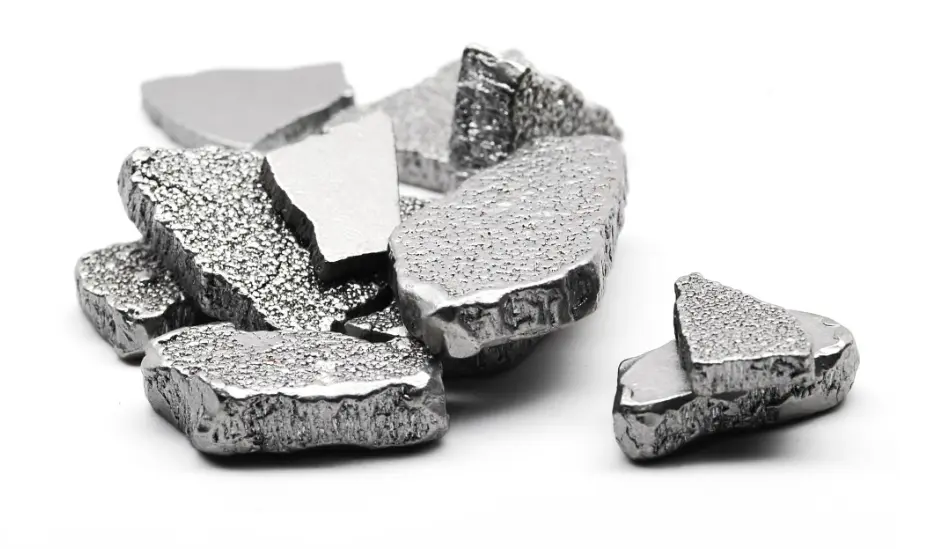
Iron is a chemical element with the symbol Fe and atomic number 26, making it one of the most abundant elements on Earth. It is a lustrous, silvery-gray metal known for its high strength, ductility, and magnetic properties. Iron is primarily extracted from iron ores such as hematite and magnetite through processes like smelting and refining.
As a key component of steel, iron plays a vital role in construction, manufacturing, and transportation, being used in buildings, bridges, vehicles, and tools. Its alloys, including stainless steel, enhance corrosion resistance and durability, making it essential in modern infrastructure and everyday products.
Historically, the discovery and mastery of ironworking marked the Iron Age (around 1200 BCE), revolutionizing human civilization by providing stronger weapons and tools than those made from bronze.
In biology, iron is crucial for human health, forming a core part of hemoglobin in red blood cells, which transports oxygen throughout the body. Deficiency can lead to anemia, while excess can cause toxicity.
Despite its benefits, iron’s reactivity with oxygen and moisture causes rusting, a common challenge mitigated by protective coatings and alloys. Today, global iron production exceeds 1 billion tons annually, underscoring its economic importance in industries worldwide.
Table of Contents
- Part 1: Best AI Quiz Making Software for Creating A Iron Quiz
- Part 2: 20 Iron Quiz Questions & Answers
- Part 3: Automatically Generate Quiz Questions Using AI Question Generator
Part 1: Best AI Quiz Making Software for Creating A Iron Quiz
OnlineExamMaker is a powerful AI-powered assessment platform to create auto-grading Iron skills assessments. It’s designed for educators, trainers, businesses, and anyone looking to generate engaging quizzes without spending hours crafting questions manually. The AI Question Generator feature allows you to input a topic or specific details, and it generates a variety of question types automatically.
Top features for assessment organizers:
● Combines AI webcam monitoring to capture cheating activities during online exam.
● Enhances assessments with interactive experience by embedding video, audio, image into quizzes and multimedia feedback.
● Once the exam ends, the exam scores, question reports, ranking and other analytics data can be exported to your device in Excel file format.
● API and SSO help trainers integrate OnlineExamMaker with Google Classroom, Microsoft Teams, CRM and more.
Automatically generate questions using AI
Part 2: 20 Iron Quiz Questions & Answers
or
1. Question: What is the atomic number of iron?
Options: A) 24
B) 25
C) 26
D) 27
Answer: C) 26
Explanation: Iron’s atomic number is 26, which means it has 26 protons in its nucleus.
2. Question: Which of the following is a common isotope of iron?
Options: A) Iron-54
B) Iron-56
C) Iron-58
D) Iron-60
Answer: B) Iron-56
Explanation: Iron-56 is the most abundant and stable isotope of iron, making up about 91.72% of natural iron.
3. Question: What is the primary ore from which iron is extracted?
Options: A) Bauxite
B) Hematite
C) Galena
D) Cinnabar
Answer: B) Hematite
Explanation: Hematite (Fe2O3) is the most important iron ore due to its high iron content and widespread availability.
4. Question: In which group of the periodic table is iron located?
Options: A) Group 1
B) Group 8
C) Group 13
D) Group 17
Answer: B) Group 8
Explanation: Iron is in Group 8 (or Group 9 in some notations), which includes transition metals like iron, ruthenium, and osmium.
5. Question: What is the melting point of pure iron?
Options: A) 1,000°C
B) 1,200°C
C) 1,538°C
D) 1,800°C
Answer: C) 1,538°C
Explanation: The melting point of pure iron is approximately 1,538°C, which is crucial for processes like smelting.
6. Question: Which process is used to remove impurities from iron ore?
Options: A) Electrolysis
B) Smelting
C) Distillation
D) Filtration
Answer: B) Smelting
Explanation: Smelting involves heating the ore with a reducing agent to extract iron by removing oxygen and other impurities.
7. Question: What type of bonding is primarily found in iron metal?
Options: A) Ionic
B) Covalent
C) Metallic
D) Hydrogen
Answer: C) Metallic
Explanation: Iron atoms in metal form are held together by metallic bonds, which allow for the free movement of electrons.
8. Question: Iron can form how many oxidation states?
Options: A) 1
B) 2
C) Several, including +2 and +3
D) None
Answer: C) Several, including +2 and +3
Explanation: Iron commonly exhibits oxidation states of +2 (ferrous) and +3 (ferric), but can have others like +6 in certain compounds.
9. Question: Which alloy is primarily made from iron?
Options: A) Brass
B) Steel
C) Bronze
D) Aluminum alloy
Answer: B) Steel
Explanation: Steel is an alloy of iron and carbon, often with other elements, making it stronger and more versatile than pure iron.
10. Question: What is the role of iron in the human body?
Options: A) It helps in bone formation
B) It is essential for oxygen transport
C) It aids in digestion
D) It regulates body temperature
Answer: B) It is essential for oxygen transport
Explanation: Iron is a key component of hemoglobin, which transports oxygen in the blood.
11. Question: Which historical period is associated with the widespread use of iron?
Options: A) Stone Age
B) Bronze Age
C) Iron Age
D) Industrial Age
Answer: C) Iron Age
Explanation: The Iron Age, starting around 1200 BCE, marked the period when iron tools and weapons became dominant.
12. Question: What is the density of iron at room temperature?
Options: A) 5.0 g/cm³
B) 7.87 g/cm³
C) 10.5 g/cm³
D) 19.3 g/cm³
Answer: B) 7.87 g/cm³
Explanation: Iron has a density of approximately 7.87 grams per cubic centimeter, which is higher than many common metals.
13. Question: Iron reacts with oxygen in the presence of water to form:
Options: A) Rust
B) Salt
C) Acid
D) Gas
Answer: A) Rust
Explanation: The reaction forms iron oxide, commonly known as rust, which is a hydrated form of iron(III) oxide.
14. Question: Which element is often alloyed with iron to prevent corrosion?
Options: A) Copper
B) Chromium
C) Zinc
D) Both B and C
Answer: D) Both B and C
Explanation: Chromium is used in stainless steel, and zinc is used in galvanization to protect iron from corrosion.
15. Question: What is the electron configuration of a neutral iron atom?
Options: A) [Ar] 4s2 3d6
B) [Ar] 4s2 3d8
C) [Ar] 4s1 3d7
D) [Ar] 4s2 3d4
Answer: A) [Ar] 4s2 3d6
Explanation: Iron has the electron configuration [Ar] 4s2 3d6, reflecting its position in the periodic table.
16. Question: In which industry is iron most commonly used?
Options: A) Electronics
B) Construction
C) Pharmaceuticals
D) Textiles
Answer: B) Construction
Explanation: Iron and its alloys are fundamental in construction for beams, reinforcements, and machinery.
17. Question: What is the primary method for producing pig iron?
Options: A) Casting
B) Blast furnace
C) Electroplating
D) Forging
Answer: B) Blast furnace
Explanation: Pig iron is produced in a blast furnace by reducing iron ore with coke and limestone.
18. Question: Iron is classified as which type of element?
Options: A) Alkali metal
B) Alkaline earth metal
C) Transition metal
D) Noble gas
Answer: C) Transition metal
Explanation: Iron is a transition metal due to its position in the d-block of the periodic table and its variable oxidation states.
19. Question: Which compound is formed when iron reacts with sulfuric acid?
Options: A) Iron sulfate
B) Iron chloride
C) Iron nitrate
D) Iron carbonate
Answer: A) Iron sulfate
Explanation: Iron reacts with sulfuric acid to produce iron(II) sulfate and hydrogen gas.
20. Question: What is the Curie temperature of iron?
Options: A) 500°C
B) 770°C
C) 1,000°C
D) 1,500°C
Answer: B) 770°C
Explanation: The Curie temperature of iron is about 770°C, above which it loses its ferromagnetic properties.
or
Part 3: Automatically generate quiz questions using OnlineExamMaker AI Question Generator
Automatically generate questions using AI