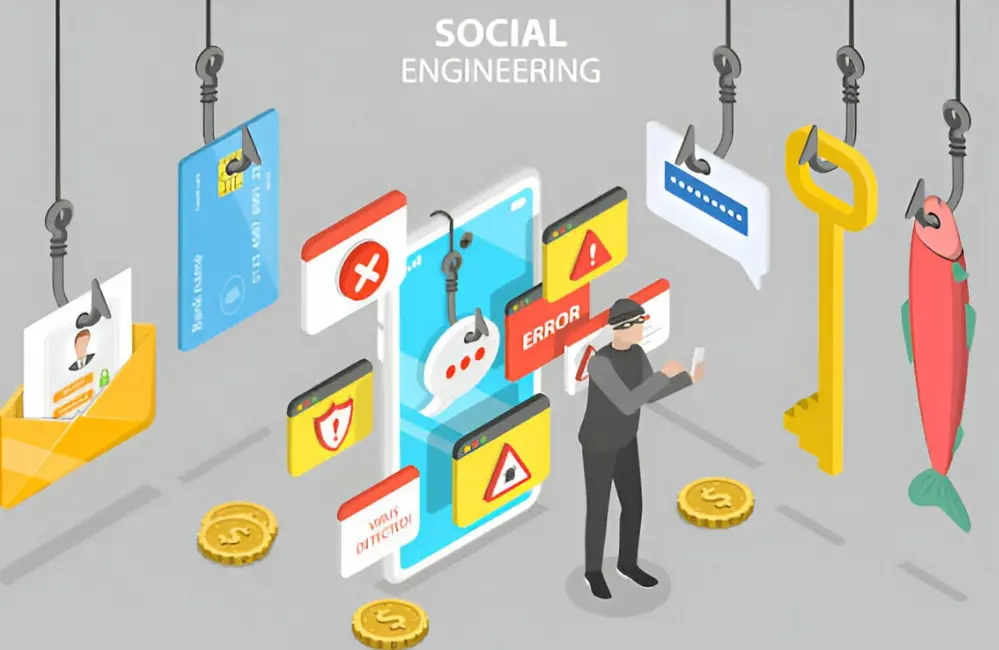
Social engineering is a psychological manipulation tactic used by attackers to deceive individuals into divulging confidential information, granting access, or performing actions that compromise security. It exploits human emotions, trust, and behavior rather than technical vulnerabilities.
#Key Types:
– Phishing: Fraudulent attempts to obtain sensitive data, such as passwords or credit card numbers, often via emails, texts, or fake websites. For example, an email posing as a legitimate company asking users to “verify” their account details.
– Pretexting: Creating a fabricated scenario or identity to build trust and extract information. An attacker might impersonate a colleague or authority figure to request sensitive data.
– Baiting: Luring victims with an enticing offer, like free software or USB drives containing malware, to infect their systems.
– Quid Pro Quo: Offering a service or favor in exchange for information, such as a hacker posing as IT support to gain remote access.
– Tailgating: Physically following someone into a restricted area without proper authorization, exploiting courtesy or distraction.
#Common Techniques and Examples:
Attackers often use urgency, authority, or scarcity to pressure targets. A classic example is a phone call from someone claiming to be from tech support, asking for login credentials to “fix” an issue. Social media is frequently exploited for reconnaissance, gathering personal details to craft personalized attacks.
#Impacts:
Social engineering can lead to data breaches, financial losses, identity theft, and reputational damage for individuals and organizations. High-profile cases include the 2016 Bangladesh Bank heist, where attackers used phishing to steal millions.
#Prevention Strategies:
– Education and Awareness: Train employees and individuals to recognize red flags, such as unsolicited requests for sensitive information.
– Verification: Always confirm the identity of the requester through official channels before sharing data.
– Technical Controls: Implement multi-factor authentication (MFA), email filters, and intrusion detection systems.
– Policies: Enforce strict access controls, regular security audits, and a culture of skepticism toward unexpected communications.
– Reporting: Encourage immediate reporting of suspicious activities to minimize damage.
By understanding and addressing social engineering, individuals and organizations can significantly reduce risks in an increasingly digital world.
Table of Contents
- Part 1: OnlineExamMaker AI Quiz Generator – The Easiest Way to Make Quizzes Online
- Part 2: 20 Social Engineering Quiz Questions & Answers
- Part 3: AI Question Generator – Automatically Create Questions for Your Next Assessment
Part 1: OnlineExamMaker AI Quiz Generator – The Easiest Way to Make Quizzes Online
When it comes to ease of creating a Social Engineering skills assessment, OnlineExamMaker is one of the best AI-powered quiz making software for your institutions or businesses. With its AI Question Generator, just upload a document or input keywords about your assessment topic, you can generate high-quality quiz questions on any topic, difficulty level, and format.
What you will like:
● AI Question Generator to help you save time in creating quiz questions automatically.
● Share your online exam with audiences on social platforms like Facebook, Twitter, Reddit and more.
● Display the feedback for correct or incorrect answers instantly after a question is answered.
● Create a lead generation form to collect an exam taker’s information, such as email, mobile phone, work title, company profile and so on.
Automatically generate questions using AI
Part 2: 20 Social Engineering Quiz Questions & Answers
or
1. What is social engineering primarily aimed at exploiting?
A. Hardware vulnerabilities
B. Human psychology
C. Software bugs
D. Network firewalls
Correct Answer: B
Explanation: Social engineering targets human psychology, as it relies on manipulating people’s emotions, trust, or behaviors to gain unauthorized access or information.
2. Which of the following is an example of phishing?
A. Installing malware on a USB drive
B. Sending an email that appears to be from a bank asking for login details
C. Guessing a password through trial and error
D. Physically breaking into a building
Correct Answer: B
Explanation: Phishing involves deceptive emails or messages that mimic legitimate sources to trick individuals into revealing sensitive information.
3. What is pretexting in social engineering?
A. Creating a false identity to obtain information
B. Using bait like free software to infect devices
C. Spreading rumors to cause panic
D. Hacking into email servers
Correct Answer: A
Explanation: Pretexting is a technique where the attacker fabricates a scenario or identity to build trust and extract confidential data from the victim.
4. How does baiting differ from other social engineering tactics?
A. It involves direct phone calls
B. It uses physical media like infected USB drives to lure victims
C. It focuses on corporate espionage
D. It requires advanced coding skills
Correct Answer: B
Explanation: Baiting entices victims with something desirable, such as a USB drive left in a public place, which contains malware to compromise their systems.
5. Which psychological principle is often exploited in social engineering?
A. Authority bias
B. Quantum mechanics
C. Economic theory
D. Color theory
Correct Answer: A
Explanation: Authority bias is exploited when attackers pose as figures of authority, like bosses or officials, to make victims comply without question.
6. What is the main goal of a vishing attack?
A. To crash a website
B. To trick victims over the phone into revealing information
C. To send spam emails
D. To encrypt files for ransom
Correct Answer: B
Explanation: Vishing, or voice phishing, uses phone calls to deceive individuals into providing personal or financial details.
7. In social engineering, what does “tailgating” refer to?
A. Following someone into a restricted area without proper authorization
B. Sending tailored emails to specific targets
C. Hacking into tail networks
D. Creating fake social media profiles
Correct Answer: A
Explanation: Tailgating involves physically following an authorized person into a secure location, exploiting courtesy or distraction to gain entry.
8. Which of the following is a common countermeasure against social engineering?
A. Ignoring all emails
B. Employee training and awareness programs
C. Disabling antivirus software
D. Sharing passwords with colleagues
Correct Answer: B
Explanation: Regular training helps employees recognize and resist social engineering attempts by educating them on common tactics and red flags.
9. What makes social engineering particularly dangerous?
A. It requires expensive tools
B. It bypasses technical security measures by targeting people
C. It only affects large organizations
D. It is easily detectable
Correct Answer: B
Explanation: Social engineering is effective because it exploits human errors, which can override even the strongest technological defenses.
10. Which famous social engineering incident involved a fake charity?
A. The Melissa virus
B. The Kevin Mitnick case
C. The Yahoo data breach
D. The Equifax hack
Correct Answer: B
Explanation: Kevin Mitnick used social engineering, including posing as a charity worker, to gain access to systems during his hacking activities.
11. What is quid pro quo in social engineering?
A. Offering something in return for information
B. Stealing identities outright
C. Sending anonymous threats
D. Brute force password attacks
Correct Answer: A
Explanation: Quid pro quo involves exchanging something of value, like free services, to persuade victims to provide sensitive information.
12. How can users protect themselves from smishing attacks?
A. Never click links in text messages from unknown sources
B. Share phone numbers freely
C. Open all attachments immediately
D. Use public Wi-Fi for banking
Correct Answer: A
Explanation: Smishing uses SMS messages to deliver phishing links, so avoiding suspicious links helps prevent falling victim to these attacks.
13. What is the purpose of a watering hole attack?
A. To infect websites frequented by a specific group
B. To flood networks with traffic
C. To guess passwords
D. To physically destroy hardware
Correct Answer: A
Explanation: In a watering hole attack, attackers compromise websites that target victims are likely to visit, infecting them with malware.
14. Why is urgency often used in social engineering?
A. To create panic and rush decisions
B. To make the attack more visible
C. To involve law enforcement
D. To slow down responses
Correct Answer: A
Explanation: Urgency tactics, like claiming immediate action is needed, exploit emotional responses and reduce the time victims have to think critically.
15. Which social engineering technique involves reverse engineering?
A. Dumpster diving
B. Phishing
C. Vishing
D. Baiting
Correct Answer: A
Explanation: Dumpster diving involves searching through trash for discarded sensitive information, which can be reverse engineered for attacks.
16. What role does reciprocity play in social engineering?
A. Making victims feel obligated to return a favor
B. Exchanging physical goods
C. Hacking into reciprocal networks
D. Creating mutual agreements
Correct Answer: A
Explanation: Reciprocity is a psychological principle where attackers give something small to make victims feel compelled to give back, often with valuable information.
17. In social engineering, what is a common outcome of a whaling attack?
A. Targeting high-level executives for large-scale gains
B. Attacking small fish in a pond
C. Flooding with water-based malware
D. Focusing on marine industries
Correct Answer: A
Explanation: Whaling is a form of phishing aimed at “big fish” like CEOs, seeking high-value information or access.
18. How does social proof influence social engineering?
A. By showing that others are complying, making victims more likely to do the same
B. By proving social status
C. By sharing social media posts
D. By conducting social audits
Correct Answer: A
Explanation: Social proof leverages the idea that people follow the crowd, so attackers might claim “everyone else is doing it” to gain compliance.
19. What is the best way to verify a suspicious request in social engineering?
A. Contact the supposed sender through a known, secure channel
B. Immediately comply to avoid trouble
C. Share the request on social media
D. Ignore it completely
Correct Answer: A
Explanation: Verifying through a trusted method, like calling a known number, helps confirm legitimacy and prevents falling for deceptive tactics.
20. Which factor makes younger individuals more vulnerable to social engineering?
A. Greater use of social media and less experience with scams
B. Advanced technical skills
C. Preference for physical security
D. Avoidance of online interactions
Correct Answer: A
Explanation: Younger people often engage more with digital platforms and may lack the experience to recognize sophisticated social engineering attempts.
or
Part 3: AI Question Generator – Automatically Create Questions for Your Next Assessment
Automatically generate questions using AI