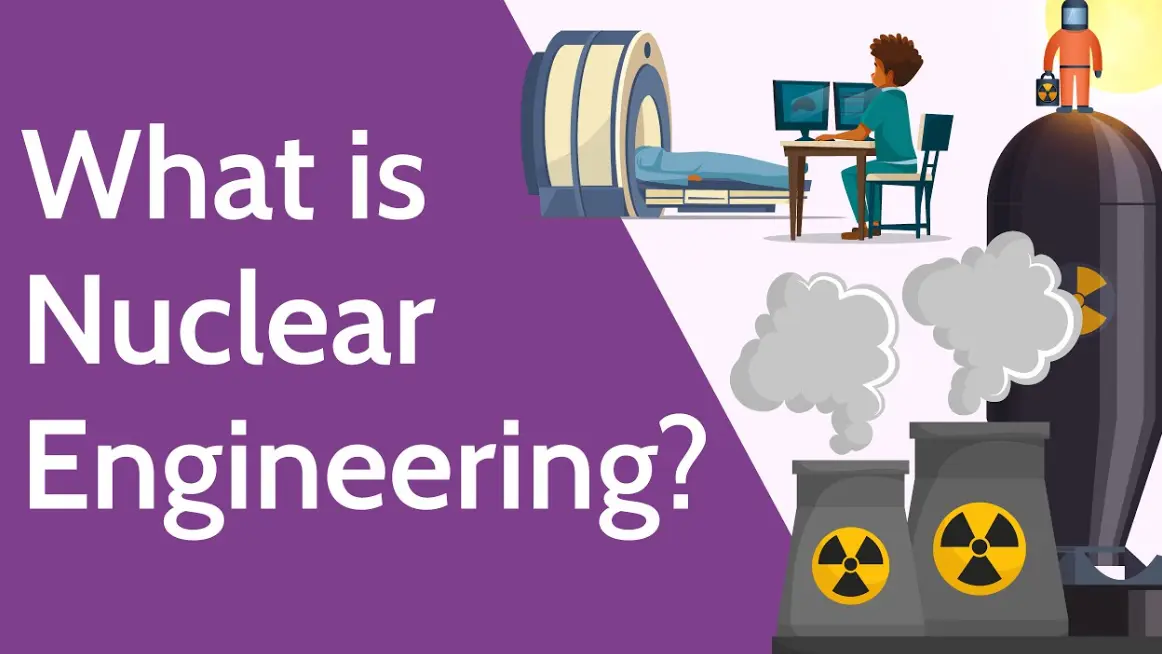
Nuclear engineering is a specialized branch of engineering that focuses on the science and technology of nuclear processes, including the harnessing of atomic energy for practical applications. It encompasses the design, construction, and operation of nuclear reactors for electricity generation, where controlled fission reactions produce heat to drive turbines. This field also involves radiation detection and protection, ensuring safety in environments exposed to radioactive materials, and advancing medical technologies like radiation therapy for cancer treatment.
Key areas include nuclear power plant engineering, where engineers optimize fuel cycles and waste management to minimize environmental impact; fusion research, aimed at developing sustainable energy sources like those mimicking the sun’s processes; and applications in materials science, such as creating radiation-resistant alloys for space exploration or industrial uses.
Nuclear engineers play a crucial role in addressing global energy demands by providing low-carbon power alternatives, while prioritizing safety protocols to prevent accidents and mitigate risks. This discipline blends physics, chemistry, and engineering principles to innovate solutions for challenges like nuclear waste disposal and non-proliferation, making it essential for sustainable development and scientific progress.
Table of Contents
- Part 1: OnlineExamMaker AI Quiz Maker – Make A Free Quiz in Minutes
- Part 2: 20 Nuclear Engineering Quiz Questions & Answers
- Part 3: Automatically Generate Quiz Questions Using AI Question Generator
Part 1: OnlineExamMaker AI Quiz Maker – Make A Free Quiz in Minutes
Still spend a lot of time in editing questions for your next Nuclear Engineering assessment? OnlineExamMaker is an AI quiz maker that leverages artificial intelligence to help users create quizzes, tests, and assessments quickly and efficiently. You can start by inputting a topic or specific details into the OnlineExamMaker AI Question Generator, and the AI will generate a set of questions almost instantly. It also offers the option to include answer explanations, which can be short or detailed, helping learners understand their mistakes.
What you may like:
● Automatic grading and insightful reports. Real-time results and interactive feedback for quiz-takers.
● The exams are automatically graded with the results instantly, so that teachers can save time and effort in grading.
● LockDown Browser to restrict browser activity during quizzes to prevent students searching answers on search engines or other software.
● Create certificates with personalized company logo, certificate title, description, date, candidate’s name, marks and signature.
Automatically generate questions using AI
Part 2: 20 Nuclear Engineering Quiz Questions & Answers
or
1. Question: What is the primary process that powers most commercial nuclear reactors?
Options:
A) Nuclear fusion
B) Nuclear fission
C) Radioactive decay
D) Chemical reactions
Answer: B
Explanation: Nuclear fission involves the splitting of heavy atomic nuclei, such as uranium-235, releasing energy that sustains a chain reaction in reactors.
2. Question: Which isotope is most commonly used as fuel in light water reactors?
Options:
A) Uranium-238
B) Uranium-235
C) Plutonium-239
D) Thorium-232
Answer: B
Explanation: Uranium-235 is fissile and can sustain a chain reaction, making it the primary fuel in most light water reactors.
3. Question: What is the purpose of control rods in a nuclear reactor?
Options:
A) To generate heat
B) To absorb neutrons and control the reaction rate
C) To produce steam
D) To cool the reactor core
Answer: B
Explanation: Control rods, often made of materials like boron or cadmium, absorb neutrons to regulate the fission rate and prevent overheating.
4. Question: In nuclear engineering, what does the term “criticality” refer to?
Options:
A) The point where the reactor shuts down
B) The state where the chain reaction is self-sustaining
C) The maximum temperature of the core
D) The level of radiation exposure
Answer: B
Explanation: Criticality occurs when the neutron production equals neutron loss, maintaining a steady chain reaction without external intervention.
5. Question: Which type of reactor uses pressurized water as both coolant and moderator?
Options:
A) Boiling water reactor (BWR)
B) Pressurized water reactor (PWR)
C) Fast breeder reactor
D) Gas-cooled reactor
Answer: B
Explanation: In a PWR, water is kept under high pressure to prevent boiling, allowing it to transfer heat from the core to a secondary loop for steam generation.
6. Question: What is the half-life of carbon-14, a commonly studied radioactive isotope?
Options:
A) 5,730 years
B) 30 years
C) 573 years
D) 5,730,000 years
Answer: A
Explanation: Carbon-14 has a half-life of approximately 5,730 years, which is used in radiocarbon dating to estimate the age of organic materials.
7. Question: Which particle is primarily responsible for initiating fission in uranium-235?
Options:
A) Alpha particles
B) Beta particles
C) Neutrons
D) Gamma rays
Answer: C
Explanation: Thermal neutrons are absorbed by uranium-235 nuclei, causing them to become unstable and split, releasing more neutrons.
8. Question: What is the main advantage of a breeder reactor?
Options:
A) It produces less waste
B) It can produce more fissile material than it consumes
C) It operates at lower temperatures
D) It uses water as a coolant
Answer: B
Explanation: Breeder reactors convert fertile isotopes like uranium-238 into fissile plutonium-239, effectively extending nuclear fuel resources.
9. Question: In nuclear safety, what does ALARA stand for?
Options:
A) As Low As Reasonably Achievable
B) Atomic Level Radiation Assessment
C) Advanced Low-Risk Atomic Reactor
D) Absolute Limit for Radiation Absorption
Answer: A
Explanation: ALARA is a principle in radiation protection that aims to minimize radiation exposure to the lowest possible level through practical means.
10. Question: What is the function of a moderator in a nuclear reactor?
Options:
A) To absorb excess heat
B) To slow down fast neutrons to thermal speeds
C) To generate electricity
D) To contain radioactive materials
Answer: B
Explanation: Moderators, such as water or graphite, reduce the speed of neutrons, increasing the likelihood of fission in fuel like uranium-235.
11. Question: Which law governs the decay of radioactive substances?
Options:
A) Newton’s law
B) Boyle’s law
C) Exponential decay law
D) Faraday’s law
Answer: C
Explanation: Radioactive decay follows an exponential law, where the rate of decay is proportional to the amount of substance present.
12. Question: What is the primary coolant in a CANDU reactor?
Options:
A) Heavy water
B) Light water
C) Helium gas
D) Molten salt
Answer: A
Explanation: CANDU reactors use heavy water (D2O) as both moderator and coolant, allowing them to use natural uranium as fuel.
13. Question: How is nuclear waste typically categorized?
Options:
A) By color
B) By half-life and radioactivity level (low, intermediate, high)
C) By weight
D) By temperature
Answer: B
Explanation: Nuclear waste is classified based on its radioactivity and half-life, such as low-level waste (e.g., contaminated tools) and high-level waste (e.g., spent fuel).
14. Question: What does the term “enrichment” mean in nuclear engineering?
Options:
A) Increasing the proportion of uranium-235 in uranium ore
B) Reducing the size of reactor components
C) Adding water to the reactor
D) Cooling the fuel rods
Answer: A
Explanation: Enrichment increases the concentration of fissile uranium-235 in uranium hexafluoride, typically to 3-5% for reactor fuel.
15. Question: Which radiation type is the most penetrating?
Options:
A) Alpha particles
B) Beta particles
C) Gamma rays
D) Neutrons
Answer: C
Explanation: Gamma rays are high-energy electromagnetic waves that can penetrate thick barriers, requiring dense materials like lead for shielding.
16. Question: What is the role of a containment building in a nuclear power plant?
Options:
A) To generate power
B) To house the reactor and prevent the release of radioactive materials
C) To store fuel
D) To cool the turbines
Answer: B
Explanation: The containment building is a reinforced structure designed to withstand accidents and contain any potential radiation leaks.
17. Question: In fusion reactions, what is the primary fuel used?
Options:
A) Uranium
B) Hydrogen isotopes like deuterium and tritium
C) Plutonium
D) Thorium
Answer: B
Explanation: Fusion reactions combine light nuclei, such as deuterium and tritium, to release energy, mimicking the process in the sun.
18. Question: What is the purpose of a reprocessing plant in the nuclear fuel cycle?
Options:
A) To mine uranium
B) To extract reusable fissile material from spent fuel
C) To build reactors
D) To dispose of waste
Answer: B
Explanation: Reprocessing separates plutonium and other fissile materials from spent nuclear fuel for potential reuse in reactors.
19. Question: Which factor primarily determines the reactivity of a nuclear reactor?
Options:
A) The color of the fuel rods
B) The number of neutrons available for fission
C) The external temperature
D) The voltage in the electrical grid
Answer: B
Explanation: Reactivity depends on the balance of neutron production and absorption, influenced by factors like fuel composition and control rods.
20. Question: What is the main challenge in developing commercial fusion reactors?
Options:
A) Achieving and sustaining the high temperatures required for fusion
B) Reducing the cost of uranium
C) Increasing radiation exposure
D) Simplifying reactor designs
Answer: A
Explanation: Fusion requires temperatures of millions of degrees to overcome the electrostatic repulsion between nuclei, making containment and energy breakeven difficult.
or
Part 3: Automatically generate quiz questions using OnlineExamMaker AI Question Generator
Automatically generate questions using AI