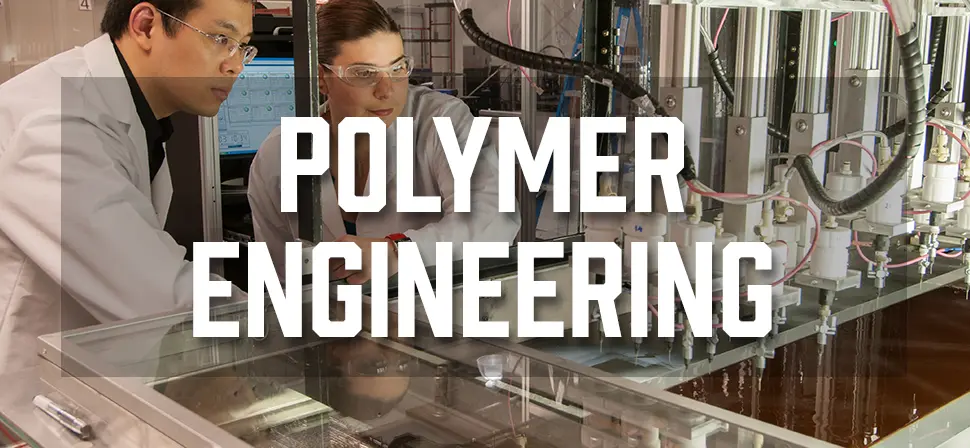
Polymer Engineering is a specialized branch of engineering that focuses on the design, processing, and application of polymer materials. These materials, which include plastics, elastomers, fibers, and composites, are large molecules made from repeating monomer units. The field encompasses the synthesis of polymers through processes like polymerization, as well as techniques for shaping and modifying them, such as extrusion, injection molding, and additive manufacturing. Polymer engineers address challenges in material durability, environmental impact, and performance, developing innovative solutions for industries like automotive, aerospace, packaging, biomedical devices, and electronics. With a growing emphasis on sustainability, the discipline advances biodegradable polymers and recycling technologies to meet global demands for eco-friendly materials. This field combines principles of chemistry, physics, and mechanics to create versatile, lightweight, and cost-effective products that enhance everyday life and technological progress.
Table of Contents
- Part 1: Create An Amazing Polymer Engineering Quiz Using AI Instantly in OnlineExamMaker
- Part 2: 20 Polymer Engineering Quiz Questions & Answers
- Part 3: Automatically Generate Quiz Questions Using AI Question Generator
Part 1: Create An Amazing Polymer Engineering Quiz Using AI Instantly in OnlineExamMaker
The quickest way to assess the Polymer Engineering knowledge of candidates is using an AI assessment platform like OnlineExamMaker. With OnlineExamMaker AI Question Generator, you are able to input content—like text, documents, or topics—and then automatically generate questions in various formats (multiple-choice, true/false, short answer). Its AI Exam Grader can automatically grade the exam and generate insightful reports after your candidate submit the assessment.
Overview of its key assessment-related features:
● Create up to 10 question types, including multiple-choice, true/false, fill-in-the-blank, matching, short answer, and essay questions.
● Automatically generates detailed reports—individual scores, question report, and group performance.
● Instantly scores objective questions and subjective answers use rubric-based scoring for consistency.
● API and SSO help trainers integrate OnlineExamMaker with Google Classroom, Microsoft Teams, CRM and more.
Automatically generate questions using AI
Part 2: 20 Polymer Engineering Quiz Questions & Answers
or
1. Question: What is the primary mechanism in free radical polymerization?
Options: A) Addition polymerization
B) Condensation polymerization
C) Ionic polymerization
D) Coordination polymerization
Answer: A) Addition polymerization
Explanation: Free radical polymerization proceeds via an addition mechanism where monomers add to a growing chain through radical intermediates, without the elimination of small molecules.
2. Question: Which polymer is typically classified as a thermoplastic?
Options: A) Bakelite
B) Polyethylene
C) Epoxy resin
D) Phenolic resin
Answer: B) Polyethylene
Explanation: Polyethylene is a thermoplastic because it can be melted and reshaped multiple times due to its linear or branched structure, unlike thermosets which form cross-links.
3. Question: What does the degree of polymerization represent?
Options: A) The number of monomer units in a polymer chain
B) The molecular weight of the polymer
C) The branching in the polymer structure
D) The crystallinity of the polymer
Answer: A) The number of monomer units in a polymer chain
Explanation: The degree of polymerization is defined as the number of repeating monomer units in a single polymer chain, which directly influences the polymer’s physical properties.
4. Question: In step-growth polymerization, what is the key characteristic?
Options: A) Rapid chain growth from a single initiator
B) Gradual increase in molecular weight over time
C) Formation of cyclic structures
D) Exclusive use of vinyl monomers
Answer: B) Gradual increase in molecular weight over time
Explanation: Step-growth polymerization involves reactions between functional groups of monomers, leading to a slow and gradual build-up of molecular weight as oligomers combine.
5. Question: Which additive is commonly used to improve the flexibility of polymers?
Options: A) Fillers
B) Plasticizers
C) Antioxidants
D) Flame retardants
Answer: B) Plasticizers
Explanation: Plasticizers are added to polymers to reduce intermolecular forces, increasing flexibility and lowering the glass transition temperature, making the material easier to process.
6. Question: What is the main advantage of injection molding in polymer processing?
Options: A) High production speed
B) Low pressure requirements
C) Suitability for thermosets only
D) Minimal tooling costs
Answer: A) High production speed
Explanation: Injection molding allows for rapid production of complex shapes with high precision, as molten polymer is injected into a mold and cools quickly, enabling mass manufacturing.
7. Question: How does cross-linking affect polymer properties?
Options: A) Increases solubility
B) Enhances elasticity and strength
C) Reduces thermal stability
D) Lowers melting point
Answer: B) Enhances elasticity and strength
Explanation: Cross-linking creates a three-dimensional network in polymers, which improves mechanical strength, elasticity, and resistance to deformation or dissolution.
8. Question: What is the role of initiators in chain-growth polymerization?
Options: A) To terminate the reaction
B) To start the chain reaction by generating active species
C) To increase the degree of polymerization
D) To act as a solvent
Answer: B) To start the chain reaction by generating active species
Explanation: Initiators, such as peroxides, decompose to produce free radicals that initiate the polymerization by reacting with monomers to form growing chains.
9. Question: Which polymer exhibits high crystallinity and is used for fibers?
Options: A) Polyvinyl chloride (PVC)
B) Polyethylene terephthalate (PET)
C) Polystyrene
D) Polyisoprene
Answer: B) Polyethylene terephthalate (PET)
Explanation: PET has a regular structure that allows for high crystallinity, making it ideal for applications like fibers and bottles due to its strength and barrier properties.
10. Question: What causes thermal degradation in polymers?
Options: A) Exposure to UV light
B) High temperatures breaking chemical bonds
C) Mechanical stress
D) Hydrolysis in water
Answer: B) High temperatures breaking chemical bonds
Explanation: Thermal degradation occurs when heat provides enough energy to break polymer chains, leading to loss of molecular weight and properties like strength and flexibility.
11. Question: In extrusion processing, what is the function of the die?
Options: A) To mix the polymer
B) To shape the molten polymer
C) To heat the polymer
D) To cool the final product
Answer: B) To shape the molten polymer
Explanation: The die in extrusion determines the cross-sectional shape of the extruded product by forcing the molten polymer through a specific opening.
12. Question: What is the polydispersity index (PDI) used for?
Options: A) To measure the average molecular weight
B) To indicate the distribution of molecular weights
C) To assess polymer crystallinity
D) To determine the monomer purity
Answer: B) To indicate the distribution of molecular weights
Explanation: PDI is the ratio of weight-average molecular weight to number-average molecular weight, providing insight into the uniformity of polymer chain lengths.
13. Question: Which monomer is used to produce nylon-6,6?
Options: A) Ethylene
B) Hexamethylenediamine and adipic acid
C) Styrene
D) Caprolactam
Answer: B) Hexamethylenediamine and adipic acid
Explanation: Nylon-6,6 is synthesized through condensation polymerization of hexamethylenediamine and adipic acid, forming a polyamide with strong intermolecular forces.
14. Question: How do fillers improve polymer composites?
Options: A) By increasing cost
B) By enhancing mechanical strength and reducing weight
C) By making the polymer more brittle
D) By decreasing thermal conductivity
Answer: B) By enhancing mechanical strength and reducing weight
Explanation: Fillers, such as glass fibers, reinforce the polymer matrix, improving properties like tensile strength and modulus while potentially lowering material costs.
15. Question: What is the glass transition temperature (Tg) of a polymer?
Options: A) The temperature at which it melts
B) The temperature range where it transitions from glassy to rubbery state
C) The boiling point of the polymer
D) The degradation temperature
Answer: B) The temperature range where it transitions from glassy to rubbery state
Explanation: Tg is the temperature at which amorphous polymers shift from a hard, brittle state to a soft, flexible one, affecting their usability in various applications.
16. Question: Which polymerization technique is used for producing high-density polyethylene (HDPE)?
Options: A) Emulsion polymerization
B) Ziegler-Natta catalysis
C) Suspension polymerization
D) Bulk polymerization
Answer: B) Ziegler-Natta catalysis
Explanation: Ziegler-Natta catalysts enable the production of HDPE by controlling the polymerization of ethylene to form linear chains with high density and crystallinity.
17. Question: What effect does branching have on polymer properties?
Options: A) Increases crystallinity
B) Decreases melting point and strength
C) Enhances solubility in water
D) Improves thermal conductivity
Answer: B) Decreases melting point and strength
Explanation: Branching disrupts the regular packing of polymer chains, reducing crystallinity, lowering the melting point, and often decreasing mechanical strength compared to linear polymers.
18. Question: In polymer blending, what is the purpose of compatibilizers?
Options: A) To separate phases
B) To improve adhesion between immiscible polymers
C) To increase viscosity
D) To act as a catalyst
Answer: B) To improve adhesion between immiscible polymers
Explanation: Compatibilizers reduce interfacial tension and enhance the mixing of incompatible polymers, leading to better mechanical properties in the blend.
19. Question: Which test is commonly used to measure the tensile strength of polymers?
Options: A) Differential scanning calorimetry
B) Universal testing machine
C) Rheometer
D) Viscometer
Answer: B) Universal testing machine
Explanation: A universal testing machine applies controlled tension to a polymer sample, measuring properties like tensile strength, elongation, and modulus.
20. Question: What is the environmental impact of biodegradable polymers?
Options: A) They contribute to microplastic pollution
B) They break down naturally, reducing waste
C) They require high energy for production
D) They release toxic gases upon degradation
Answer: B) They break down naturally, reducing waste
Explanation: Biodegradable polymers, like polylactic acid, decompose through microbial action, helping to mitigate plastic pollution and promote sustainability.
or
Part 3: Automatically generate quiz questions using OnlineExamMaker AI Question Generator
Automatically generate questions using AI