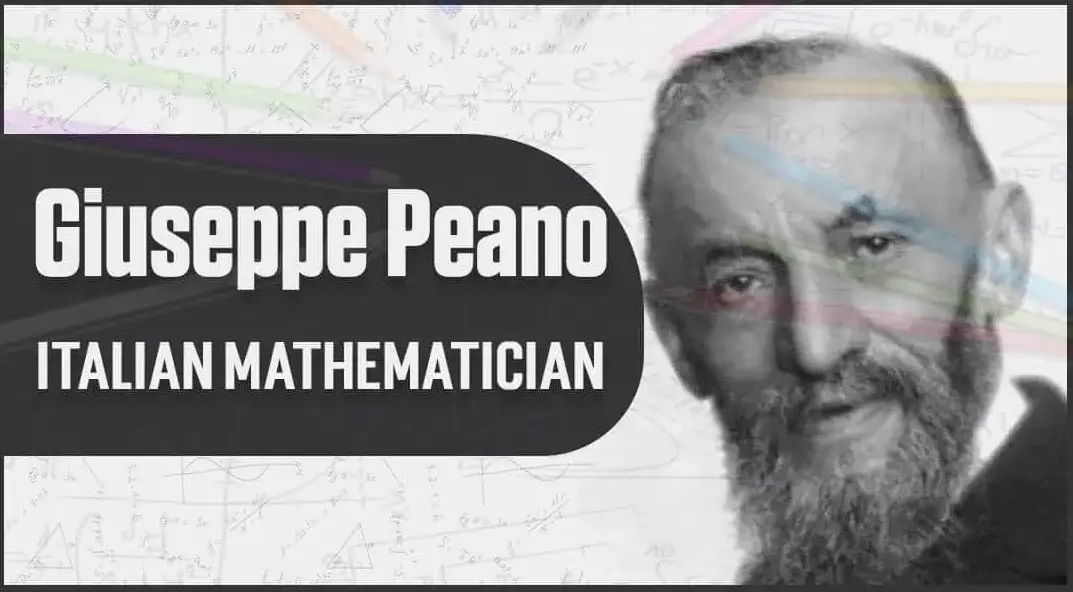
Giuseppe Peano (1858–1932) was an influential Italian mathematician and philosopher renowned for his foundational contributions to mathematical logic and the philosophy of mathematics. Born in Spinetta, near Cuneo, Italy, Peano studied at the University of Turin, where he later became a professor.
His most significant achievement was the formulation of the Peano axioms in 1889, a set of postulates that rigorously define the natural numbers and serve as the basis for arithmetic in modern mathematics. These axioms, published in his work “Arithmetices principia, nova methodo exposita,” emphasized the importance of precise definitions and logical rigor, influencing figures like Bertrand Russell and Alfred North Whitehead.
Peano also made strides in symbolic logic, developing a system of logical notation that predated some of Gottlob Frege’s ideas. He worked on set theory and contributed to the study of differential equations and calculus of variations.
Beyond mathematics, Peano was a pioneer in international communication, creating Interlingua (or Latino sine flexione), a simplified version of Latin intended as a universal auxiliary language to facilitate global understanding. He advocated for the use of symbols in mathematics to minimize ambiguity and co-founded the journal “Rivista di Matematica.”
Peano’s legacy lies in his commitment to formalism and clarity in mathematics, bridging the gap between pure logic and applied sciences, and inspiring the development of contemporary mathematical foundations.
Table of Contents
- Part 1: OnlineExamMaker AI Quiz Generator – Save Time and Efforts
- Part 2: 20 Giuseppe Peano Quiz Questions & Answers
- Part 3: Save Time and Energy: Generate Quiz Questions with AI Technology
Part 1: OnlineExamMaker AI Quiz Generator – Save Time and Efforts
What’s the best way to create a Giuseppe Peano quiz online? OnlineExamMaker is the best AI quiz making software for you. No coding, and no design skills required. If you don’t have the time to create your online quiz from scratch, you are able to use OnlineExamMaker AI Question Generator to create question automatically, then add them into your online assessment. What is more, the platform leverages AI proctoring and AI grading features to streamline the process while ensuring exam integrity.
Key features of OnlineExamMaker:
● Combines AI webcam monitoring to capture cheating activities during online exam.
● Allow the quiz taker to answer by uploading video or a Word document, adding an image, and recording an audio file.
● Automatically scores multiple-choice, true/false, and even open-ended/audio responses using AI, reducing manual work.
● OnlineExamMaker API offers private access for developers to extract your exam data back into your system automatically.
Automatically generate questions using AI
Part 2: 20 Giuseppe Peano Quiz Questions & Answers
or
1. Question: Who is Giuseppe Peano?
A) A physicist known for relativity
B) An Italian mathematician who developed axioms for natural numbers
C) A philosopher of the Enlightenment
D) A biologist who studied evolution
Answer: B
Explanation: Giuseppe Peano was an Italian mathematician famous for his work in mathematical logic and for formulating the Peano axioms, which define the properties of natural numbers.
2. Question: What is the primary purpose of the Peano axioms?
A) To describe the properties of real numbers
B) To provide a formal foundation for the natural numbers
C) To solve equations in algebra
D) To explain quantum mechanics
Answer: B
Explanation: The Peano axioms serve as a set of axioms that rigorously define the natural numbers and their arithmetic operations.
3. Question: How many axioms are typically included in the standard Peano axioms?
A) 5
B) 7
C) 10
D) 3
Answer: A
Explanation: The original Peano axioms consist of five axioms that outline the successor function and properties of natural numbers.
4. Question: Which of the following is NOT one of the Peano axioms?
A) Zero is a natural number
B) Every natural number has a successor
C) The successor of a number is always even
D) Addition is associative
Answer: C
Explanation: The Peano axioms do not state that the successor of a number is always even; this is unrelated to the axioms.
5. Question: In Peano arithmetic, what does the successor function represent?
A) Subtraction of one
B) The next natural number
C) Multiplication by two
D) Division by zero
Answer: B
Explanation: The successor function in Peano axioms defines how to get from one natural number to the next, such as from 1 to 2.
6. Question: Giuseppe Peano is associated with which language?
A) Latin
B) Esperanto
C) Interlingua
D) Latino sine flexione
Answer: D
Explanation: Peano created Latino sine flexione, a simplified version of Latin intended for international communication.
7. Question: What mathematical field did Peano contribute to significantly?
A) Geometry
B) Mathematical logic
C) Calculus
D) Statistics
Answer: B
Explanation: Peano’s work laid the groundwork for modern mathematical logic, including symbolic logic and set theory.
8. Question: According to the Peano axioms, what property ensures that there are no infinite descending chains of natural numbers?
A) The well-ordering principle
B) The induction axiom
C) The commutativity of addition
D) The distributive property
Answer: B
Explanation: The induction axiom in Peano arithmetic guarantees that every natural number can be reached through a finite process, preventing infinite descending chains.
9. Question: When was Giuseppe Peano born?
A) 1858
B) 1900
C) 1820
D) 1945
Answer: A
Explanation: Giuseppe Peano was born on August 27, 1858, in Italy.
10. Question: Which of the following is a key feature of Peano’s axiomatization?
A) It includes fractions and decimals
B) It defines natural numbers without relying on geometry
C) It requires complex numbers
D) It focuses on irrational numbers
Answer: B
Explanation: Peano’s axioms provide a purely arithmetic foundation for natural numbers, independent of geometric interpretations.
11. Question: What did Peano use to symbolize logical connectives?
A) Greek letters
B) Roman numerals
C) Special symbols like upside-down A for universal quantifier
D) Arabic script
Answer: C
Explanation: Peano introduced symbols such as an upside-down A for “for all” in his logical notation.
12. Question: In Peano arithmetic, how is the number 1 defined?
A) As the successor of 0
B) As the square root of 1
C) As zero plus zero
D) As an infinite set
Answer: A
Explanation: In the Peano axioms, 1 is defined as the successor of 0, building the natural numbers sequentially.
13. Question: What impact did Peano’s work have on later mathematicians like Bertrand Russell?
A) It influenced the development of Principia Mathematica
B) It led to advances in physics
C) It was used in engineering designs
D) It focused on art and aesthetics
Answer: A
Explanation: Peano’s logical foundations inspired Russell and Whitehead’s work in Principia Mathematica.
14. Question: Which axiom in Peano’s system states that if a property holds for 0 and the successor of every number it holds for, then it holds for all natural numbers?
A) The zero axiom
B) The successor axiom
C) The induction axiom
D) The addition axiom
Answer: C
Explanation: This is the mathematical induction axiom, which is central to proving statements about all natural numbers.
15. Question: Giuseppe Peano worked as a professor at which university?
A) University of Cambridge
B) University of Turin
C) Harvard University
D) Sorbonne University
Answer: B
Explanation: Peano was a professor of mathematics at the University of Turin for much of his career.
16. Question: What does the Peano curve represent?
A) A space-filling curve
B) A straight line in geometry
C) A circle in trigonometry
D) A parabola in physics
Answer: A
Explanation: The Peano curve is a famous example of a space-filling curve, though it was actually first described by Peano in the context of fractal geometry.
17. Question: In Peano’s axioms, what is assumed about the successor function?
A) It is not one-to-one
B) It is one-to-one and maps to a different number
C) It always equals zero
D) It is undefined for even numbers
Answer: B
Explanation: The successor function is defined to be one-to-one, ensuring each natural number has a unique successor.
18. Question: How did Peano contribute to the notation of vectors?
A) By introducing arrow notation
B) By using boldface letters
C) By creating the concept of matrices
D) By defining differential equations
Answer: A
Explanation: Peano is credited with introducing the arrow notation for vectors in his mathematical works.
19. Question: What limitation does Gödel’s incompleteness theorem reveal about Peano arithmetic?
A) It is complete and consistent
B) It is incomplete for certain true statements
C) It applies only to geometry
D) It is fully decidable
Answer: B
Explanation: Gödel’s theorem shows that Peano arithmetic is incomplete, meaning there are true statements that cannot be proven within the system.
20. Question: What was Peano’s role in the international mathematical community?
A) He founded the International Congress of Mathematicians
B) He was a key figure in promoting symbolic logic
C) He invented the calculator
D) He wrote novels about mathematics
Answer: B
Explanation: Peano was influential in the development and promotion of symbolic logic, influencing global mathematical discourse.
or
Part 3: Save Time and Energy: Generate Quiz Questions with AI Technology
Automatically generate questions using AI