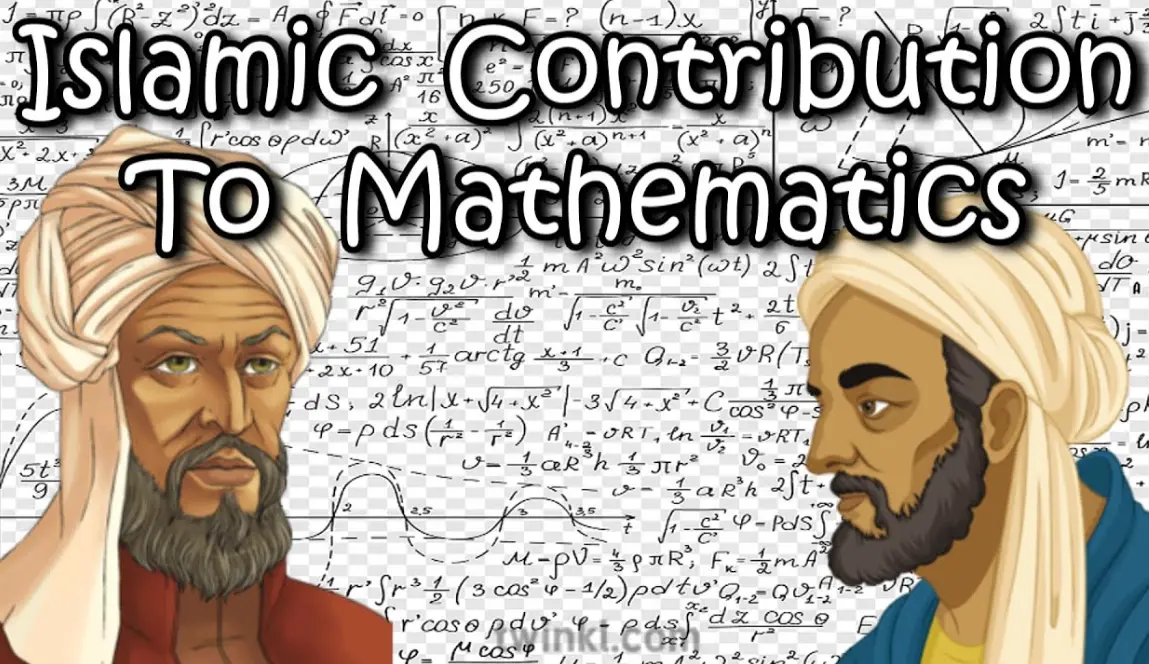
Islamic Mathematics, flourishing during the Islamic Golden Age from the 8th to the 15th centuries, encompasses significant advancements made by scholars in the Muslim world. Key figures like Muhammad ibn Musa al-Khwarizmi, who pioneered algebra and introduced the concept of algorithms, and Al-Biruni, who contributed to trigonometry and geography, built upon Greek, Indian, and Persian knowledge. This era saw the development of algebra as a systematic discipline, including solving quadratic equations and the use of algebraic symbols. Trigonometry was refined for astronomical purposes, with sine, cosine, and tangent functions becoming standard. Geometry progressed through works on Euclid and the creation of intricate designs in Islamic art and architecture. Number theory advanced with studies on perfect numbers and Diophantine equations, while the decimal system and zero were popularized from Indian sources. Islamic mathematicians also applied their knowledge to calendars, optics, and commerce, influencing global science through translations into Latin during the European Renaissance. Figures like Omar Khayyam solved cubic equations and worked on the parallel postulate, while Al-Kindi integrated philosophy with mathematics. Overall, Islamic Mathematics bridged ancient and modern eras, fostering innovation that shaped Western science.
Table of Contents
- Part 1: Create An Amazing Islamic Mathematics Quiz Using AI Instantly in OnlineExamMaker
- Part 2: 20 Islamic Mathematics Quiz Questions & Answers
- Part 3: Save Time and Energy: Generate Quiz Questions with AI Technology
Part 1: Create An Amazing Islamic Mathematics Quiz Using AI Instantly in OnlineExamMaker
The quickest way to assess the Islamic Mathematics knowledge of candidates is using an AI assessment platform like OnlineExamMaker. With OnlineExamMaker AI Question Generator, you are able to input content—like text, documents, or topics—and then automatically generate questions in various formats (multiple-choice, true/false, short answer). Its AI Exam Grader can automatically grade the exam and generate insightful reports after your candidate submit the assessment.
Overview of its key assessment-related features:
● Create up to 10 question types, including multiple-choice, true/false, fill-in-the-blank, matching, short answer, and essay questions.
● Automatically generates detailed reports—individual scores, question report, and group performance.
● Instantly scores objective questions and subjective answers use rubric-based scoring for consistency.
● API and SSO help trainers integrate OnlineExamMaker with Google Classroom, Microsoft Teams, CRM and more.
Automatically generate questions using AI
Part 2: 20 Islamic Mathematics Quiz Questions & Answers
or
1. Who is known as the “Father of Algebra” and wrote the book “Al-Kitab al-Mukhtasar fi Hisab al-Jabr wal-Muqabala”?
A. Al-Biruni
B. Al-Khwarizmi
C. Omar Khayyam
D. Fibonacci
Answer: B
Explanation: Al-Khwarizmi’s work introduced systematic methods for solving linear and quadratic equations, forming the basis of algebra.
2. What mathematical concept, derived from Arabic, refers to the ratio of the circumference of a circle to its diameter?
A. Pi
B. Sine
C. Algorithm
D. Zero
Answer: A
Explanation: The term “pi” comes from the Greek letter, but Islamic mathematicians like Al-Khwarizmi refined its use in calculations involving circles.
3. In Islamic geometry, what is the primary shape used in intricate patterns found in mosques?
A. Circles
B. Squares
C. Triangles
D. All of the above
Answer: D
Explanation: Islamic art combines circles, squares, and triangles to create tessellations and patterns that reflect mathematical symmetry.
4. Which Islamic mathematician developed the concept of the decimal point and improved the Hindu-Arabic numeral system?
A. Al-Battani
B. Al-Kindi
C. Al-Khwarizmi
D. Ibn Sina
Answer: C
Explanation: Al-Khwarizmi’s promotion of the Hindu-Arabic numerals included practical applications that led to the use of the decimal system.
5. What is the mathematical term for the process of repeated subtraction or division, as used in Islamic arithmetic?
A. Algorithm
B. Calculus
C. Geometry
D. Trigonometry
Answer: A
Explanation: The word “algorithm” derives from Al-Khwarizmi’s name, referring to step-by-step procedures for solving problems.
6. Omar Khayyam is famous for solving cubic equations using what geometric method?
A. Conic sections
B. Straight lines
C. Pythagorean theorem
D. Euclidean proofs
Answer: A
Explanation: Khayyam used intersections of conic sections to find roots of cubic equations, advancing algebraic geometry.
7. In trigonometry, which function was first defined by Islamic mathematicians like Al-Battani?
A. Tangent
B. Sine
C. Cosine
D. Both B and C
Answer: D
Explanation: Al-Battani and others refined sine and cosine functions, essential for astronomy and navigation.
8. What did Islamic mathematicians contribute to the understanding of zero as a number?
A. Inventing it
B. Refining its use in calculations
C. Ignoring it
D. Replacing it with Roman numerals
Answer: B
Explanation: Scholars like Al-Khwarizmi integrated zero into the positional numeral system, making complex calculations easier.
9. Which Islamic mathematician wrote “The Compendious Book on Calculation by Completion and Balancing”?
A. Al-Biruni
B. Al-Khwarizmi
C. Ibn al-Haytham
D. Al-Farabi
Answer: B
Explanation: This book by Al-Khwarizmi laid the foundations for algebra by introducing equations and their solutions.
10. In Islamic architecture, mathematical patterns often involve what type of symmetry?
A. Bilateral symmetry
B. Rotational symmetry
C. Translational symmetry
D. All types of symmetry
Answer: D
Explanation: Islamic designs use various symmetries, including rotational and translational, to create infinite, non-repeating patterns.
11. Al-Biruni calculated the Earth’s circumference using what mathematical principle?
A. Trigonometry
B. Algebra
C. Geometry
D. Calculus
Answer: A
Explanation: Al-Biruni applied trigonometric methods to measure the Earth’s radius accurately through observations.
12. What is the significance of the “House of Wisdom” in Baghdad for Islamic mathematics?
A. It was a library for storing books
B. It was a center for translating and advancing mathematical knowledge
C. It focused only on religious texts
D. It was a school for artists
Answer: B
Explanation: The House of Wisdom facilitated the translation of Greek and Indian texts, leading to innovations in mathematics.
13. Ibn al-Haytham’s work on optics involved which mathematical concept?
A. Refraction using algebra
B. Reflection using geometry
C. Both A and B
D. Neither A nor B
Answer: C
Explanation: Ibn al-Haytham used algebraic and geometric principles to explain light reflection and refraction.
14. Which Islamic mathematician introduced the concept of mathematical induction?
A. Al-Khwarizmi
B. Omar Khayyam
C. Al-Kindi
D. None of the above
Answer: D
Explanation: While not directly attributed, Islamic scholars like Al-Karaji laid groundwork for concepts similar to mathematical induction.
15. In Islamic mathematics, what was the purpose of developing spherical trigonometry?
A. For art and design
B. For astronomical calculations
C. For architecture
D. For everyday arithmetic
Answer: B
Explanation: Spherical trigonometry, advanced by Al-Battani, was crucial for determining positions of celestial bodies.
16. What did Fibonacci learn from Islamic mathematicians that he included in his book “Liber Abaci”?
A. The abacus
B. Hindu-Arabic numerals
C. Geometric patterns
D. Trigonometric tables
Answer: B
Explanation: Fibonacci adopted the numeral system from Islamic sources, popularizing it in Europe.
17. Al-Kindi contributed to cryptography using what mathematical technique?
A. Frequency analysis
B. Encryption algorithms
C. Both A and B
D. Neither A nor B
Answer: C
Explanation: Al-Kindi used statistical methods and early algorithms for code-breaking and secure communication.
18. Which equation type was first solved geometrically by Omar Khayyam?
A. Linear equations
B. Quadratic equations
C. Cubic equations
D. Quartic equations
Answer: C
Explanation: Khayyam provided geometric solutions for cubic equations using curves and intersections.
19. Islamic mathematicians improved the astrolabe, which relies on what mathematical principles?
A. Geometry and trigonometry
B. Algebra only
C. Arithmetic only
D. Calculus
Answer: A
Explanation: The astrolabe used geometric designs and trigonometric calculations for navigation and timekeeping.
20. What role did mathematics play in the development of Islamic calendars?
A. It had no role
B. It was used for accurate astronomical observations
C. It was only for religious purposes
D. It was limited to basic counting
Answer: B
Explanation: Mathematicians like Al-Biruni used precise calculations to reform calendars based on lunar and solar cycles.
or
Part 3: Save Time and Energy: Generate Quiz Questions with AI Technology
Automatically generate questions using AI