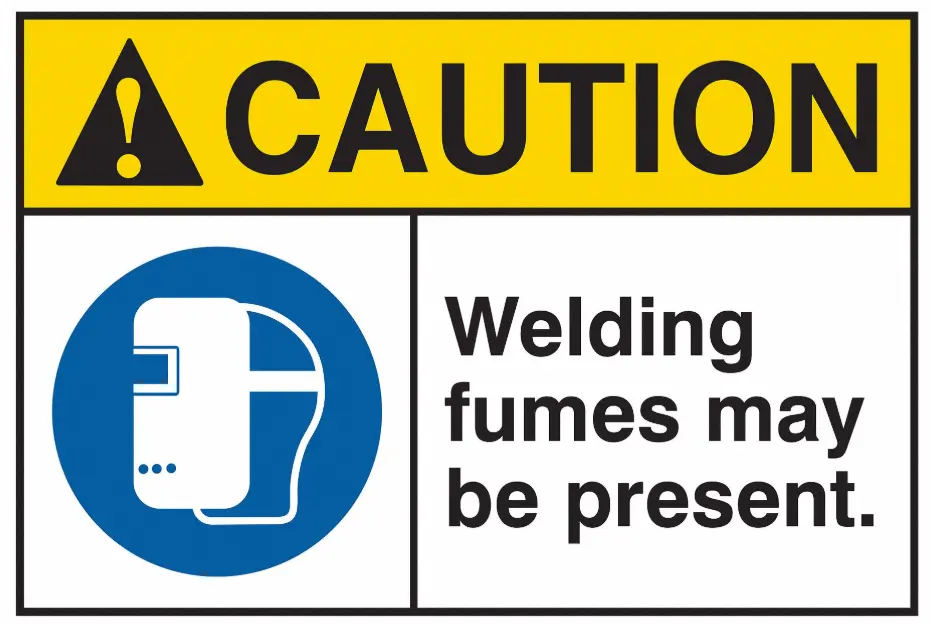
Welding fumes are hazardous airborne particles generated during welding, cutting, or brazing processes, consisting of metals, oxides, and gases that can pose serious health risks if not properly managed.
## Health Risks
Exposure to welding fumes can lead to immediate effects such as eye irritation, dizziness, and nausea, as well as long-term issues like respiratory diseases, lung cancer, metal fume fever, and neurological disorders. Key components like manganese, chromium, and hexavalent chromium are particularly dangerous, potentially causing permanent damage to the lungs, kidneys, and central nervous system.
## Sources and Composition
Fumes arise from the vaporization of base metals, coatings, and fluxes. Common compositions include iron, aluminum, lead, and cadmium oxides. Factors influencing fume production include the type of welding (e.g., MIG, TIG, arc), materials used, and environmental conditions like ventilation.
## Safety Measures and Controls
To minimize risks, implement a hierarchy of controls:
– Engineering Controls: Use local exhaust ventilation (LEV) systems, such as fume extractors or welding hoods, to capture fumes at the source. Ensure adequate general ventilation in workspaces.
– Administrative Controls: Rotate workers to limit exposure time, conduct regular air monitoring, and provide training on fume hazards and safe practices.
– Personal Protective Equipment (PPE): Wear respirators (e.g., N95 or higher-rated masks), protective clothing, and eye protection. Fit-testing for respirators is essential.
– Exposure Limits: Adhere to standards like OSHA’s Permissible Exposure Limits (PEL) for specific metals and NIOSH Recommended Exposure Limits (REL) to keep airborne concentrations below safe thresholds.
## Regulations and Best Practices
Compliance with regulations from bodies like OSHA, NIOSH, and ANSI is crucial. In the U.S., follow 29 CFR 1910.252 for welding operations. Best practices include conducting risk assessments, maintaining equipment, and promoting a culture of safety through regular education and health monitoring for workers.
By prioritizing fume control and awareness, welding operations can significantly reduce health risks and ensure a safer work environment.
Table of Contents
- Part 1: OnlineExamMaker – Generate and Share Welding Fume Safety Quiz with AI Automatically
- Part 2: 20 Welding Fume Safety Quiz Questions & Answers
- Part 3: Save Time and Energy: Generate Quiz Questions with AI Technology
Part 1: OnlineExamMaker – Generate and Share Welding Fume Safety Quiz with AI Automatically
The quickest way to assess the Welding Fume Safety knowledge of candidates is using an AI assessment platform like OnlineExamMaker. With OnlineExamMaker AI Question Generator, you are able to input content—like text, documents, or topics—and then automatically generate questions in various formats (multiple-choice, true/false, short answer). Its AI Exam Grader can automatically grade the exam and generate insightful reports after your candidate submit the assessment.
What you will like:
● Create a question pool through the question bank and specify how many questions you want to be randomly selected among these questions.
● Allow the quiz taker to answer by uploading video or a Word document, adding an image, and recording an audio file.
● Display the feedback for correct or incorrect answers instantly after a question is answered.
● Create a lead generation form to collect an exam taker’s information, such as email, mobile phone, work title, company profile and so on.
Automatically generate questions using AI
Part 2: 20 Welding Fume Safety Quiz Questions & Answers
or
1. What are welding fumes primarily composed of?
A. Oxygen and nitrogen gases
B. Fine particles of metals and oxides
C. Liquid droplets from the welding rod
D. Carbon dioxide and water vapor
Answer: B
Explanation: Welding fumes are primarily fine particles of metals and oxides produced when the welding arc vaporizes the base metal and electrode, posing inhalation risks.
2. Which of the following health effects is most commonly associated with short-term exposure to welding fumes?
A. Lung cancer
B. Metal fume fever
C. Chronic bronchitis
D. Kidney damage
Answer: B
Explanation: Metal fume fever is a short-term flu-like illness caused by inhaling freshly formed metal oxides in welding fumes, often resolving within 24-48 hours.
3. What is the primary purpose of local exhaust ventilation in welding?
A. To cool the weld area
B. To remove hazardous fumes from the breathing zone
C. To provide fresh air for the welder
D. To reduce noise levels
Answer: B
Explanation: Local exhaust ventilation captures and removes welding fumes at the source, preventing them from entering the welder’s breathing zone and reducing exposure risks.
4. Which personal protective equipment (PPE) is essential for protecting against welding fume inhalation?
A. Safety glasses
B. Respirators or masks
C. Leather gloves
D. Steel-toe boots
Answer: B
Explanation: Respirators or masks, such as N95 or higher-rated filters, are crucial for filtering out harmful particles in welding fumes and protecting the respiratory system.
5. What factor increases the risk of welding fume exposure in a confined space?
A. Higher oxygen levels
B. Poor ventilation
C. Use of inert gases
D. Cooler temperatures
Answer: B
Explanation: Poor ventilation in confined spaces allows welding fumes to accumulate, leading to higher concentrations and greater health risks for the welder.
6. Which metal in welding fumes is known to cause neurological effects if inhaled over time?
A. Iron
B. Manganese
C. Aluminum
D. Copper
Answer: B
Explanation: Inhaling manganese from welding fumes can lead to manganism, a condition similar to Parkinson’s disease, affecting the nervous system with prolonged exposure.
7. How often should air monitoring be conducted in areas with regular welding activities?
A. Once a year
B. As needed based on risk assessment
C. Daily during shifts
D. Only after accidents
Answer: B
Explanation: Air monitoring should be performed as needed based on risk assessments to ensure fume levels are below exposure limits, helping to maintain a safe working environment.
8. What is the best practice to minimize welding fume exposure when welding outdoors?
A. Increase welding speed
B. Use natural wind for dispersion
C. Wear additional clothing layers
D. Position upwind of the fume source
Answer: D
Explanation: Positioning upwind of the welding area allows fumes to be carried away from the welder, reducing inhalation risks in outdoor settings.
9. Which welding process typically produces the least amount of fumes?
A. Shielded metal arc welding (SMAW)
B. Gas metal arc welding (GMAW)
C. Laser beam welding
D. Flux-cored arc welding (FCAW)
Answer: C
Explanation: Laser beam welding produces minimal fumes because it uses a focused beam of light rather than an electric arc, resulting in less vaporization of materials.
10. What should a welder do if they experience symptoms like coughing and dizziness during welding?
A. Continue working to finish the task
B. Stop welding and move to fresh air immediately
C. Drink water and rest for a few minutes
D. Ignore symptoms if they subside quickly
Answer: B
Explanation: Stopping welding and moving to fresh air helps prevent further exposure and allows for assessment of potential fume-related health effects.
11. Which regulation in the United States addresses permissible exposure limits for welding fumes?
A. OSHA’s Hazard Communication Standard
B. EPA’s Clean Air Act
C. NIOSH’s recommended exposure limits
D. ANSI’s welding safety guidelines
Answer: A
Explanation: OSHA’s Hazard Communication Standard includes requirements for controlling exposure to welding fumes, ensuring workers are informed and protected.
12. What type of respirator is most effective for welding fumes containing hexavalent chromium?
A. Dust mask
B. Half-face air-purifying respirator with P100 filters
C. Full-face shield without filters
D. Powered air-purifying respirator (PAPR)
Answer: D
Explanation: A PAPR provides a higher level of protection against carcinogenic fumes like hexavalent chromium by supplying filtered air under positive pressure.
13. How can welding fume exposure be reduced when using stainless steel?
A. Weld at higher temperatures
B. Use low-fume electrodes
C. Increase the welding current
D. Work without ventilation
Answer: B
Explanation: Low-fume electrodes are designed to produce fewer hazardous particles, helping to minimize exposure to chromium and other toxins in stainless steel welding.
14. What is a long-term health risk associated with chronic welding fume exposure?
A. Skin irritation
B. siderosis (iron deposition in lungs)
C. Temporary eye strain
D. Muscle cramps
Answer: B
Explanation: Chronic exposure to iron-rich welding fumes can lead to siderosis, a lung condition where iron particles accumulate, potentially causing fibrosis over time.
15. Which action is NOT recommended for cleaning up welding fume residues?
A. Using a vacuum with HEPA filters
B. Sweeping with a broom
C. Wet wiping surfaces
D. Proper disposal as hazardous waste
Answer: B
Explanation: Sweeping with a broom can stir up fumes and particles into the air, increasing inhalation risks; instead, use methods like HEPA vacuums to contain contaminants.
16. What role does proper electrode selection play in welding fume safety?
A. It affects the strength of the weld only
B. It can reduce the types of fumes produced
C. It has no impact on fume generation
D. It only influences electrical costs
Answer: B
Explanation: Selecting electrodes with lower fume-emitting properties can reduce the release of harmful substances, contributing to safer welding practices.
17. In what scenario might welding fumes be more toxic?
A. When welding clean metals
B. During galvanized steel welding
C. In open, ventilated areas
D. With low-amperage settings
Answer: B
Explanation: Welding galvanized steel releases zinc fumes, which can cause severe toxicity like metal fume fever, making it a high-risk scenario.
18. What is the minimum recommended distance for welders from the fume source?
A. 1 foot
B. As close as possible for precision
C. At least 2-3 feet with ventilation
D. No specific distance required
Answer: C
Explanation: Maintaining at least 2-3 feet from the fume source, combined with ventilation, helps reduce direct inhalation and exposure levels.
19. How does humidity affect welding fume risks?
A. It reduces fume production
B. It can make fumes more irritating to the respiratory system
C. It eliminates the need for PPE
D. It has no effect on fumes
Answer: B
Explanation: Higher humidity can make welding fumes more hygroscopic and irritating, potentially worsening respiratory symptoms upon inhalation.
20. What is the first step in responding to a welding fume exposure incident?
A. Continue welding to assess the situation
B. Remove the affected person from the area
C. Wait for symptoms to appear
D. Clean up the work area first
Answer: B
Explanation: Immediately removing the person from the exposure source ensures they get fresh air, which is critical for minimizing health impacts and providing first aid.
or
Part 3: Save Time and Energy: Generate Quiz Questions with AI Technology
Automatically generate questions using AI