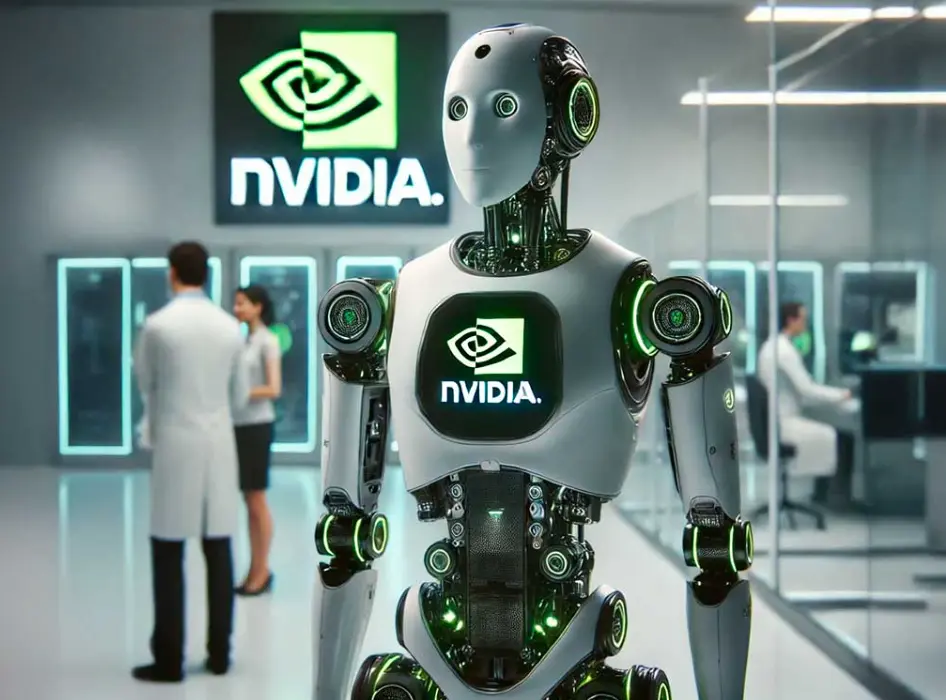
Nvidia has emerged as a leader in robotics by leveraging its advanced AI and GPU technologies to enable intelligent, autonomous systems. At the core of Nvidia’s robotics ecosystem is the Isaac platform, a comprehensive software development kit (SDK) that provides tools for simulation, perception, navigation, and manipulation. This platform allows developers to build and deploy robots for various applications, including manufacturing, logistics, healthcare, and autonomous vehicles.
Key components include:
– Isaac Sim: A highly realistic simulation environment powered by Nvidia’s Omniverse platform, enabling developers to train and test robotic systems in virtual worlds before real-world deployment. It supports physics-based simulations and integrates with popular tools like ROS (Robot Operating System).
– Jetson Series: A family of embedded AI computing platforms, such as Jetson Xavier and Jetson Orin, designed for edge devices. These modules deliver high-performance computing in a compact form factor, making them ideal for robots that require real-time processing for tasks like object detection, path planning, and decision-making.
– AI and Deep Learning Integration: Nvidia’s CUDA ecosystem accelerates machine learning models, allowing robots to learn from data and adapt to dynamic environments. This includes support for neural networks that enhance vision, speech, and sensor fusion capabilities.
Nvidia collaborates with industry partners, including automotive giants like Mercedes-Benz and Toyota for self-driving cars, as well as robotics firms like Boston Dynamics and Fanuc for industrial applications. These partnerships have driven innovations in areas such as warehouse automation, where robots use Nvidia’s technology for efficient picking and sorting.
The company’s focus on ethical AI and safety ensures that robotic systems are reliable and accountable, addressing challenges like data privacy and human-robot interaction. As robotics advances, Nvidia’s hardware and software solutions are poised to play a pivotal role in the next wave of automation, potentially transforming industries and everyday life.
Table of Contents
- Part 1: Create An Amazing Nvidia Robotics Quiz Using AI Instantly in OnlineExamMaker
- Part 2: 20 Nvidia Robotics Quiz Questions & Answers
- Part 3: OnlineExamMaker AI Question Generator: Generate Questions for Any Topic
Part 1: Create An Amazing Nvidia Robotics Quiz Using AI Instantly in OnlineExamMaker
The quickest way to assess the Nvidia Robotics knowledge of candidates is using an AI assessment platform like OnlineExamMaker. With OnlineExamMaker AI Question Generator, you are able to input content—like text, documents, or topics—and then automatically generate questions in various formats (multiple-choice, true/false, short answer). Its AI Exam Grader can automatically grade the exam and generate insightful reports after your candidate submit the assessment.
Overview of its key assessment-related features:
● Create up to 10 question types, including multiple-choice, true/false, fill-in-the-blank, matching, short answer, and essay questions.
● Automatically generates detailed reports—individual scores, question report, and group performance.
● Instantly scores objective questions and subjective answers use rubric-based scoring for consistency.
● API and SSO help trainers integrate OnlineExamMaker with Google Classroom, Microsoft Teams, CRM and more.
Automatically generate questions using AI
Part 2: 20 Nvidia Robotics Quiz Questions & Answers
or
1. Question: What is the primary purpose of Nvidia’s Isaac platform?
A) Gaming graphics rendering
B) Developing AI-powered robots
C) Video editing software
D) Cloud storage solutions
Answer: B
Explanation: Nvidia Isaac is a robotics platform designed to accelerate the development of AI-driven robots by providing tools for simulation, perception, and manipulation.
2. Question: Which Nvidia hardware is commonly used for edge AI in robotics?
A) GeForce RTX series
B) Jetson series
C) Tesla V100
D) Quadro series
Answer: B
Explanation: The Jetson series is optimized for embedded AI applications, enabling real-time processing for robotics tasks like object detection and navigation.
3. Question: In Nvidia Robotics, what role does GPU acceleration play?
A) It slows down computations for safety
B) It enables faster parallel processing for AI algorithms
C) It is used only for rendering 3D models
D) It replaces traditional CPUs entirely
Answer: B
Explanation: GPUs in Nvidia Robotics handle massive parallel computations, speeding up machine learning tasks essential for real-time robotic decision-making.
4. Question: What is Nvidia Isaac Sim?
A) A physical robot kit
B) A simulation engine for robotics development
C) A programming language
D) A cloud-based data storage
Answer: B
Explanation: Isaac Sim is a scalable simulation platform built on Omniverse that allows developers to test and train robotic systems in virtual environments.
5. Question: Which Nvidia technology integrates with robotics for 3D mapping?
A) CUDA cores
B) Deep Learning Institute
C) Omniverse
D) TensorRT
Answer: C
Explanation: Omniverse provides a collaborative platform for 3D simulation and digital twins, which is used in robotics for accurate environmental mapping and interaction.
6. Question: What does Nvidia’s ROS (Robot Operating System) integration support?
A) Only basic motor controls
B) Advanced AI perception and navigation
C) Wireless networking only
D) Battery management systems
Answer: B
Explanation: Nvidia integrates with ROS to enhance robotic capabilities, including AI-based perception, planning, and navigation for complex autonomous operations.
7. Question: In Nvidia Robotics, what is the function of the Isaac SDK?
A) To create video games
B) To provide tools for robot software development
C) To manage hardware repairs
D) To optimize web browsing
Answer: B
Explanation: The Isaac SDK offers libraries and tools for building, simulating, and deploying robotic applications, focusing on AI and computer vision.
8. Question: Which Nvidia board is ideal for autonomous drones?
A) Titan RTX
B) Jetson Xavier
C) GeForce GTX
D) A100
Answer: B
Explanation: Jetson Xavier provides high-performance AI computing with low power consumption, making it suitable for aerial robotics like drones.
9. Question: How does Nvidia enhance robotic vision systems?
A) By using only CPU-based processing
B) Through deep learning models on GPUs for object recognition
C) With basic image filters
D) By limiting frame rates
Answer: B
Explanation: Nvidia’s GPUs accelerate deep learning models that process visual data in real-time, improving accuracy in robotic vision for tasks like obstacle avoidance.
10. Question: What is the key benefit of using Nvidia’s AI in robotic arms?
A) Reduced precision
B) Faster learning through reinforcement learning
C) Increased energy consumption
D) Limited adaptability
Answer: B
Explanation: Nvidia’s AI technologies enable robotic arms to learn and adapt quickly via reinforcement learning, enhancing efficiency in manufacturing and assembly.
11. Question: In Nvidia Robotics, what does the term “digital twin” refer to?
A) A physical copy of a robot
B) A virtual replica for simulation and testing
C) A software update tool
D) A network connection
Answer: B
Explanation: Digital twins in Nvidia Robotics are virtual models that mirror real-world robots, allowing for safe testing and optimization of behaviors.
12. Question: Which Nvidia tool is used for optimizing neural networks in robotics?
A) Blender
B) TensorRT
C) Photoshop
D) Excel
Answer: B
Explanation: TensorRT optimizes deep learning inference engines, making them run faster on Nvidia hardware for real-time robotic applications.
13. Question: What enables Nvidia robots to handle unstructured environments?
A) Fixed programming scripts
B) AI-driven perception and adaptability
C) Manual controls only
D) Predefined paths
Answer: B
Explanation: Nvidia’s AI technologies provide robots with the ability to perceive and adapt to dynamic environments, such as warehouses or outdoor settings.
14. Question: How does Nvidia support collaborative robotics?
A) By isolating robots from humans
B) Through safe AI interactions and simulation
C) Limiting robot speed
D) Using non-AI methods
Answer: B
Explanation: Nvidia’s platforms simulate and implement safe human-robot interactions, ensuring collaborative robots can work alongside people without risk.
15. Question: What is the role of CUDA in Nvidia Robotics?
A) It is a graphics driver
B) A parallel computing platform for GPU-accelerated code
C) A robot operating system
D) A data encryption tool
Answer: B
Explanation: CUDA allows developers to write GPU-accelerated applications, which are crucial for running complex AI algorithms in robotics.
16. Question: In Nvidia’s ecosystem, what does the Jetson Nano offer for robotics?
A) High-end gaming performance
B) Affordable AI computing for small robots
C) Enterprise-level data centers
D) Virtual reality simulations
Answer: B
Explanation: Jetson Nano is a low-cost platform that provides AI capabilities, making it accessible for hobbyists and beginners in robotics development.
17. Question: How does Nvidia Isaac Gemini improve robotic perception?
A) By reducing sensor inputs
B) Through multi-modal AI for better environmental understanding
C) By simplifying algorithms
D) With slower processing speeds
Answer: B
Explanation: Isaac Gemini integrates various sensors and AI models to enhance perception, allowing robots to interpret audio, visual, and tactile data effectively.
18. Question: What is the primary use of Nvidia’s DeepStream in robotics?
A) Streaming video for entertainment
B) Real-time video analytics for surveillance robots
C) Basic file sharing
D) Audio processing
Answer: B
Explanation: DeepStream accelerates video analytics pipelines, enabling robots to process and react to visual data in real-time for applications like security.
19. Question: In Nvidia Robotics, how is machine learning deployed?
A) Only on cloud servers
B) At the edge using on-device inference
C) Through manual coding
D) Via external consultants
Answer: B
Explanation: Nvidia emphasizes edge deployment of machine learning models, allowing robots to make decisions autonomously without constant cloud reliance.
20. Question: What makes Nvidia’s robotics solutions scalable?
A) Limited to single devices
B) Modular software and hardware for fleet management
C) High costs for expansion
D) Incompatibility with other systems
Answer: B
Explanation: Nvidia’s platforms offer modular tools that can scale from individual robots to large fleets, supporting efficient development and deployment.
or
Part 3: OnlineExamMaker AI Question Generator: Generate Questions for Any Topic
Automatically generate questions using AI