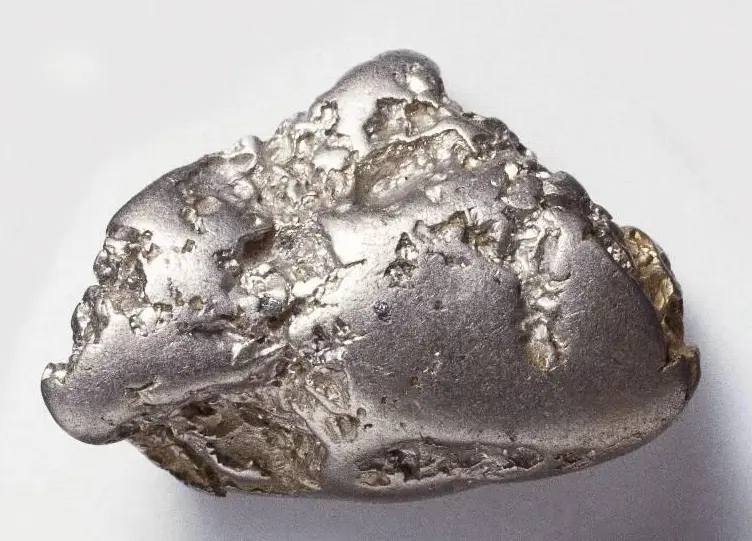
Platinum is a dense, malleable, and ductile transition metal with the chemical symbol Pt and atomic number 78. It belongs to the platinum group metals and is highly valued for its resistance to corrosion, making it ideal for various industrial, medical, and decorative applications.
Physical and Chemical Properties
– Appearance: Platinum is a silvery-white metal with a high luster.
– Density: One of the densest elements, at approximately 21.45 g/cm³.
– Melting Point: 1,768°C (3,214°F), which is exceptionally high.
– Reactivity: Chemically inert under standard conditions, resisting oxidation and acids, though it can dissolve in aqua regia.
– Isotopes: Naturally occurring platinum has six stable isotopes, with platinum-195 being the most abundant.
History and Discovery
Platinum was first encountered by Spanish conquistadors in the 16th century in South America, where it was initially considered an impurity in gold ores. The element was formally identified and named in the 18th century by scientists like Antonio de Ulloa. Its name derives from the Spanish word “platina,” meaning “little silver.”
Uses and Applications
– Jewelry and Investment: Highly prized for its rarity and durability, platinum is used in high-end jewelry, wedding rings, and as an investment asset.
– Catalysis: Essential in catalytic converters for automobiles, helping reduce harmful emissions by converting pollutants into less harmful substances.
– Electronics and Technology: Used in hard disk drives, electrodes, and thermocouples due to its excellent electrical conductivity and stability.
– Medicine: Found in chemotherapy drugs like cisplatin, which treat various cancers, and in dental alloys for crowns and bridges.
– Other Industries: Employed in glassmaking, petroleum refining, and as a standard for measuring purity in alloys.
Economic and Environmental Aspects
Platinum is one of the rarest elements, primarily mined in South Africa, Russia, and Zimbabwe. Global demand often outstrips supply, leading to price volatility. Environmentally, mining practices are being improved to minimize ecological impact, though extraction can involve hazardous processes.
Platinum’s rarity and versatility ensure its continued importance in modern society, with ongoing research into sustainable uses and recycling methods.
Table of Contents
- Part 1: OnlineExamMaker – Generate and Share Platinum Quiz with AI Automatically
- Part 2: 20 Platinum Quiz Questions & Answers
- Part 3: Automatically Generate Quiz Questions Using AI Question Generator
Part 1: OnlineExamMaker – Generate and Share Platinum Quiz with AI Automatically
OnlineExamMaker is a powerful AI-powered assessment platform to create auto-grading Platinum skills assessments. It’s designed for educators, trainers, businesses, and anyone looking to generate engaging quizzes without spending hours crafting questions manually. The AI Question Generator feature allows you to input a topic or specific details, and it generates a variety of question types automatically.
Top features for assessment organizers:
● Prevent cheating by randomizing questions or changing the order of questions, so learners don’t get the same set of questions each time.
● AI Exam Grader for efficiently grading quizzes and assignments, offering inline comments, automatic scoring, and “fudge points” for manual adjustments.
● Embed quizzes on websites, blogs, or share via email, social media (Facebook, Twitter), or direct links.
● Handles large-scale testing (thousands of exams/semester) without internet dependency, backed by cloud infrastructure.
Automatically generate questions using AI
Part 2: 20 Platinum Quiz Questions & Answers
or
1. Question: What is the atomic number of Platinum?
Options:
A) 76
B) 78
C) 80
D) 82
Answer: B) 78
Explanation: Platinum has an atomic number of 78, indicating it has 78 protons in its nucleus.
2. Question: Which group in the periodic table does Platinum belong to?
Options:
A) Group 8
B) Group 9
C) Group 10
D) Group 11
Answer: C) Group 10
Explanation: Platinum is in Group 10 of the periodic table, along with elements like nickel and palladium.
3. Question: What is the primary use of Platinum in the automotive industry?
Options:
A) Battery production
B) Catalytic converters
C) Tire manufacturing
D) Engine lubricants
Answer: B) Catalytic converters
Explanation: Platinum is used in catalytic converters to reduce harmful emissions from vehicle exhaust.
4. Question: What is the melting point of Platinum in degrees Celsius?
Options:
A) 1,417°C
B) 1,768°C
C) 1,962°C
D) 2,250°C
Answer: C) 1,962°C
Explanation: Platinum has a high melting point of approximately 1,962°C, making it suitable for high-temperature applications.
5. Question: Which of the following is a common alloy of Platinum?
Options:
A) Brass
B) Bronze
C) Platiridium
D) Steel
Answer: C) Platiridium
Explanation: Platiridium is an alloy of Platinum and Iridium, often used in scientific instruments and jewelry.
6. Question: What is the electron configuration of Platinum?
Options:
A) [Xe] 4f14 5d8 6s2
B) [Xe] 4f14 5d9 6s1
C) [Xe] 4f14 5d10 6s0
D) [Xe] 4f14 5d10 6s1
Answer: D) [Xe] 4f14 5d9 6s1
Explanation: The correct electron configuration for Platinum is [Xe] 4f14 5d9 6s1, reflecting its position in the periodic table.
7. Question: In which year was Platinum first isolated as a distinct element?
Options:
A) 1735
B) 1748
C) 1783
D) 1803
Answer: B) 1748
Explanation: Platinum was first isolated and recognized as a distinct element by Antonio de Ulloa in 1748.
8. Question: What is the density of Platinum in grams per cubic centimeter?
Options:
A) 10.5 g/cm³
B) 12.0 g/cm³
C) 21.45 g/cm³
D) 19.3 g/cm³
Answer: C) 21.45 g/cm³
Explanation: Platinum has a density of about 21.45 g/cm³, making it one of the densest naturally occurring elements.
9. Question: Which property makes Platinum ideal for jewelry?
Options:
A) Low melting point
B) High reactivity
C) Resistance to corrosion
D) Brittleness
Answer: C) Resistance to corrosion
Explanation: Platinum’s resistance to tarnish and corrosion ensures it maintains its luster over time, ideal for jewelry.
10. Question: What is the primary ore from which Platinum is extracted?
Options:
A) Bauxite
B) Hematite
C) Sperrylite
D) Galena
Answer: C) Sperrylite
Explanation: Sperrylite is a platinum arsenide mineral and one of the primary ores from which Platinum is commercially extracted.
11. Question: How many isotopes of Platinum occur naturally?
Options:
A) 2
B) 5
C) 6
D) 8
Answer: C) 6
Explanation: There are six naturally occurring isotopes of Platinum, including Platinum-194, which is the most abundant.
12. Question: In medicine, Platinum is commonly used in which treatment?
Options:
A) Antibiotics
B) Chemotherapy drugs
C) Painkillers
D) Vaccines
Answer: B) Chemotherapy drugs
Explanation: Platinum-based compounds, like cisplatin, are widely used in chemotherapy to treat various cancers.
13. Question: What is the symbol for Platinum on the periodic table?
Options:
A) Pl
B) Pt
C) Pn
D) Pm
Answer: B) Pt
Explanation: The chemical symbol for Platinum is Pt, derived from its Latin name, Plumbum album.
14. Question: Which element is most commonly alloyed with Platinum for electrical contacts?
Options:
A) Gold
B) Iridium
C) Silver
D) Copper
Answer: B) Iridium
Explanation: Iridium is often alloyed with Platinum to create durable electrical contacts due to its hardness and corrosion resistance.
15. Question: What is the boiling point of Platinum in degrees Celsius?
Options:
A) 3,827°C
B) 4,000°C
C) 3,500°C
D) 2,800°C
Answer: A) 3,827°C
Explanation: Platinum has a boiling point of approximately 3,827°C, which is one of the highest among metals.
16. Question: Platinum is classified as which type of metal?
Options:
A) Alkali metal
B) Alkaline earth metal
C) Transition metal
D) Rare earth metal
Answer: C) Transition metal
Explanation: Platinum is a transition metal, characterized by its d-orbitals and variable oxidation states.
17. Question: In which continent is the largest reserve of Platinum found?
Options:
A) North America
B) Europe
C) Africa
D) Asia
Answer: C) Africa
Explanation: The majority of the world’s Platinum reserves are located in South Africa, making Africa the continent with the largest deposits.
18. Question: What oxidation state is most common for Platinum in its compounds?
Options:
A) +1
B) +2
C) +4
D) +6
Answer: C) +4
Explanation: Platinum commonly exhibits a +4 oxidation state in many of its compounds, such as Platinum(IV) oxide.
19. Question: Which famous artifact is made primarily of Platinum?
Options:
A) The Hope Diamond
B) The Rosetta Stone
C) The Inkalamu Meteorite
D) The Crown Jewels
Answer: C) The Inkalamu Meteorite
Explanation: The Inkalamu Meteorite contains a significant amount of Platinum, making it a notable natural artifact.
20. Question: What is the primary environmental concern associated with Platinum mining?
Options:
A) Acid rain
B) Habitat destruction
C) Ozone depletion
D) Water pollution
Answer: D) Water pollution
Explanation: Platinum mining often leads to water pollution due to the chemicals used in extraction processes, affecting local ecosystems.
or
Part 3: Automatically generate quiz questions using OnlineExamMaker AI Question Generator
Automatically generate questions using AI